

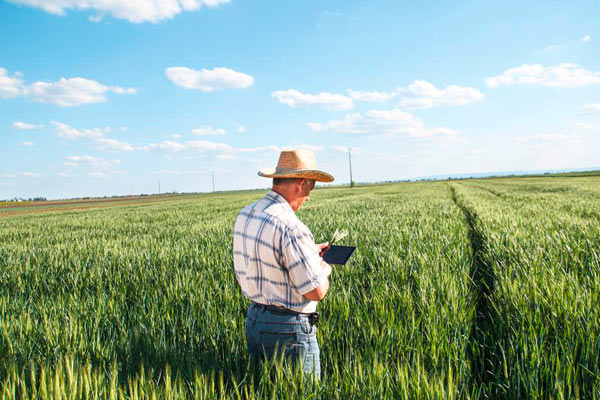
At the Agricultural University in Plovdiv there has been practical experience with forecasting systems for cereals since 2015. The two systems used, grano.net and orzo.net, are internet-based. They have been developed by the spin-off company Horta s.r.l. at the Catholic University in Piacenza, Italy. These two systems support farmers in Italy, Greece and now also in Bulgaria in making decisions on the overall cultivation of soft wheat, durum wheat and barley.
In recent years, the topic of precision agriculture and the application of forecasting models for plant diseases has become increasingly relevant. The first association that many specialists make when forecasting is mentioned are diseases in intensive crops – downy mildew in grapevine, apple scab, etc. In this respect, there is long-standing practical and theoretical experience in Bulgaria. Over the last five years, within the framework of two projects for work with farmers, the Agricultural University in Plovdiv has introduced modern, internet-based forecasting models for diseases in apple, cherry and grapevine. These have found wide application among producers and have become an extremely important tool for them. The positive results in perennial crops, as well as the strong development of the grain production sector, raised the question of the extent to which forecasting models are applicable to cereals.
Application of a forecasting system for cereals in Bulgaria
At the Agricultural University in Plovdiv there has been practical experience with forecasting systems for cereals since 2015. The two systems used, granо.net and orzo.net, are internet-based. They have been developed by the spin-off company Horta s.r.l. at the Catholic University in Piacenza, Italy. These two systems support farmers in Italy, Greece and now also in Bulgaria in making decisions on the overall cultivation of soft wheat, durum wheat and barley. In Italy they are used by hundreds of producers growing wheat and barley for one of the largest pasta factories (Barilla) and the two largest breweries in the country. The system requires detailed data entry for numerous aspects of the technology – sowing date, soil composition and type, previous crop, expected yield, fertilizers applied so far, humus content in the soil and applied organic matter, variety, etc. After the data are entered, a simulation is prepared for each “production unit” described in this way.
The first trials with the grano.net forecasting system in Bulgaria date back to 2015. At that time, in addition to the successful forecast for septoria leaf blotch, the results were also convincing for rust diseases.
Besides the phytosanitary status, the forecasting system also analyses the need for nitrogen fertilization in the respective phenophases. The economic and agronomic benefits of such an option should be very significant, given the range of factors taken into account, such as soils and climate, variety, etc. The software provides recommendations on how suitable the climatic conditions are for the application of a particular fungicide or herbicide, the choice of herbicide in the respective growth stage and weed combination, the choice of fungicide based on demonstrated efficacy against specific diseases under field conditions, soil profile water availability and seeding rate.
Why are forecasting and forecasting models necessary?
On 21 October 2009, the European Parliament and the Council of Europe adopted Directive 2009/128/EC establishing a framework for Community action to achieve the sustainable use of pesticides. It is part of the 2006 Thematic Strategy on the sustainable use of plant protection products. The Directive provides for a number of actions in this direction, applicable throughout the European Union, with the aim of reducing the risks and impacts of pesticide use on human health and the environment. Under the same Directive, each Member State is obliged to promote and create conditions for the application of integrated pest management, organic farming and other approaches related to a more rational and reduced use of these products. Compared to conventional agriculture, decision-making under integrated pest management and organic farming is much more complex and responsible. Therefore, not just forecasting models, but a whole set of tools integrated into a modern “forecasting system“ or Decision Support System (DSS) and work organisation are required.
Experience in Bulgaria and research abroad make it possible to outline some key reasons why farmers should turn to forecasting systems.
Reducing pesticide use
The purpose of forecasting is not to eliminate chemical means of control, but to optimise their application and keep them in use for a longer time. Climate change is an important factor determining the need for the use of forecasting models. An important aspect of these processes is not only the mean values of precipitation or temperature, but the occurrence of periods with extreme rainfall, for example, followed by drought in an atypical period, etc. Rainfall stimulates the development of many cereal diseases such as septoria leaf blotch, Fusarium head blight, net blotch, rust diseases, etc., and temporarily suppresses powdery mildew by washing off its spores. All this demonstrates a niche for the application of forecasting and the identification of specific risk-free or risky periods. In recent years, a large number of new wheat and barley varieties have been introduced in Bulgaria. It is a fact that some of them have a different reaction to the main diseases. For example, some diseases such as septoria leaf blotch or powdery mildew are more important in the first part of the growing season, and if climatic factors are unfavourable for their progression, there is a real opportunity to skip or delay the first spray of the season.
Reducing fungicide costs
More and more farms are finding that their costs are increasing while product prices remain relatively stable or lower, and are therefore focusing on improving economic efficiency by reducing expenses. Given the large relative share of wheat, every lev saved per unit area is multiplied and the savings are significant.
Development of resistance to fungicides
One of the most large-scale problems in plant protection is the emergence of resistance in pathogen populations to key active substances and entire groups thereof. Against the background of the increasingly real possibility that key products currently on the market may be removed from the list of registered products, this problem may become more acute. Forecasting would be very useful in implementing these rules. Fungicide treatments with the help of local weather and disease forecasts can be carried out before symptoms appear and even before infection has taken place. Forecasting is the only way to use preventive products correctly – contact (chlorothalonil, folpet) or penetrant (strobilurins, SDHI), which are mainly preventive and much less curative. The correct use, for example, of the new group of SDHI fungicides is very important, as they are at high to medium risk of resistance development.
Carrying out treatments based on symptoms or upon reaching a certain threshold of attack is not the most rational decision in the modern system for disease control. Indiscriminate treatment with systemic products leads to a higher risk of resistance, and results from field and molecular studies in Western Europe confirm this.
Treatments based on forecasting consist in a comprehensive assessment of the risk of various diseases and the possibility of a flexible approach. According to FRAC recommendations, it is necessary to combine products with different modes of action, and from an economic point of view it is better to control more current diseases with a single treatment.
Forecasting systems and models provide hope for a “step forward” in many aspects of plant protection, nutrition and the overall organisation of grain production in Bulgaria. The large scale of Bulgarian farms is an advantage in this respect. Our experience shows that adaptation to local varieties, technology and communication with farmers are no less difficult tasks than the development of effective forecasting systems and may prove decisive for the final results.
The text is published in an abridged version from the special supplement of the journal “Plant Protection” – Dangerous pathogens in agricultural crops, issue 4 – Assist. Prof. Dr. Zvezdomir Zhelev – Agricultural University in Plovdiv – Conditions for development and forecasting of dangerous pathogens in cereal crops