

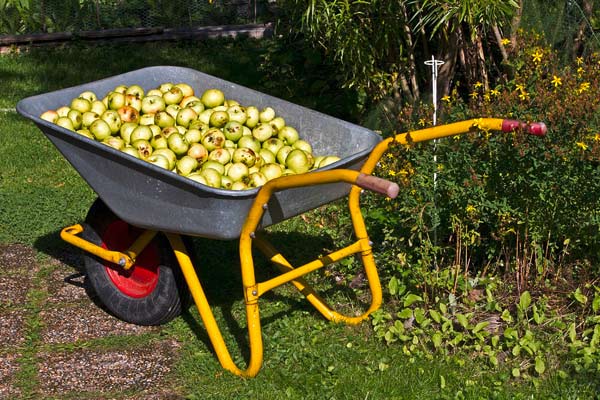
And in the orchard, do not neglect plant protection. During the harvesting of the fruit, remove all dried branches and mummified fruits. Collect and destroy them – the causal agents of many diseases overwinter in them. Scrape off the old and cracked bark – dangerous pests spend the winter there.
Winter varieties of apples, pears, quinces and peaches need regular irrigation, because during this month precipitation is limited, and normal soil moisture is necessary for the proper colouring and final ripening of these fruits. In addition, irrigation contributes to better ripening of the wood of the trees and to the accumulation of sufficient reserve substances in its tissue.
The mass harvesting of late varieties of fruit trees begins. It is very important to determine correctly their harvesting maturity. Be more careful with apples, quinces and pears. Harvest them when the colour of the skin becomes clearer and acquires the characteristic colouring of the variety. Carefully pick the fruits so as not to injure them and not to break the short bearing twigs that carry fruit buds for the next crop. Ripe pears are easily detached, but there are cases when the fruits detach easily even before they are fully ripe, and sometimes even ripe fruits do not separate easily from the branches. It is useful to know that as pears ripen, the seeds change from light to dark brown to black. The colour of the seeds is one of the most important indicators for correctly determining the time of harvest. The pear varieties that you will store must be checked regularly, because even a single rotten fruit is capable of transmitting the infection to the entire production. For storage, choose perfect fruits – healthy and without mechanical damage. It is best to arrange them on wooden racks, leaving a space between the individual fruits. A good effect is also achieved by wrapping each fruit in newspaper.
In September and October, care for strawberry plantations continues with regular hoeing and 1–2 irrigations. The plants continue to form fruit buds, therefore it is very important that the soil surface be free of weeds and that there is sufficient moisture in the soil.
During this period raspberries should not be irrigated, so that the new shoots can ripen and prepare for overwintering. For remontant varieties, which bear fruit also in summer, after each rain or irrigation the soil around them must be loosened.
The canes of fruited blackberries are cut to ground level, which enables the young canes to strengthen.