

Greenhouse production
Main pests for the period
Late blight (Phytophthora infestans)
Early blight (Alternaria solani)
Leaf mold (Fulvia fulva)
Gray mold (Botrytis cinerea)
Downy mildew of cucumber (Pseudoperonospora cubensis)
Powdery mildew of cucumber (Podosphaera xanthii)
Tomato leaf miner (Tuta absoluta)
Greenhouse whitefly (Trialeurodes vaporariorum)
Thrips (Thrips tabaci, Frankliniella occidentalis)
During this period mass harvesting of the fruits is carried out, therefore plant protection products with short pre-harvest intervals must be selected.
Tomatoes and cucumbers
Late blight
The greenhouses must be regularly inspected for the occurrence of the disease, especially in the presence of “critical periods”. The fungus attacks all above-ground parts of tomato plants. The first symptoms appear as water-soaked spots of irregular shape on the oldest leaves. Later they turn brown and dry up. At high air humidity, the lower surface of the spots is covered with a loose whitish growth – the sporulation of the fungus. In case of severe infection the entire leaf mass may die. The spots on petioles and fruit stalks are dry, dark brown. The spots on the stem are also large and water-soaked and encircle it completely. This manifestation is particularly dangerous because entire plants may soon dry out. On the fruits the spots are brown, rough, with a radiating structure. They rapidly increase in diameter. At high air humidity a loose whitish sporulation appears on them. Green fruits are usually attacked.
Strategy for pest control
Regular ventilation of greenhouses. Maintaining an optimal temperature and humidity regime. Dew drops must not be allowed to remain on the plants. In the presence of “critical periods” preventive treatments with plant protection products should be carried out.
Authorized plant protection products
valbon – 180-200 g/ha; verita WG - 0.15%; winker WG – 200 g/ha; equation pro – 0.04%; curial star – 60 ml/ha; consento SC – 200 ml/ha; corsate 60 WG – 20-30 g/ha; quadris 25 SC – 0.075%; lieto – 40-45 g/ha; manfil 75 WG – 210 g/ha; melody compact 49 WG – 185 g/ha; pencozeb 80 WP – 200 g/ha; pencozeb 75 WG – 210 g/ha; pergado med 27 WG – 500 g/ha; polyram DF – 0.2%; revus 250 SC – 0.05%; ridomil gold R WG – 500 g/ha; sankozeb 80 WP – 200 g/ha; sinstar 70-80 ml/ha; fortuna globe – 200 g/ha;
Tomato leaf miner
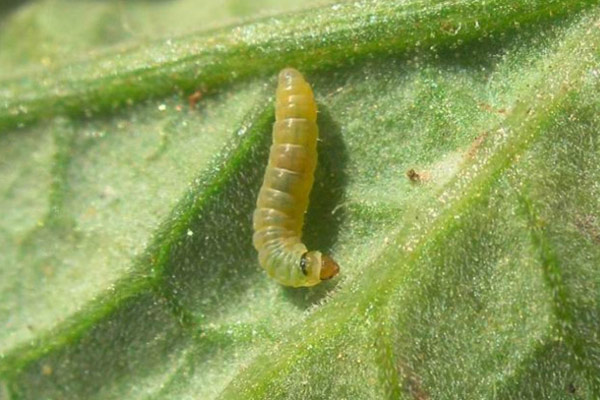
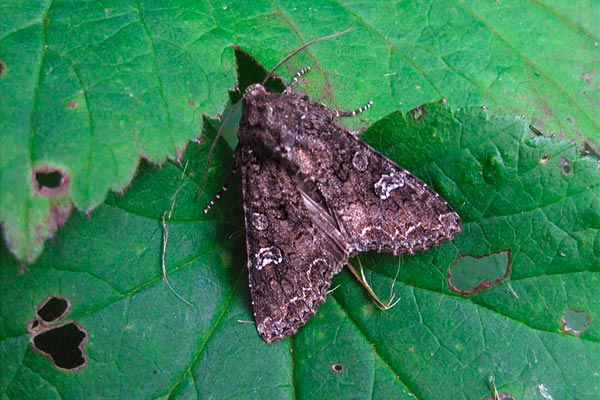
The moths of the pest are active at night and during the day hide among the leaves. Damage is caused by the larvae. They prefer mainly the leaves and stems of the plants, but also attack the fruits. Symptoms of the presence of the moth are short and wide mines on the leaves, in which larvae and excrements can be seen, located at one end. Damage to the fruits provides an opportunity for the development of diseases causing their rotting.
Strategy for pest control
Use of pheromone traps for timely detection of the pest and undertaking timely control measures. At low population density one of the biological agents Macrolophus pygmaeus or Nesidiocoris tenuis may be introduced.
Authorized plant protection products
avant 150 EC – 25 ml/ha, alverde 240 SC – 0.1%, altacor WG – 8-12 g/ha, ampligo 150 ZC – 40 ml/ha, affirm 095 SG – 150 g/ha, voliam targo 063 SC – 0.08%, decis 2.5 EC – 0.05%, confidor energy OD – 0.08%, coragen 20 SC – 14-20 ml/ha, lannate 20 SL – 125 ml/ha, lannate 25 WP – 100 g/ha, mospilan 20 SP – 0.02%, neem azal T/S – 0.3%, picador 20 SL – 0.05%, rapax – 100-200 ml/ha, syneis 480 SC – 10-25 ml/ha (20-25 ml/100 l water), warrant 20 SL – 50 ml/ha.
Field production
Main pests for the period
Onion - Downy mildew of onion (Peronospora destructor)
Onion fly (Delia antiqua),
Onion moth (Acrolepia assectella)
Cabbage - Downy mildew of cabbage (Peronospora parasitica)
Cabbage moth (Mamestra brassicae),
Cabbage fly (Delia brassicae)
Pea
Downy mildew of pea (Peronospora pisi),
Weevils (Sitona spp.)
Potatoes - Late blight of potatoes (Phytophthora infestans), Colorado potato beetle (Leptinotarsa decemlineata)
Cabbage
Downy mildew of cabbage
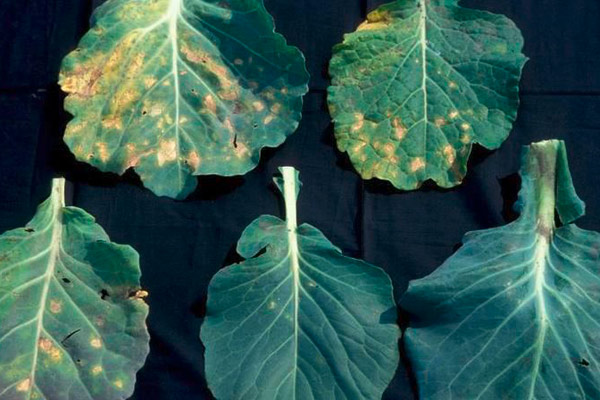
The disease is more harmful on seedlings for early production and on late crops. It is particularly dangerous for seed production. The first symptoms are the appearance of sunken spots on the leaves, which on the lower side are covered with a whitish to ashy gray growth with numerous spores. Later the growth disappears and the spots scorch. On adult plants the outer leaves of the heads are attacked first. In seed production crops the pathogen attacks both vegetative parts and flower stalks, fruit stalks and pods, from where it passes onto the seeds and infects them.
Strategy for pest control
Seedlings and crops should be regularly inspected for early detection of the first symptoms. In seedlings preventive treatments with plant protection products are carried out, while in early crops one treatment is sufficient after the appearance of the first spots. In seed crops control must be more intensive.
Authorized plant protection products
bordo mix 50 WP – 375-500 g/ha; infinito SC – 160 ml/ha; ridomil gold R WG – 500 g/ha.
Cabbage moth
The larvae cause feeding damage on the leaves and heads. After hatching they feed on the underside of the leaves, skeletonizing them. Later they eat the leaves, leaving only the thick veins, and penetrate into the head. Damaged heads rot and have an unpleasant odor.
Strategy for pest control
Deep ploughing to reduce the population of the cabbage moth, destruction of weeds, regular hoeing, irrigation and fertilization of the cabbage.
Authorized plant protection products
avant 150 EC – 17 ml/ha, altacor WG – 8-10 g/ha, decis 2.5 EC – 50-70 ml/ha, decis 25 WG – 7 g/ha, dipel 2 X – 100 g/ha, dursbane 4 EC – 100 ml/ha, karate zeon – 15 ml/ha, confidor energy – 80 ml/ha, neksid 015 CS – 40 ml/ha, runner 240 SC – 40 ml/ha, sumi alpha 5 EC – 25 ml/ha, supersect mega – 25 ml/ha, fury 10 EC – 10 ml/ha.
Cabbage fly
The larvae feed superficially on the roots, make spiral tunnels and bore into the root itself. The outer leaves fade, acquire a bluish-violet hue and later wilt. The attacked plants lag in their development and die.
Strategy for pest control
High-level agrotechnics must be applied – fertilization, irrigation, soil cultivation, in order to grow strong and rapidly developing plants. To reduce damage from cabbage fly it is necessary to remove all plant residues after harvesting.
Authorized plant protection products
Broad-spectrum insecticides are used – bi 58 100 ml/ha, vaztak nov 100 EC – 0.02%, dursbane 4 EC – 100 ml/ha (the soil surface around the plants is also sprayed).
Due to the presence of a waxy coating on cabbage leaves, a wetting agent should be added to the spray solutions.
A detailed description and control of diseases and pests for the period can be found in issue 5/2017 of the journal "Plant Protection"