

Planting cultivars that are resistant or weakly susceptible to powdery mildew is the most reliable and environmentally friendly method for controlling the disease.
Fruit crops such as apple, pear, quince, sweet cherry, sour cherry, plum, strawberry, black currant and hazelnut are hosts of nine species of fungi from the family Erisiphaceae, which cause powdery mildews. Among them, apple powdery mildew and peach powdery mildew cause significant damage to fruit growing in our country, which necessitates the application of fungicide sprays to protect the trees and fruit production.
Apple powdery mildew
The specialised literature reports 57 fungal diseases of apple. In our country 21 of them have been identified and described, but economically important are apple scab Venturia inaequalis (Cooke) G. Wint and powdery mildew Podosphaera leucotricha (Ellis and Everh.) E. S. Salmon, against which it is necessary every year to carry out from 5 to 18 sprays, depending on the susceptibility of the cultivated cultivars and the meteorological conditions, in particular precipitation.
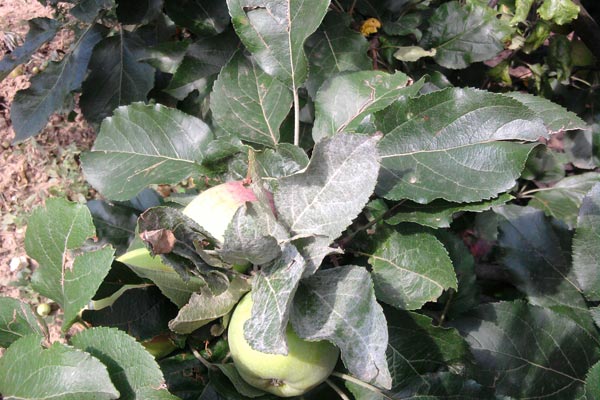
The fungus causing powdery mildew attacks mainly the leaves and shoots and very rarely the fruits of highly susceptible cultivars such as Jonathan and Moira. This pathogen overwinters in infected leaf and flower buds. From them are formed leaves and shoots that are entirely covered with a greyish-white coating consisting of the mycelium, conidiophores and spores of the fungus. The shoots that develop from infected buds are short, with small, narrow, underdeveloped and easily breakable leaves, which turn brown and fall prematurely. No fruits develop from the infected flower buds. In the local form of the disease, irregularly rounded greyish-white spots are formed on the leaves, which can cover the entire leaf and cause necrosis and premature leaf fall. On the fruits of highly susceptible cultivars necrosis of the skin and cracking are also observed.
The damage caused by this disease to leaf and fruit buds, leaves, shoots and, very rarely, to fruits is considerable, especially in highly susceptible cultivars. It has been established that the total leaf area of healthy plants is on average three times larger than that of those attacked by powdery mildew, and the intensity of transpiration of leaves infected with powdery mildew is from 50 to several hundred percent higher than that of healthy leaves.
Numerous authors report yield reductions of 50 to 80% in cultivars with high susceptibility to the disease when infected with powdery mildew. Data from studies carried out at the Institute of Agriculture in Kyustendil show that the damage coefficient of powdery mildew in the highly susceptible cultivar Jonathan reaches up to 97% if no control measures against the disease are applied.
The causal agent of powdery mildew Podosphaera leucotricha (Ellis and Everh.) E. S. Salmon belongs to the class Ascomycetes, order Erysiphales with conidial stage Oidium farinosum. The mycelium of the fungus is superficial, septate, initially white, and as it ages it acquires a greyish-white colour. It is attached to the diseased organ by special branches called appressoria, and through other branches – haustoria – it extracts nutrients from the host. On the mycelium short conidiophores with 6–9 single-celled spores arranged in a chain are formed. The fruiting bodies of the fungus are cleistothecia and are formed on the surface of the shoots. The cleistothecia are spherical with two types of appendages – simple ones emerging from the base and long dichotomously branched ones formed on the upper side of the fruiting body. In them a single ascus with 8 single-celled ascospores is formed.
The causal agent of powdery mildew overwinters mainly as mycelium in infected leaf and fruit buds. In some years it forms cleistothecia, but in our country they are not a source of infection.
The optimum temperature for the development of the causal agent of powdery mildew is within the range of 11–28°C. A water droplet is not required for conidia germination. They can germinate at air humidity above 34%. Heavy rainfall limits the development of apple powdery mildew by washing off the conidiospores.
The development of powdery mildew is also influenced by the applied agronomic practices. Planting density, improper pruning, and unbalanced fertilisation lead to increased losses. Unilateral nitrogen fertilisation significantly enhances powdery mildew infection in apple, while potassium fertilisation reduces losses from the disease. Omissions in sanitary pruning increase the risk of accumulation of primary inoculum.
Apple powdery mildew is controlled by:
- Planting cultivars that are resistant or weakly susceptible to powdery mildew;
- Pruning (winter – during formative and fruiting pruning, and green – during the growing season), in which all infected buds, shoots and twigs are removed;
- Spraying with fungicides that are approved for control of the disease.
Planting cultivars that are resistant or weakly susceptible to powdery mildew is the most reliable and environmentally friendly method for controlling the disease. All European breeding programmes include the development of cultivars resistant to scab and powdery mildew. Most of the apple cultivars created in recent years that are resistant to scab are also weakly susceptible to powdery mildew. So far, in apple there is no cultivar that is resistant to powdery mildew, but a number of cultivars are weakly susceptible and can be grown with a minimal number of sprays. Such cultivars are Gala, Lodi, Prima, Priscilla and others.
At the Institute of Agriculture in Kyustendil, trials are being conducted to determine the susceptibility of some apple cultivars that are new for the Kyustendil region. During the period 2012–2015 it was established that all studied cultivars are susceptible to powdery mildew, but to a different extent. The comparatively least susceptible are Rubinola, Sharden and Rosana, in which the degree of infection on average for the study period does not exceed 13%. Of the 12 cultivars studied, the comparatively most susceptible is Braeburn, in which the degree of infection on average for the period reaches 21%.
Pruning can solve the problem of powdery mildew without the use of fungicides during the first years of cultivation, but only in cultivars that are weakly to moderately susceptible to powdery mildew and resistant to scab such as Brightgold, COOP 10, Prima, Priscilla, Priam, Florina, Freedom and others.
Very good results are obtained when pruning is combined with spraying with suitable fungicides. In addition, control of powdery mildew must be coordinated with that of scab. Recommendations for the control of scab and powdery mildew in apple in cultivars susceptible to both diseases should be based on the forecast and determination of infection periods for scab, and monitoring of conditions for the development of powdery mildew, whereby fungicides that are effective against both diseases are selected.
Protecting apple production from harmful organisms in organic farming is very difficult, given the ban on the use of synthetic pesticides as well as the limited number of bioproducts. For the control of powdery mildew in this type of production in our country only sulphur-containing fungicides are permitted. In a number of countries in organic apple production the biofungicide Serenade Opti is used, whose active basis is the bacterium Bacillus subtilis, which acts in three ways on the causal agent of apple powdery mildew. There are scientific reports that this biofungicide provides very good results when used at the beginning of the growing season.