Small-fruited peppers - a variety of species, colors, shapes and flavors. Significance.
Author(s): доц. д-р Величка Тодорова, ИЗК "Марица", ССА; докторант Дарина Аргирова, Институт по зеленчукови култури "Марица", Пловдив, ССА
Date: 03.05.2026
3450
![MultipartFile resource [file_data]](/assets/img/articles/заглавна-пипери-дребни.jpg)
![MultipartFile resource [file_data]](/assets/img/articles/снимка-29-пипер.jpg)
![MultipartFile resource [file_data]](/assets/img/articles/руевит-2026-пипер.jpg)
![MultipartFile resource [file_data]](/assets/img/articles/снимки-17-18-пипер.jpg)
![MultipartFile resource [file_data]](/assets/img/articles/снимки-19-20-пипер.jpg)
![MultipartFile resource [file_data]](/assets/img/articles/снимка-22-пипер.jpg)
![MultipartFile resource [file_data]](/assets/img/articles/снимка-28.jpg)
Summary
Pepper, genus Capsicum, is a significant crop worldwide due to the diverse applications of its fruits, which come in a multitude of shapes, sizes, colors, flavors, and varying degrees of pungency (from lethally hot to non-pungent/sweet). They are present in the diet of most nations. They are used not only as a fresh and processed vegetable but also as a spice. They also find application in pharmacy and medicine, while the substance capsaicin, extracted from hot peppers, is used as an ingredient in self-defense weapons. Peppers are found all over the world, and even if not consumed, they are included in various landscapes as ornamental plants. Over 40 species have been identified in the genus Capsicum, most of which are small-fruited. The discovery of new species in the primary centers of origin continues. Many of them are a valuable source of resistance to biotic stress factors and can be used in breeding programs to create resistant lines and varieties.
In Bulgaria and Neighboring Countries of the Balkan Peninsula
Primarily, peppers belonging to the species Capsicum annuum L. are cultivated. Academician Pavel Popov made a classification of local pepper varieties, forms, and populations depending on the fruit shape. He distinguished three subspecies: Large-fruited, Small-fruited, and Bouquet. Later, this classification for the Bouquet pepper subspecies was supplemented and expanded by Hristov and Todorov [1]. The Large-fruited subspecies includes two groups - Broad and Long-fruited, each with three types. This subspecies has the greatest economic importance, hence breeding is focused primarily on creating large-fruited lines and varieties. As a result, there is a larger number of registered pepper varieties, which are quite diverse, differing in fruit shape, production and consumption direction, bush growth, coloration, fruit orientation and taste, and other plant and fruit characteristics.
A smaller part of Capsicum annuum L. constitutes the Small-fruited pepper subspecies, which, depending on fruit shape, is divided into the Cherry-like pepper group and the Shishka group with types: blunt-tipped, ordinary (conical), spindle-shaped, and thin long shishkas. From the Small-fruited peppers, the varieties 'Shipka Sladka' and 'Dzhyulyunska Shipka 1021' were created at the Maritsa Vegetable Crops Institute, the latter of which for many years was one of the main varieties of this subspecies grown in Bulgaria. At the Institute, seed production of another widely distributed local variety-population – 'Byala Shipka' – has been carried out for a number of years. This subspecies also includes the 'Ribki' peppers, which are sought after by consumers, albeit in smaller quantities. The consumption of small-fruited peppers, predominantly hot in taste, has its traditions but does not have such economic importance for the country and this region. The Bouquet pepper subspecies, which is the least numerous, is in turn also divided into two groups - the first Large-fruited and the second Small-fruited.
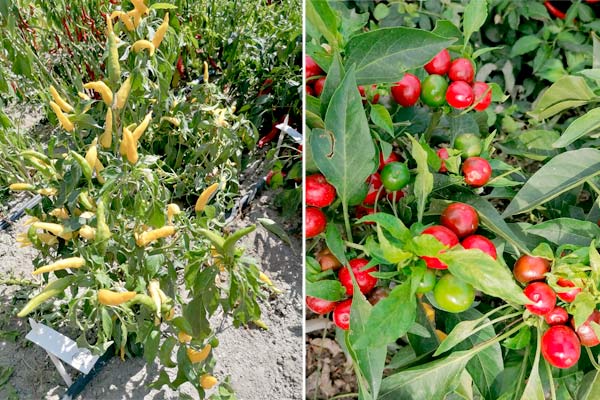
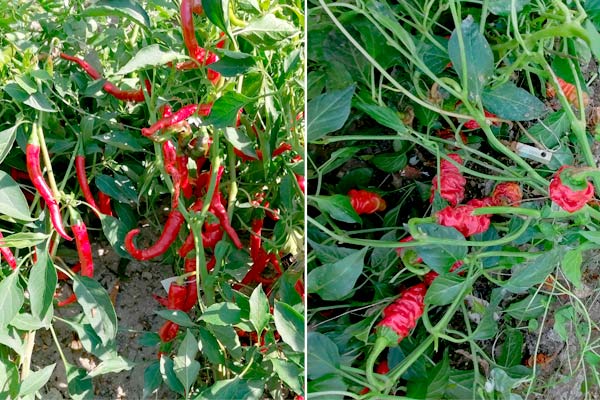
Worldwide, among the small-fruited peppers belonging to the species C. annuum, widely distributed are varieties of the cayenne pepper, jalapeño, and pimiento types. The first type has strongly pungent fruits, narrow, long, and according to Acad. P. Popov's classification are similar to the shishka group up to the horn-shaped type, which are used mainly at botanical maturity. The second type originates from Mexico and forms moderately pungent fruits, similar to blunt-tipped shishkas, which are harvested and consumed predominantly in the green state. Pimiento-type varieties have cherry-like fruits, sweet to mildly pungent, and are used at botanical maturity.
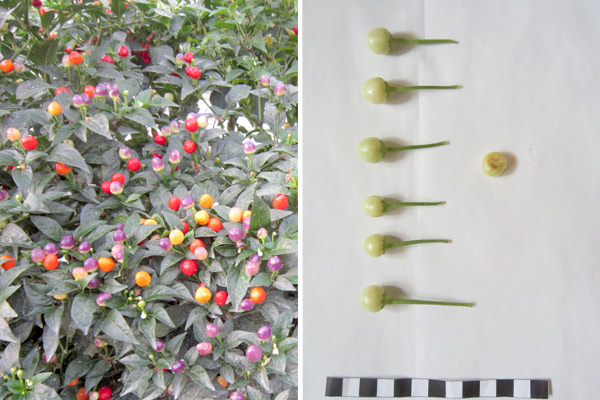
Additionally, the small-fruited wild pepper C. annuum var. glabriusculum (so-called bird peppers, bird's eye, chile tepin) also belongs to the species Capsicum annuum L., whose primary centers are in the northern parts of South and the southern parts of North America. The plant is a perennial shrub, highly branched, forming a very large number of fruits (from 100 to 250), which are very small (from 0.5 to 2.5 g), round, slightly elongated to conical, strongly pungent, and attached to thin long stalks[2]. It can also be successfully grown for ornamental purposes. In a study of a specimen of this species under Bulgarian conditions, a weight of 1.28g was established [3].
Identification and Species Diversity
The first discovered pepper remains date from 8000 BC, and cultivation began earliest around 6000 BC. Initially, five pepper species were introduced into cultivation – C. annuum, C. chinense, C. frutescens, C. pubescens and C. baccatum. The first three are distributed worldwide, and the last two – mainly in South America. The species with the most pungent fruits is C. chinense, including the lethally hot habanero. The famous Tabasco sauce is prepared from the fruits of C. frutescens. C. pubescens has very pungent, thick-walled fruits, cultivated by the Incas for millennia. The most widely cultivated and with the greatest varietal diversity is the species C. annuum L., which is also the main one for Bulgaria and the Balkan region.
Even 20 years ago, it was reported that over 36 species had been identified, including C. cardenasi, C. chacoense, C. eximium, C. praetermisum, C. galapagoense, C. tovarii, C. ciliatum and others [4]. Specimens of C. chacoense have been identified as resistant to bacterial spot, anthracnose, powdery mildew, and Phytophthora root rot, which highlights the strong natural defense mechanisms inherent in wild Capsicum species and their potential applications as sources of resistance for breeding. C. baccatum species also prove to be a promising source of resistance to major pepper diseases [5].
Of interest to the evolution and botanical characteristics of the genus, its taxonomy, and also in connection with the search for gene sources possessing resistance to economically significant diseases and pests, new wild species continue to be discovered in the primary centers of pepper origin - the tropical zones of North (Mexico), Central (the Caribbean), and South America (in the lowlands of Bolivia, northern Amazonia, and the mid-levels of the southern Andes) [6]. Supporting this is that in recent years, a total of 43 species have been classified and described [7]. Some of these wild species are very difficult to cultivate but are characterized molecularly to distinguish them from each other, to know their genetic profile and potential. Work is underway on their classification, and kinship relationships between species are being sought.
Diversity of Colors, Shapes, and Flavors
The general lack of detailed phenotypic characterization is probably the biggest factor for the insufficient use of these important sources of genetic variability, followed by limited access to plant material, hybridization and pollination barriers between them, etc. Efforts to conserve these species both in situ and ex situ are limited, and as a result, one species, C. lanceolatum (Greenm.) C. V. Morton and Standl., is already extinct in North America [8].
Detailed phenotypic characterization of species includes plant and stem height, stem thickness and hairiness, leaf dimensions, shape and hairiness, etc., but the most significant are the traits describing the floral parts and the fruit.
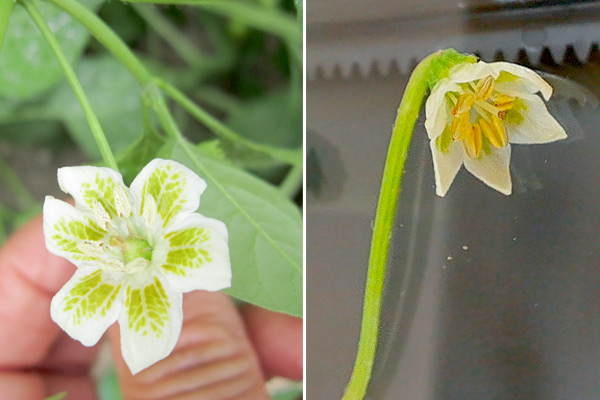
Pepper flowers are bisexual, located singly or grouped in clusters (in bouquet forms) on upright, horizontally oriented, or downward-curved pedicels. The corolla is white, pale yellow, purple, or pale greenish, without or with spots on the petals. The stamens are bluish, purple, or pale yellow.
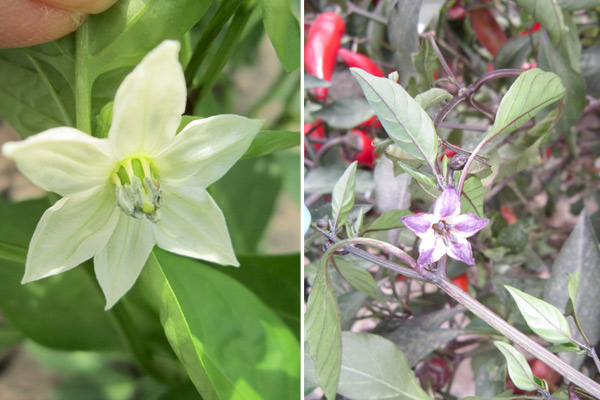
The coloration of the floral parts helps determine and distinguish some pepper species. For example, C. pubescens is characterized by blue-purple petals with a white spot in the center and partially white, partially purple stamens. C. eximium forms flowers whose petals are colored in various shades of purple, while in C. pereirae – the corolla has greenish or yellowish spots at the base and purple-red spots above them, and in C. baccatum the petals are white with a pale yellow-greenish spot in the middle.
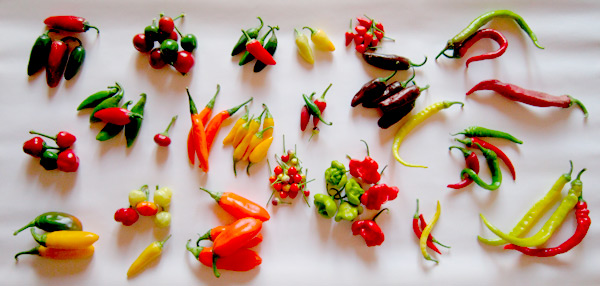
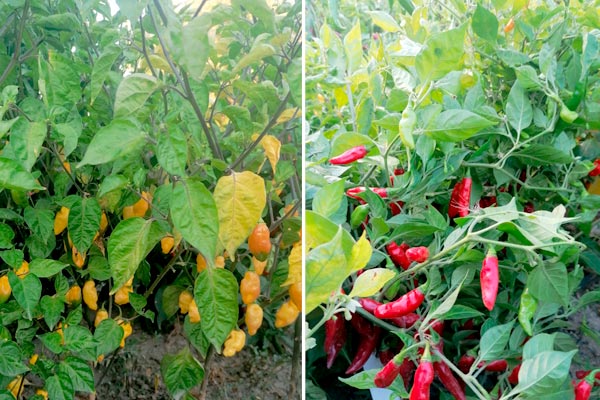
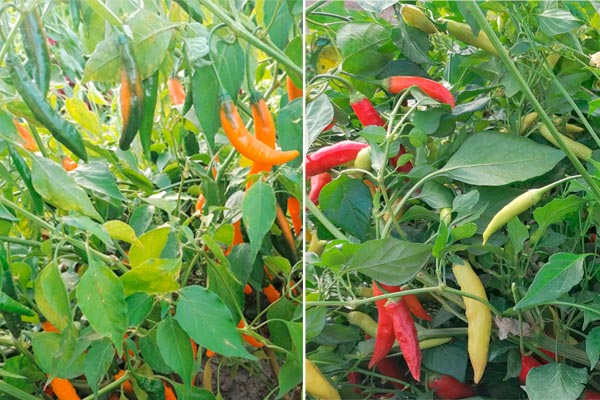
The fruit is a fleshy false berry (pepper). In shape, size, color, and taste, it varies extraordinarily depending on the species, variety, and growing conditions. Fruit color is determined by the quantity and ratio of different pigments. The red color is mainly due to the presence of capsanthin, carotene, and capsorubin. The yellow color is determined by the substances lutein and zeaxanthin, the orange – by beta-carotene, and the purple - by anthocyanins, etc. Before maturity, it can be greenish-white, waxy white, yellow, green, and purple, and during fruit maturity – whitish, yellow, orange, red, brown.
Picture 17, 18,19, 20, 21, 22, 23, 24, 25, 26, 27
The fruits are characterized by low levels of calories and fats and are rich in antioxidants. They contain many vitamins, minerals, sugars, and other valuable substances. The most significant are vitamins C, P, A, B, E, and among the minerals - potassium and folic acid. In terms of vitamin C content (from 50 to 400 mg%), pepper equals blackcurrant and surpasses almost all vegetables, lemon, and orange. It has been established that red peppers contain 300 – 450 mg% rutin, possessing P-vitamin activity. A very valuable component of red pepper is also carotene. The intake of 1/2 tbsp. (3 - 4 g) of ground pepper can satisfy the body's daily needs for vitamin A.
Pepper fruits have a number of nutritional and health benefits. As early as the 17th century, doctors prescribed it in powder form to those suffering from sciatica, as well as for digestive problems. Modern doctors have proven that they stimulate gastric secretions and act as a powerful vasodilator on the circulatory system. They have antimicrobial and bactericidal properties. They boost the immune system. They keep the skin young. They make hair and nails healthy, shiny, and strong. They improve vision. They lower bad cholesterol. They help control diabetes. They support heart function. They reduce the risk of cancer.
The taste of pepper is so different and also depends on the direction of use. Hot peppers are an almost inseparable part of the national cuisines of many countries. They contain various alkaloids, so-called capsaicinoids, which are produced solely in the genus Capsicum and are a secondary metabolite responsible for the pungency. Capsaicin is the one with the highest levels. In a study of the inheritance of capsaicin in an F2 segregation generation, it was found that the absence of pungency is controlled by two genes. One is Pun1, whose recessive allele - pun-1-1 in a homozygous state blocks the synthesis of capsaicinoids [9].
The amount of capsaicin varies depending on the variety and is measured in Scoville Heat Units (SHU). The fruits of C. baccatum have a pungency of 30,000 to 50,000 SHU. For comparison, in shishka-type varieties, capsaicin is from 12,000 to 30,000 SHU, while in the hottest varieties Carolina Reaper and Trinidad Moruga Scorpion, which are of the species C. chinense, it reaches 2.2 million and 2 million SHU respectively, and in self-defense spray, capsaicin levels are from 2 to 5.3 million SHU. Growing conditions also influence pungency - it intensifies when plants are drought-stressed.
In 2006, a new species was identified - C. ceratocalyx M.Nee, which can be found in Bolivia and Peru. It has a long vegetative period, is self-incompatible, i.e., requires pollen from another plant. It forms small, fleshy, red fruits with strongly elongated calyx lobes. The fruits are 7-9 mm in diameter, with thin flesh and a pungent taste – up to 30,000 SHU. The seeds are brown, few in number - up to 12. [4].
The most recently discovered species are four, three of which are included in a new phylogenetic analysis for the genus Capsicum [10]:
Capsicum benoistii Hunz. ex Barboza,