

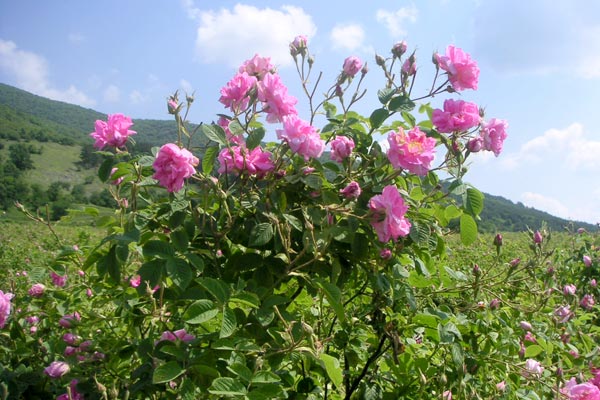
The name of the native essential oil has been added to the list of over 1200 protected European products. This was announced on the official website of the European Commission.
Oil-bearing roses were first cultivated in Persia, and it is the first country to produce rose oil. It is believed that the soldiers of Alexander the Great brought it to the Balkan Peninsula during their campaigns. The highest quality and most sought-after rose oil is obtained from the *Rosa damascena* cultivated in Bulgaria - the Kazanlak oil-bearing rose, grown in the Rose Valley, where it finds the most suitable conditions for development and yields the highest quality oil. The distinguishing qualities of Bulgarian rose oil are its rich and lasting aroma, the balanced composition of volatile substances and hydrocarbons, as well as its pale yellow-green color.
Obtaining the Oil
Bulgarian rose oil is an essential oil obtained by distilling the flowers of the Damask rose. This rose is traditionally cultivated in the Rose Valley in Central Bulgaria.
The method of steam distillation of fresh rose flowers is used. The petals are collected early in the morning in dry weather and subjected to distillation. The oil can also be obtained by the extraction method, where the material is extracted with ether, resulting in the so-called "rose concrete". This is a soft, wax-like substance from which the rose oil is extracted with alcohol. The flowers contain 0.02%-0.04% essential oil and in rare cases can reach up to 0.09%. Typically, 1 kilogram of rose oil is obtained from 2-3 tons of flowers.
There are also special requirements for harvesting the flowers, which must take place several hours before dawn until the early morning hours, picking only open buds.
For more information:
http://ec.europa.eu/agriculture/quality/schemes/index_en.htm