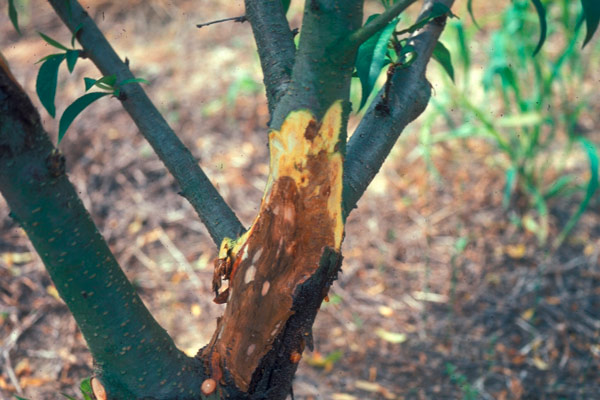
The causal agent of bacterial canker in stone fruit species is the bacterium Pseudomonas syrigae pv.syringae.
Symptoms are most often observed on the trunk, scaffold branches and shoots. Around the site of damage, depressions or swellings of the tissues can be noticed. The bark is darker in colour, shiny and oily. In most cases it is torn and the wounds are covered with resin. When the bark is peeled off at and around the site of infection, the cambium and pith are seen to be dark brown in colour. Damage is also observed on terminal shoots and buds, which do not develop in spring and remain dry and covered with resin.
Under favourable conditions for the development of the disease, it gradually affects the entire tree. Initially, individual twigs and scaffold branches die back, and later the whole tree. Usually, the leaves of diseased trees do not fall in autumn.
The problem with bacterial canker is serious, as with all bacterial diseases. Now is the time to prune all affected branches and twigs, cutting back to healthy tissue. Immediately remove and burn the plant residues. Cover larger wounds with oil-based paint or a 10% solution of copper sulfate. To prevent the spread of the disease, cutting tools must be disinfected with formalin diluted at a ratio of 1:25 or sodium hypochlorite – 1:4.
In autumn during leaf fall and in early spring before bud break, spray the affected trees with copper-containing products.