

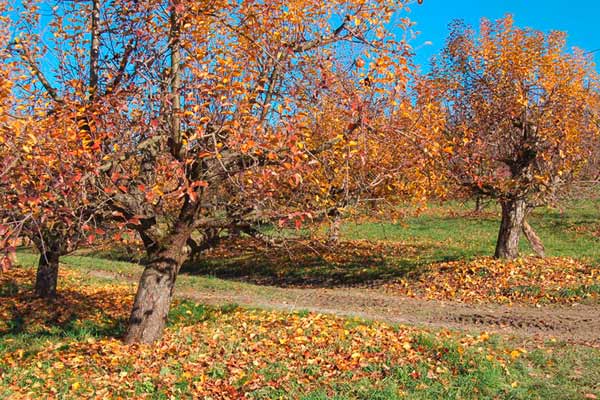
To ensure the production of healthy fruit, it is necessary to continue caring for the fruit orchards during the winter months, when the plants are dormant. With the onset of the period of relative dormancy of the fruit species, the harmful activity of pests and disease agents is reduced, but most of them remain in the orchards – in the soil, on the fallen leaves and fruits. This provides the opportunity to continue the control measures against them during the autumn-winter period.
Agronomic and mechanical practices
These operations, carried out during the non-vegetation period of the fruit trees, are an important element of Good Plant Protection Practice, since their proper implementation reduces the number of in-season treatments against pests, as well as contributes to obtaining higher quality fruit production without pesticide residues.
Which are they?
1. Pruning of dead branches, stunted and dried trees, their removal and burning outside the orchards, with the aim of destroying infestations of bark beetles and wood-boring insects, bark beetles, woolly apple aphid, bacterial blight, plum pox (sharka), fire blight and other pests. After each cut, the cutting tools must be disinfected with a 10% solution of bleach or formalin, and they may also be treated with denatured alcohol and water in a ratio of 3:1. Immediately after pruning, it is necessary to coat the cuts with oil-based paint or white latex paint, to which a copper-containing fungicide should be added, or to use the ready-made fruit-growing paste Tervanol, for better callus formation and protection against the entry of secondary infections and infestation with diseases and pests.
2. Destruction of caterpillar nests and dried, mummified fruits remaining on the trees, as well as the fallen damaged fruits, which are a source of infestation by leaf-feeding caterpillars, almond seed wasp and of infection with brown rot, dieback of quince fruitlets, etc.
3. Removal, taking out of the orchards and burning of old and cracked bark from the trunks of the trees in order to destroy the overwintering stages beneath it of codling moths, mites, apple leaf-miner moth, pear psylla, apple leafroller and other pests, as well as the causal agents of early brown rot in stone fruits, powdery mildew in apple and peach, and fire blight in fruit crops.
4. Whitewashing of the tree trunks and thick scaffold branches to protect them from frost damage and to destroy lichens and mosses on the stems.
5. Wrapping young trees with wrapping paper, corrugated cardboard, polyethylene or other materials to protect them from rodents.
6. Soil tillage by digging around the tree trunks to a depth of 8–10 cm and ploughing between the rows to a depth of 18–20 cm. In this way, the fallen leaves are incorporated into the soil, the mineralization process is activated and thus the infection pressure from apple and pear scab, cherry and sour cherry white rust, and red leaf spots in plum is reduced. Ploughing of the soil destroys part of the pupae of cherry fruit fly, the false caterpillars of the sawfly of stone fruits, black plum sawfly, cherry weevil and the hairy beetle. During soil cultivation, the root system must not be injured, as this leads to infections with bacterial canker and causal agents of root rot. The depth of ploughing is determined by the age of the orchard and the type of rootstock.
7. Fertilization of fruit trees in autumn provides nutrients to the plants during the period of active root growth and accumulation of reserve substances in the wood, on which their growth and fruiting in the following years largely depend. In bearing fruit species, part of the fertilizers is applied in autumn and another part – during the spring-summer period. Phosphorus and potassium fertilizers are applied every 3–4 years or every other year, at rates per 0.1 ha of 60–80 kg double granular superphosphate, 30–40 kg potassium sulfate and 3–5 t well-rotted farmyard manure, which is ploughed in at a depth of 35–40 cm.
Nitrogen is usually applied several times a year. After fruit harvest in autumn, surface fertilization with 1/4 to 1/3 of the planned rate (15–20 kg per 0.1 ha) is recommended, followed by ploughing at 15–18 cm or discing at 6–8 cm. These rates are indicative and their amount depends on the age of the trees, the preceding crop, whether the orchard has been fertilized every year, whether another crop has been grown between the rows, the way ploughing, harrowing and discing have been carried out, whether it has been irrigated frequently, etc.
Chemical activities
The next very important activity during the dormant period is the implementation of winter spraying against the overwintering stages of a number of pests in fruit crops. It affects a large number of pests on fruit plants and is particularly beneficial for older trees, where there is an accumulation of infection from brown rot – early and late, scale insects, European red mite, aphids, psyllids, leafrollers, winter moths.
In pome fruit species, winter spraying limits infection from apple and pear scab, fire blight, black rot, codling moth, etc. In stone fruits, it reduces the incidence of shot-hole disease, peach leaf curl, bacterial canker, plum pockets and others. In raspberries, it reduces bud spot and cane blight (dieback of shoots).
At 70% leaf fall, stone fruit species should be sprayed with copper-containing fungicides: Bordeaux mixture – 2%, Funguran OH 50 WP – 0.15%, Champion 50 WP – 0.3%.
Apples and pears are sprayed with a 5% urea solution. The fallen leaves around the trees are also thoroughly sprayed. In addition to fertilizing the orchard, urea also creates favourable conditions for the development of certain microorganisms that destroy scab inoculum in the leaves.
Conditions for carrying out winter spraying
To ensure effective spraying, it must be carried out on calm, sunny days, with air temperatures above 5 degrees. The nozzles of the sprayers should have an orifice size of 2 mm in order to achieve optimal coverage of the tree crown, from the top to the base of the trunk. Between 50 and 120 litres of spray solution per 0.1 ha should be used, depending on the age of the trees and the shape of the crown.