

Potato wart – a problem for decades in the main potato-producing regions of the country. The causal agent of potato wart – the fungus Synchytrium endobioticum (Schilbersky) Percival has the status of a quarantine pest due to its great economic importance for potato production worldwide. In recent years the disease has become a serious problem also in the European region. The situation is alarming due to the detection of outbreaks of new aggressive pathotypes, as well as the diagnosis of the disease in the southern part of the Balkan Peninsula: Türkiye, Greece and Bulgaria – countries which until recently were considered to fall outside the typical range of distribution of the pathogen.
The main means of transmission of the infection are the persistent winter sporangia, which remain viable in the soil for over 40 years. Final diagnosis and identification are carried out at the Central Plant Quarantine Laboratory, Potato Laboratory Division in Samokov, in accordance with the EPPO Diagnostic Protocol PM 7/28 (2). Detailed observations on potato wart have been carried out since 2004, when it was established for the first time in Bulgaria in the Samokov region.
During routine control inspections in 2011 new outbreaks were localized in the territory of Smolyan Municipality; in 2012, 2015 and 2017 in Dospat Municipality; in 2017 in Madan and Borino Municipalities. The current year 2018 is proving to be extremely favorable for the development of potato wart. From mid-May a prolonged rainy period has persisted in the regions with established outbreaks. The precipitation continued throughout June, accompanied by temperatures lower than the normal for the period. This had an extremely beneficial effect on the growth and development of potatoes, which very quickly passed from the phenophase of active growth to the phenophase of budding – flowering. This is the critical period for them, when under favorable conditions the summer cycle of infection with zoospores covers several waves of infections, which are repeated as long as the meteorological conditions are favorable.
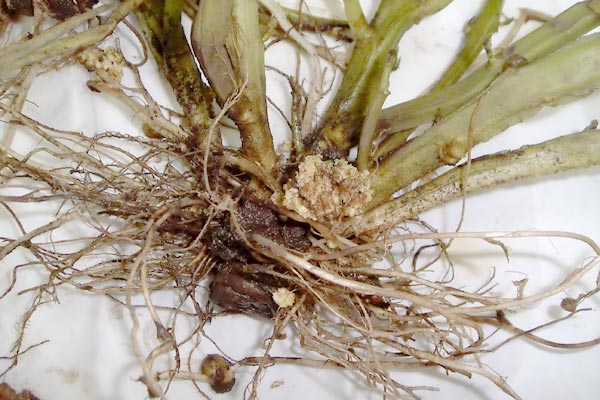
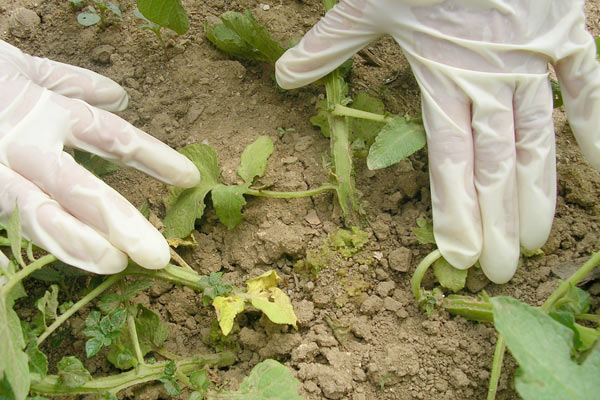
Analysis of surveys from previous years shows that the greatest risk is in the established buffer zones around the outbreaks (with prolonged monoculture potato cultivation and the use of uncertified seed potatoes of unknown origin). As a result of the favorable meteorological conditions this year, it is necessary to carry out visual inspections in the risk areas at the end of June and throughout July. The symptoms during this period are tumorous formations localized in the basal part of the stem, which resemble cauliflower. They are green, with a granular structure, and their size varies depending on the variety and conditions.
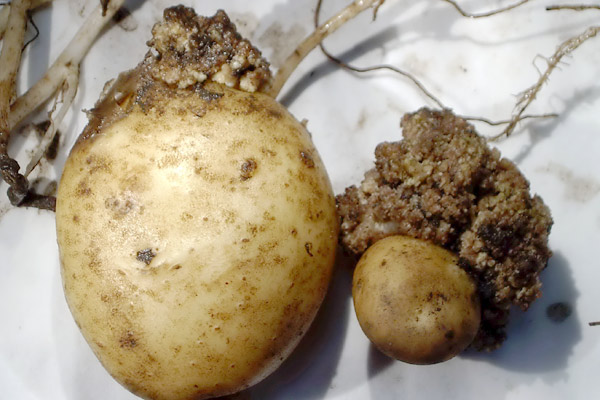
The second stage suitable for visual survey is during potato harvesting. The typical symptoms are whitish to dark brown tumors around the eyes of the tubers and on the stolons. In weakly resistant varieties, hyperplasia, deformation of the tubers and a scab-like form may be observed. If necessary, cuts are made for microscopic examination and identification of the sporangia of the causal agent. During harvesting, part of the tumors darken and disintegrate, releasing winter sporangia into the soil.
Control of potato wart is extremely difficult and very time-consuming. There is no alternative for chemical control. The main measures to limit the spread of the disease are: preventive control, strict phytosanitary and quarantine measures, as well as resistant varieties for cultivation in the established buffer zones. The use of potatoes from wholesale markets and exchanges as seed material carries an enormous risk. Certified seed potatoes must also be used for planting small household plots and gardens.
When symptoms are detected, producers must immediately contact specialists from the Plant Protection Departments of the Regional Food Safety Directorates. Information is available on the use of resistant varieties to the established pathotypes under the conditions in Bulgaria.
Reprinted from Issue 8/9 2018 of the journal “Plant Protection”