

For the protection of trees and fruit yield from diseases and pests in cherry, a significantly smaller number of spray applications is carried out compared to apple. Nevertheless, the problem of residues and environmental pollution is also relevant in cherry production, bearing in mind that in this fruit species the period from flowering to harvest is considerably shorter than in apple.
Phytopathological literature describes 24 fungal diseases in cherry. Of those established in Bulgaria, the most economically important are cherry leaf spot and brown rot.
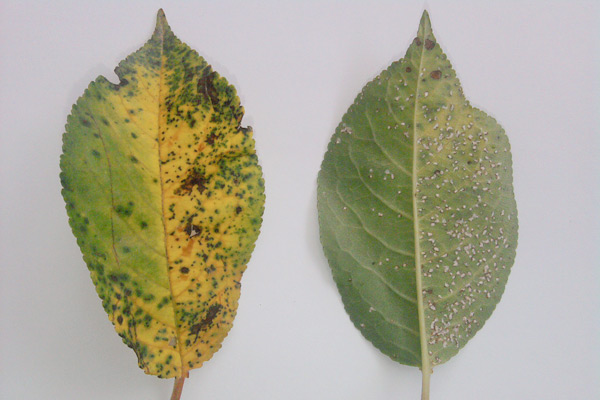
Cherry leaf spot is the key disease of sweet and sour cherry that determines the number of fungicide spray applications each year. This disease causes significant damage to cherry production, as it leads to premature defoliation of the trees, which not only reduces the quantity and quality of the produce, but also results in freezing injury to the trees during winters with low temperatures. Damage from cherry leaf spot occurs mainly on the leaves and, in some cultivars only, also on the fruit stalks. The most reliable way to protect cherry from cherry leaf spot is to grow cultivars that are resistant or very weakly susceptible to the disease. In Bulgaria, the first studies on the susceptibility of cherry cultivars to cherry leaf spot were conducted by Velichkova in 1975, who established that among the cultivars observed, the most highly susceptible to the disease are Napoleon, Bing and Early Large Black, while Silistra Cherry and Sofia Early No. 24 are weakly susceptible. Later, at the Institute of Agriculture in Kyustendil, an assessment of the susceptibility of more than 40 cultivars was carried out. It was established that the rootstock, fertilization rates and soil surface management systems affect the degree of infestation by cherry leaf spot.
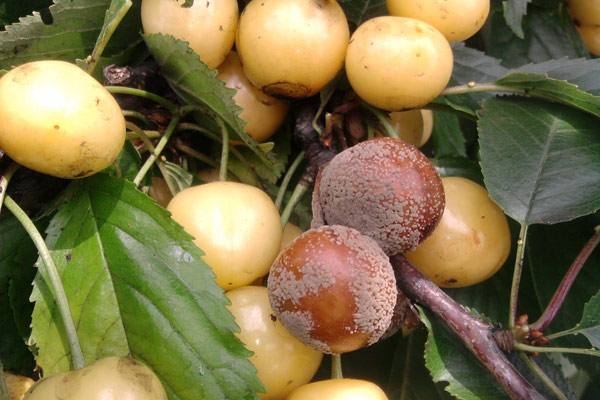
Brown rot is the second most economically important disease (and in some years the first) in Bulgaria and a number of other countries where this fruit species is grown. It is caused by three species of fungi of the genus Monilia.
Measures to protect cherry from the causal agents of brown rot include sanitary pruning and fungicide spray applications.
Sanitary pruning is applied to remove infected twigs, and in addition all mummified fruits must be removed from the canopy, collected and destroyed. These measures are applied annually, bearing in mind that infection is renewed by spores formed on infected twigs, branches and fruits. Sanitary measures alone cannot solve the problem of brown rot, which necessitates fungicide spraying to protect the trees from infection. Sprays are carried out before bud break, at the phenological stages “pink bud”, “flowering” and immediately after flowering to protect blossoms, young fruitlets and shoots, and later, to protect the fruits, they are applied in the period before ripening.
From a study conducted at the Institute of Agriculture in Kyustendil it was established that after fruit cracking the main causal agents of fruit rot are early brown rot (Monilinia laxa), late brown rot (Monilinia fructigena), grey mould (Botrytis cinerea), Alternaria rot (Alternaria alternata). Minor damage was also established from Rhizopus rot (Rhizopus stolonifer) and bitter rot (Glomerella cingulata).
To reduce losses from cracking caused by rains during ripening, and thereby indirectly reduce fruit rotting, it is recommended to plant cultivars that are resistant or weakly susceptible to cracking; to spray with CaCl2, RainGard, SureSeal, and to cover the trees.
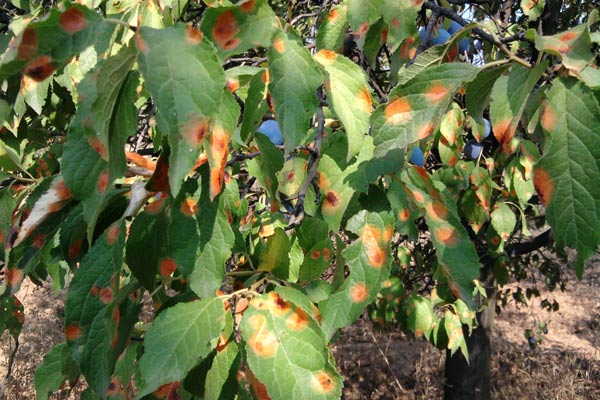
Red leaf spot of plum
In Bulgaria the disease is widespread in all regions where plum is grown and causes damage every year to susceptible cultivars.
Of the plum cultivars grown in Bulgaria, Kyustendil Blue Plum, Anna Späth, Queen Victoria, Gabrovka and Čačanska Najbolja are highly susceptible to the disease. Among the Reine Claude group, the most susceptible is Large Green Reine Claude. Weakly susceptible are Lyubimets Hramovykh, Sofia 2, Ashatan, Giley and Stanley.
It is important for growers to know that the first spray against red leaf spot can be combined with spraying against the larvae of plum sawfly.
More details on the dangerous pathogens in cherry and plum are provided in the insert to issue 8/9 2018 of the journal “Plant Protection”.