

domati-(1).jpg)
Diseases causing leaf spot are common in vegetable crops. Foliar pathogens are usually active in humid weather. Their spores are spread by raindrops and water splashes. Symptoms are spots of various sizes, colours and shades on the leaves. The causal agents are mainly fungal and bacterial pathogens.
BACTERIAL LEAF SPOTS: bacterial speck on tomato and pepper (Xanthomonas vesicatoria, X. euvesicatoria, X. gardneri) (Bacterial leaf blight), bacterial speck (black speck) (Pseudomonas syringae pv. tomato), angular leaf spot of cucumber (Pseudomonas syringae pv. lacrymans), halo blight of bean (Pseudomonas syringae pv. phaseolicola), bacterial blight of pea (Pseudomonas syringae pv. pisi)
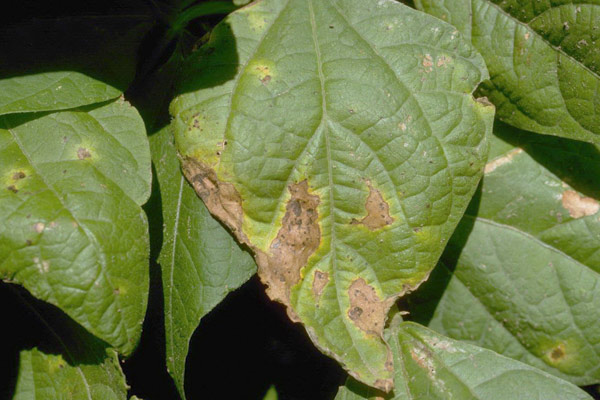
Bacterial blight of bean (Xanthomonas campestris pv. phaseoli) is economically the most important disease of bean in our country. It develops annually, causing significant yield losses. Under favourable conditions for its development it may lead to severe damage.
Symptoms
When infected seed is sown, a large part of the seedlings die before emerging above the soil surface. Oily spots appear on the cotyledons of emerged seedlings, and sometimes they do not open and cause the so‑called “snake heads”. In rainy weather the infection spreads from the cotyledons to the true leaves. Small, greasy, irregularly shaped spots appear on them. Later the tissue in these spots blights and falls out. On pods the spots are dark green and greasy. Later they dry out and become reddish‑brown. They are sunken and covered with dried bacterial exudate. The bacterium reaches the seeds and infects them. Small ulcers appear on the seeds.
Control
Introduction of a 2–3 year crop rotation. Use of healthy or treated seed. Under favourable conditions for the disease or at the appearance of the first spots, treatment with copper‑containing plant protection products: Bordomix 20 WP 375–500 g/da; Funguran OH 50 WP 0.15–0.3%; Champion 0.15–0.3%.
FUNGAL LEAF SPOTS: leaf mould of tomato (Fulvia fulva), black leaf spot of crucifers (Alternaria brassicae, A. brassicicola and A. raphani),white leaf spot of tomato (Septoria lycopersici), late blight of celery (Septoria apii-graveolentis), early blight of celery(Cercospora apii), leaf spots on parsley (Septoria petroselini, Cercospora depresa)
Black leaf spot (alternariosis) of tomato, pepper and eggplant (Alternaria porri f. solani) is the most widespread and most commonly occurring disease of tomato grown both in protected cultivation and in the open field. In our country black leaf spot is widespread, especially in plastic‑covered structures. In pepper and eggplant it occurs relatively less frequently.
Symptoms
On the oldest tomato leaves, and later on the whole plant, small water‑soaked spots appear, which increase to 5–7 mm in diameter. Later the spots dry out, become dark brown to black with a concentric structure, coalesce and the leaf blights. The spots on the stem and on leaf and flower petioles are similar, with the characteristic concentric structure. They may completely encircle the affected parts and cause their desiccation above the point of infection. The spots on the fruits start from the stem scar and also have a concentric structure. For yield reduction, the spots on the flower stalks are particularly important, as they may cause flower drop. At high relative air humidity the affected areas are covered with a black coating of the fungal sporulation.
On the lowest pepper leaves, spots 1–2 cm in size with a concentric structure appear. The infection progresses upwards. Infected leaves wilt, die and fall off. On the stem, small, dark and slightly sunken lesions appear. Later they enlarge and form round or slightly elongated, lighter spots with a concentric structure. The fungus also attacks the fruits. The spots on them may cover the entire upper part of the fruit. Infected fruits drop before reaching maturity.
The pathogen attacks eggplant in all stages of its development. It may cause damping‑off of seedlings. The attack starts from the lowest leaves and continues upwards. The spots have a concentric structure. Infection on the fruit stalks may cause premature fruit drop.
Control
Introduction of a 3–4 year crop rotation. Cultivation of resistant varieties. Seed disinfection. Production of seedlings in sterile or disinfected substrate. Maintenance of an optimal temperature and humidity regime in protected structures; regular ventilation of the facilities. Application of plant protection products at the onset of the disease or under favourable conditions for its development.
In issue 7/2018 of the journal “Plant Protection” you can read more detailed information on the symptoms of the diseases and their control.