

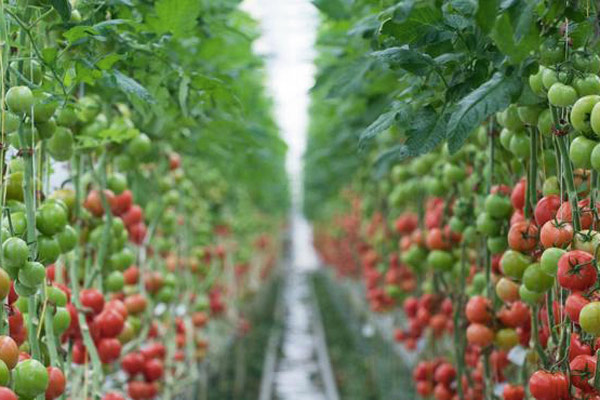
Greenhouse vegetable production makes it possible to supply the market with fresh produce continuously and regularly, even during the winter months. The main crops grown are tomatoes, cucumbers and peppers. About 90% of the total greenhouse production is accounted for by these crops. On smaller areas there are eggplants, lettuces, spinach, radishes, onions and other vegetable crops.
The greenhouses in the country cover an area of 1002 ha, of which 621 ha are polyethylene and 381 ha – glass greenhouses. According to data of the “Agrostatistics” Department of the Ministry of Agriculture, Food and Forestry, the production of vegetables in greenhouses, harvest 2016, amounts to 113.1 thousand tonnes. In the cultivation facilities, plants are grown all year round. Greenhouses create an ideal microclimate, which makes them one of the most successful solutions for organizing structures for vegetable cultivation. There are major differences between growing plants in greenhouses and in the open field. Crops in greenhouses form a larger vegetative mass and provide much higher yields compared to those in the field. Therefore, the methods of cultivation and care differ from those applied outdoors. Thanks to them, we can enjoy greenhouse vegetables as part of a balanced and healthy diet in every season.
Due to its high intensity, Bulgarian greenhouse production provides 15–17% of the total harvested vegetables in the country. The share of greenhouse-grown tomatoes is 50%, while in the case of cucumbers the predominant part of the quantities produced are grown in greenhouses – 80%.
Almost 50% of the existing greenhouse complexes are concentrated in the South-Central region, followed by the South-West-Central region. The main reason for this concentration is the more favourable climatic conditions in these areas: higher average daily temperatures during the winter and spring months, more solar and physiologically active radiation, and a smaller number of days with persistent snow cover.
Climatic conditions have a direct impact on the level of heating costs and on the yields and quality of production. The larger greenhouse complexes in Bulgaria are Zverino (sole trader “Yordan Velichkov – Vladi”), Purvomay Greenhouses (“Greens” Ltd.), Sliven Greenhouses (“Skat” Ltd.), Petrich Greenhouses (“V&VGD Greenhouses Petrich” Ltd.), Momchilgrad Greenhouses (“Agro Omega” Ltd.), Gimel Greenhouses, Silistra Greenhouses (“Eco Vegetables” Ltd.), Y. Gruevo and Krichim Greenhouses (“Agreco Select” Ltd.), Rakovski Greenhouses (“Gard Invest” Ltd.), Dubene Greenhouses (“Karlovo-05” Ltd.), Sinitovo Greenhouses (“Ecofruit K&K” Ltd.), Tsalapitsa Greenhouses (“Enza Zaden Bulgaria” Ltd.), Pchelin Greenhouses (“Bulfruct” Ltd. – Kostenets), Mokrishte Greenhouses (“Agroprogramma” Ltd. and Dimitar Matov) and others.
The level of average yields in greenhouse production depends on a complex of factors. To a large extent, and unlike field production, it is relatively independent of climatic factors. Modern technologies make it possible to obtain high average yields per unit area. The specific conditions created in greenhouses, regardless of their type and design, allow the cultivation of more than one crop, whereby the average yield per unit area increases significantly. For example, hydroponic cultivation in a number of species makes it possible to increase the average annual yield per calendar year several times.
Worldwide, greenhouse areas are showing a continuous growth rate. The specific requirements of these vegetables determine the design and functional purpose of greenhouses and explain the existence of requirements for heating systems and management.
Greenhouses can be, in terms of heating – heated and unheated; depending on the type of covering – glass, polyethylene, polypropylene, multi-layer, etc. Another criterion for the classification of greenhouses is the type of roof. On the basis of this criterion, they are divided into single-span and multi-span (block) greenhouses. Depending on the source of heating: gas, renewable energy sources, coal, geothermal heating. In terms of the method of planting and fertilization: conventional cultivation (geoponics), hydroponics (water culture, substrate culture, aeroponic culture). Depending on the growing period and the time of ripening of the production: early production in unheated and early production in heated greenhouses, late production in unheated and in heated greenhouses.
In territorial terms, the largest greenhouse areas in the EU are in Spain, followed by Italy and France. The main reason for the extensive greenhouse areas in these countries is the favourable climatic conditions. The undisputed leader in productivity is the Netherlands. Average yields in Finland are three times higher than in our country. In Turkey they are close to those in Bulgaria, but it should be noted that the data refer to unheated greenhouse complexes.
Greenhouse production is characterized by innovation and dynamic development. It provides higher yields, leading to greater profits, which determines its higher profitability. On the other hand, indoor vegetable production largely eliminates adverse environmental and climatic factors. Along with its positive aspects, greenhouse vegetable production is not devoid of negative ones.
The impossibility of introducing balanced crop rotations and the enclosed space create conditions for the deterioration of the nutrient regime and for the rapid multiplication of pests. To prevent these negative circumstances, it is necessary to observe a number of principles known as Good Agricultural Practices (GAP). Part of them is Good Plant Protection Practice (GPPP), which requires maintaining phytosanitary standards at a high level throughout the entire growing season – from seedling production to harvesting and cleaning of the cultivation facilities. It is a practice through which plant protection products (PPPs) authorized for use are applied at the exact dose and at the appropriate time for optimum efficacy, in accordance with microclimatic conditions, the biological characteristics of cultivated plants and biological control.
Reducing the use of pesticides in order to diminish the risks of their adverse effects on human health and the environment is a priority task in vegetable production. EU Directive 91/414, which regulates the placing on the market of PPPs, requires that the rules of GPPP and the principles of Integrated Pest Management (IPM) be applied when using them, including the rational application of a combination of biological, biotechnological, chemical, physical, agrotechnical and breeding measures.
Organic production of vegetables in greenhouses in Bulgaria is a fact. One of the major producers is the company “Gimel”. It was established in 1995. Today the company is the undisputed leader in the production of greenhouse cucumbers and tomatoes in Bulgaria, a main supplier of organic greenhouse vegetables for Europe and one of the most sought-after business partners in this field. “Gimel” JSC. The facilities are located in different regions of the country: the village of Zvanichevo, Pazardzhik district, the town of Levski, Pleven district, and the town of Marten, Ruse district. Since 2001, vegetables have been grown in the company’s greenhouses using the method of organic production. The packaging of organic production is carried out in accordance with European standards and quality requirements in a special packing facility created for this purpose.
The establishment of alternative methods and means for pest control in vegetable crops in cultivation facilities is an important step towards improving integrated and organic plant protection systems. The conservation and improvement of soil fertility through the optimal use of biological resources make it possible to obtain stable yields of high-quality vegetable production.