

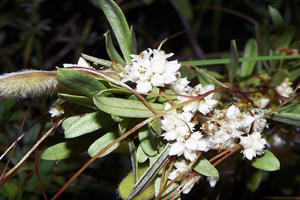
Parasitic weeds are achlorophyllous plants; therefore, they cannot photosynthesize and feed heterotrophically, i.e. for their growth and development they use ready plastic substances from the green plants on which they parasitize. If parasitic weeds are not destroyed in time, the plants attacked by them, the hosts, may completely perish. Depending on which organs of the plants they attach to, parasitic weeds are divided into stem and root parasites.
Dodder is the most widespread stem parasite in our country. It is also known by the names “cuckoo’s thread”, “fairy hair”, “devil’s threads”, etc. In Bulgaria the most widespread variety is thyme dodder – Cuscuta epithymum (L.) L. Besides it, in our country there also occur field dodder C. campestris Yunker, flax dodder – C. epilinum Weihe, European dodder – C. Europaea L., clover dodder – C. trifolii Bab. and others. Thyme dodder reproduces by seeds, which germinate at a depth of 0–4 cm at a soil temperature of 16–18°C, which means mass emergence in April–May. It flowers and sets seed from July to October. The practical problem is that dodder seeds are mainly harvested together with the crop and are partially dispersed in the soil. A single plant forms up to 2500 seeds. The species is thermophilic and light-loving. It infests stands of clover, vetch, lucerne (alfalfa), row crops and vegetable crops, as well as many wild-growing species. It occurs up to 850 m above sea level.
In the control of dodder the following measures are of primary importance: for sowing, seed material free from dodder seeds should be used; stands attacked by the parasite should not be used for seed production; proper crop rotations should be applied, in which cultivated plants attacked by dodder are alternated with crops that are not its hosts (flax and sugar beet should be alternated with cereals); for seedlings that are attacked by dodder (tomato, pepper, tobacco, etc.), disinfected or well-rotted farmyard manure should be used; feed and irrigation water containing viable dodder seeds should not be used; areas infested with dodder should not be used for seedling production, or they should be disinfected with a total pesticide before sowing; seedlings heavily attacked by dodder should be destroyed with total herbicides or ammonium nitrate. Dodder must be destroyed as soon as it is noticed in lucerne, vetch and other crops with a dense canopy. If individual patches are infested, they should be cut low, before the dodder plants have flowered, and the cut biomass should be removed from the stand. The cut area should be treated with herbicides or the soil should be cultivated.
In lucerne, dodder can be controlled with a low dose of glyphosate, which is applied 1 to 3 days after harvesting the infested cut. In row crops and vegetable gardens the parasite must also be destroyed as soon as it is noticed. Currently, in our country there are no registered herbicides for dodder control in these crops. The attacked cultivated plants must be destroyed before the flowering of the parasite.
Root parasites in our country are represented by numerous varieties and races of broomrape. The parasite belongs to the family Orobanchaceae, which is represented by about 212 species from 14 genera. In Bulgaria, 24 species of Orobanche occur. Of these, 10 species with eight varieties parasitize various representatives of the family Asteraceae. Hosts are also species from the genera Ahillea, Artemisia, Carduus, Centaurea, Chrysantemum, Cirsium and Helianthus. Broomrape is a very dangerous parasite of tobacco, sunflower, tomato, potato, pepper, cabbage, eggplant, carrot, dill, hemp, vetch, hop, lupine, petunia and others.
Of practical importance for the country are branched broomrape Orobanche ramose L., large tobacco broomrape – O. Mutelli F. W.chultz and sunflower broomrape – Orobanche cumana Wallr. The main species that attacks sunflower in our country is O. cumana Wallr, and for tobacco this is O. ramosa (L). In some regions in our country broomrape is also known as “blue flower”, “devil’s root”, “hyacinth”, etc.
Sunflower broomrape reproduces by seeds that germinate in the soil at a shallow depth – up to 2 cm, at a temperature above 20–22°C. It has been established that there are two main biological races of broomrape: the seeds of one germinate only when they are close to the sunflower roots, and those of the other – regardless of the sunflower roots. The sprout develops haustoria and penetrates the root of the crop. Sunflower broomrape flowers and sets seed from July to September. A single plant forms from 15,000 to 40,000 (sometimes up to 100,000 seeds!), which are mainly dispersed in the soil. It is a thermophilic and light-loving species, tolerant to prolonged summer droughts. It parasitizes mainly on sunflower and less frequently on other plants. It develops on all soil types.
Broomrape is the most dangerous parasite of tobacco in regions with a warmer climate. In our country it is distributed with the species Or. ramosa (branched broomrape) and Or. mutelii (large tobacco broomrape). During the period 2002–2005, under a project funded by the “Tobacco” Fund, the latest studies on the distribution of the parasite in tobacco-growing areas in Bulgaria were carried out. The capabilities of the GIS-Cadis geographic information system were used to enter into an index map data on broomrape infestation in the regions of Sandanski–Melnik; Petrich; Gotse Delchev; Krumovgrad; Kardzhali and Dzhebel. The degree of infestation with broomrape species was determined using a method developed at ITTI – Markovo and approved by the Ministry of Agriculture and Forestry. As a result of the study, a database on the distribution of broomrape in the surveyed regions was created. It was established that in the Kardzhali region there is mixed infestation with both species – Orobanche mutelii and Orobanche ramosa, while in the Blagoevgrad and Plovdiv regions Orobanche ramose L predominates.
Branched broomrape is shorter (7–8 cm) and, as its very name suggests, is strongly branched (with 5–10 shoots), with pale blue flowers and small seed capsules. Large tobacco broomrape is taller (10–35 cm), less branched (only with 2 to 4 shoots), with thicker and succulent stems with a brownish tinge, with dark violet flowers and larger seed capsules.
The seeds of the parasite usually germinate at a temperature above 10°C. At a temperature of 20–25°C this occurs within 7 to 21 days. The embryo of broomrape does not have a cotyledon and plumule. It forms an egg-shaped outgrowth, which elongates into a thread-like structure. When it touches the roots of the host, the outgrowth attaches and penetrates them. In this way the parasite connects to the phloem and cambial elements of the roots, from which it extracts nutrients and water. Once haustoria are formed, the parasite develops tuberous swellings above them, from which the stems and underground root-like threads develop, with which the parasite also attaches to the roots of surrounding plants. The stems are pale yellow, irregularly cylindrical and instead of leaves they have small scales. Each broomrape flower produces a single medium-sized capsule containing numerous small, light and slightly sticky seeds. A large number of flowers are formed on one plant over an extended period of time, so that while some of them are in the initial phase of development, seeds have already been formed from others. From one plant 30,000 to 150,000 seeds are produced, which are dispersed by wind, surface water, animals, etc. Broomrape seeds can remain viable in the soil for more than 10 years. Precisely these physiological, biological and ecological characteristics of the parasite make its control extremely difficult.
In sunflower, the control of broomrape has been successfully solved through the development of resistant varieties and hybrids. Over the last 10–15 years, the success in this field has been indisputable. The newly developed varieties and hybrids, in addition to resistance, also possess the required high technological qualities and yield potential. In other crops, the control of the parasite includes a complex of preventive and eradication measures such as: proper agronomic practices, physical methods (solarization), chemical means (herbicides and artificial stimulants for seed germination), use of resistant species, biological control methods, etc. On small areas, mechanical pulling of emerged broomrape stems is a suitable control measure. Pulling out and burning the parasite immediately after its emergence is an effective way of destroying it, provided weeding is carried out before seed maturation and if the parasite density is low.
Crop rotation is of essential importance for broomrape control. Rotating sunflower at intervals of at least 5 years is an effective measure to protect it from O.cumana. Crop rotation including trap crops is a very good way to limit the spread of broomrape. It has been established that some plants that are non-hosts of the parasite exude substances that induce the germination of Orobanchе. Such plants are lucerne, clover, winter pea, oilseed rape, castor bean, sesame, maize for O.ramosa and pepper for O. cumana.
In solarization the effect of high temperatures is used to reduce seed germination. A soil temperature of 48 to 50°C under polyethylene film is sufficient to kill the germination capacity of broomrape seeds.
Fumigation requires well-tilled moist soil at the time of treatment, because seeds are most sensitive when they are swollen. In our country, the total pesticide Dazomet (Basamid granulate) is used for fumigation, incorporated at a depth of 15 cm with sprinkler irrigation, at a rate of at least 5 l water/m². Fumigation is applied in a limited way on small areas, since the measure is expensive and often economically unprofitable. Chemical means for broomrape control are, as a rule, applied before or after the emergence of the host crop, but must always be applied before the emergence of the parasite. The most limiting factor in the use of herbicides is their low degree of selectivity to crops at the effective dose for parasite control. Glyphosate is the first herbicide used against Orobanchе crenata for control in common bean and faba bean. A single glyphosate treatment at a dose of 20 g/da provides complete control of the parasite without damaging the crop. Satisfactory results for chemical control have been obtained under experimental production conditions with the herbicides metsulfuron-methyl, chlorsulfuron, triasulfuron, imazamox, s-metolachlor and others. It must be emphasized that these are literature data and none of the mentioned herbicides has official registration for broomrape control in any of the host crops in our country!
The development of resistant crop varieties and hybrids is by far the best method for the control of parasitic weeds. However, complete immunity of host plants to Orobanche has not been established so far. The resistant varieties developed often have lower than normal yield and poorer quality, which makes them unattractive in practice.
As biological agents against species of the genus Orobanchе the fly Phytomyza orobanchia, the fungus Fusarium lateritum and the fungus Ulocladium atrum are used. The phytomyzid fly lays eggs in incisions on the stem of the host, and the larva feeds either in the seed capsule or by mining the stem and causing desiccation. In our country good results have also been obtained, and in some years up to 90% efficacy from the use of the fly against O. ramosa and O. mutelli has been recorded. In recent years, commercial preparations from Fusarium species have been developed for the control of O. cumana in Egypt and Jordan.