

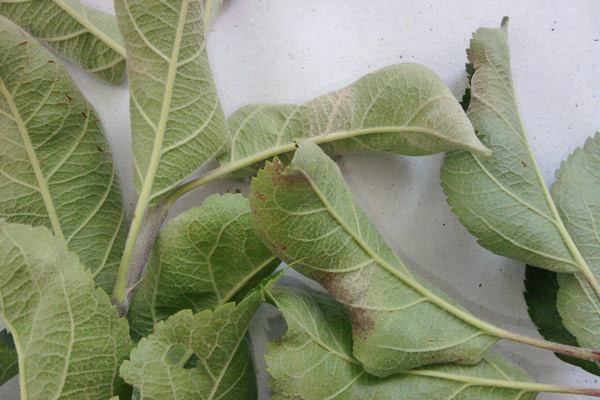
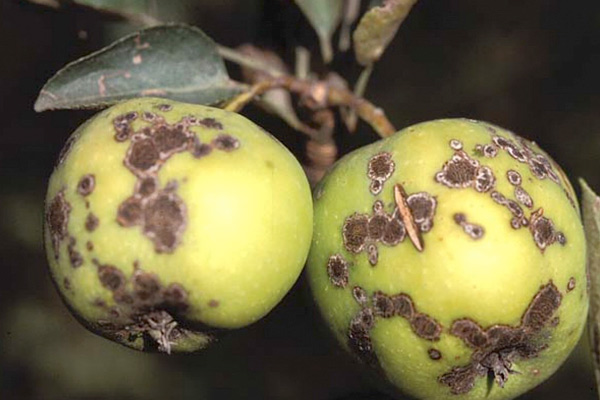
The apple is a host to a number of fungi, bacteria, viruses and mycoplasmas that cause significant damage to producers. In the specialized literature, 57 fungal diseases are described, but scab caused by the fungus Venturia inaequalis is the most harmful disease of this crop in all countries where apples are grown. Under favorable conditions for the development of the disease, losses on susceptible cultivars, if no control measures are taken, may reach 70 - 100%. This disease was described for the first time by Fries in 1819.
Apple scab infects and damages the leaves, their petioles, the flowers and the fruits. Very rarely damage is observed also on the shoots, mainly of crab apples and of some highly susceptible cultivated cultivars.
The causal agent of apple scab, the fungus Venturia inaequalis (Cooke) Wint with conidial form Spilocea pomi Fr., belongs to the subclass Loculoascomycetidae, order Pleosporales, family Venturiaceae. Seven physiological races have been identified so far within Venturia inaequalis.
Three conditions are required for the development of the fungus Venturia inaequalis – a susceptible host, a favorable temperature and the presence of moisture. The first condition is present in almost all orchards, since most of the main cultivars grown in our country are susceptible to the disease. The fungus develops at temperatures from 6 to 30ºC, with an optimum of 18 to 23ºC. Throughout the entire vegetative period of the apple there is a favorable temperature for the development of the pathogen. Moisture is the limiting factor for the development of scab, bearing in mind that the spores of the fungus germinate in the presence of a water droplet and an air humidity above 90%. In most years, in the apple-growing regions of our country, during the period May-June there are favorable conditions for the development of the disease.
Control of scab must begin as early as autumn and continue almost until the following autumn. For good protection of apple orchards from scab and to avoid the risk of the development of resistance of V. inaequalis to the fungicides used, a complex of measures must also be applied that contribute to the creation of favorable conditions for the development of the apple, namely:
- Establishment of apple orchards in the most suitable regions for this species;
- The planting scheme should be in accordance with the application of differentiated plant protection. Scab-resistant cultivars should be arranged in such a way that they are not sprayed as frequently as the susceptible ones;
- Planting distances, crown shape and pruning should ensure a good air regime, under which no favorable conditions are created for the development of diseases and pests;
- Planting of cultivars that are resistant or slightly susceptible to scab. Studies on the susceptibility of widely distributed and newly introduced apple cultivars in our country have established that the cultivars Idagold, Jupiter, Cox Orange Spur, Tuxan, Cox Orange Kathegard, Akane and Polared are slightly susceptible to scab. Highly susceptible are: Fuji, Gloster-69, Starkrimson, Granny Smith, Golden Delicious, Mutsu, Jerseymac, Oray, Chadel, Kinsei, Orin;
- Balanced fertilization and irrigation. The level of mineral nutrition should be monitored by means of plant analysis (leaf diagnostics) and on the basis of the obtained yield and growth;
- Maintaining the soil surface free from weeds.
Powdery mildew Podosphaera leucotricha (Ellis and Everh.) E. S. Salmon is the second most economically important fungal disease of apple not only in our country, but also in all countries where this fruit species is grown.
The fungus that causes the disease attacks mainly the leaves and shoots and very rarely the fruits of highly susceptible cultivars such as Jonathan and Moira.
Control of apple scab and powdery mildew must be carried out simultaneously, bearing in mind that most of the approved fungicides are effective against both pathogens.
Treatments against powdery mildew can also be reduced by planting apple cultivars that are less susceptible to the disease, such as Golden Delicious, Melrose, Prima, Priscilla, Florina, Gala Beauty, Brina and others. When growing cultivars that are resistant to scab and slightly susceptible to powdery mildew, the number of fungicide sprays is reduced by 50%. Reducing the use of fungicides also leads to a reduction in acaricide treatments, as a result of the higher density of predatory mites that regulate the multiplication of the European red mite. The result of reducing fungicide and acaricide sprays is not only significantly lower costs, but also the protection of human health and the environment, which has no monetary equivalent but is much more important than saving financial resources.
This material is part of the content of issue 6/2018 of the journal “Plant Protection“.