

Protecting oilseed rape from diseases and pests is a real challenge for farmers. Plant protection measures are extremely important, but at the same time the costs are considerable as a share of the overall farm budget. The disease control strategy should be adequate to the conditions and the level of risk, so that the expected profit can be achieved even in less favourable seasons.
Phoma stem canker, sclerotinia stem rot and, more recently, clubroot, are a major problem.
Phoma stem canker is among the most important diseases of oilseed rape worldwide. In the areas where the disease occurs, losses are usually less than 10%, but they can reach much higher levels. In the history of the disease there have been catastrophic epidemics during the period from the 1970s to the 1990s in Australia, Canada and Western Europe. In recent years, with the introduction of resistant hybrids, the risk of the disease has decreased drastically; nevertheless, annual global losses from it are estimated at about EUR 1.3 billion. In Bulgaria, severe attacks have been recorded, including lodging of crops as a result of this disease, but in recent years such cases have rarely been reported. However, the high potential and strong variability of its causal agents can always surprise us. Proper agronomic practices minimise the pressure on resistant hybrids and help preserve their effectiveness.
Causal agent
The disease is associated with two fungal species, Leptosphaeria maculans and Leptosphaeria biglobosa. The asexual form of both is Phoma lingam, from which the name of the disease is derived. Biologically, the two pathogens are similar and until recently were described as a single species, L. maculans with two groups, A and B. In Bulgaria both species have been isolated.
Symptoms and disease development
The first symptoms are detected on the cotyledons and young leaves in the form of pale green or chlorotic spots. They are round or irregular in shape, reach 1–2 cm and are delimited by the leaf venation. Subsequently the spots become grey or brownish, their periphery darkens, and a large number of small black fruiting bodies – pycnidia – appear on their surface. Under heavier attack, the tissue between the spots may turn yellow and the leaves may die.
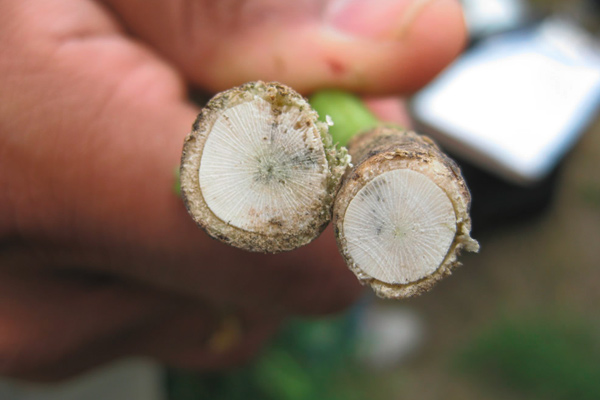
In rare cases, under severe infection of the seedlings, lesions may appear below the base of the first leaves, which can lead to damping-off and blight of the entire plant. After flowering, characteristic lesions of the disease are found at the stem base and the root neck. They are broadly elliptical, with a grey centre and dark margin, and are located at the base of the petiole. Under severe attack, the lesions become corky, crack and cause necrosis with cavities near the vascular bundles. The most significant damage from phoma stem canker is expressed in stem breakage and lodging of the crops. Damage from the disease is also observed on the pods and their stalks; in this case the spotting is superficial, greyish, with pycnidia on the surface. The seeds are slightly shrivelled and discoloured.
Control measures
Crop rotation. It is of great importance, since the fungus survives in crop residues for 2–3 years. Ascospores are dispersed over long distances and the effect of rotation decreases if neighbouring fields are not included in it. Increasing the distance from previous oilseed rape fields by more than 200–500 m leads to a sharp reduction of the inoculum level.
Deep ploughing, chopping of plant residues. This ensures easier decomposition of residues and their isolation from new fields. It is not by chance that in countries such as Australia and Canada, where minimum tillage is practised (and poor rotation due to large field sizes), phoma stem canker is a significant problem.
Optimal plant density and balanced fertilisation. More tender and thinner stems are more easily damaged and broken.
Earlier sowing. This is a common practice in Australia and aims at passing the sensitive growth stages of oilseed rape before the onset of severe infections by ascospores. In Bulgaria, due to autumn drought, similar sowing dates are also used and it is possible to achieve the same effect indirectly. Supporting this thesis are our observations that in Bulgaria the sexual form matures no earlier than the second half of autumn.
Breeding approach. At present this is one of the most effective ways to control the disease. The main reason for the lower incidence of phoma stem canker in recent years is the use of combined quantitative and qualitative resistance.
Chemical control and infection risk forecasting.
In Bulgaria there are registered fungicides with very good current efficacy against phoma stem canker. Most of them belong to the triazole group (Folicur 25 WG, Orius 25 EC, Toprex 375 SC, Caryx), but there are also products from other groups (Pictor SC). Fungicides are applied mainly as foliar sprays during vegetation, but in some countries such as Australia, where dangerous early infections are more frequent, seed treatment or application in the soil near the seeds is practised. Such treatment has given results, but not without the assistance of another product in later growth stages of the crop. Damage from phoma stem canker is relatively constant over the years, but it does not always lead to economically significant yield reduction. The disease is highly harmful, yet there are many limiting factors for its development. Through proper forecasting and assessment of these factors, farmers can determine the risk and make a decision regarding chemical treatment.
Recording the growth stage is a factor that should routinely be monitored by producers, not only because of diseases. With regard to phoma stem canker, the most widely accepted opinion is that infections up to the 6th true leaf stage can lead to cavities in the stem in spring. In England it is considered that the most critical period is from the 3rd to the 10th leaf stage, but in fact it continues until the beginning of intensive stem elongation. Earlier infection leads to more severe damage to the stem. To avoid mistakes, it is important to know that young leaves (1st–4th leaf) are more susceptible to infection, i.e. it becomes established and develops more rapidly in them, but symptoms appear twice as slowly compared to those on the 6th and other higher-positioned leaves. In addition, symptoms develop more slowly on young than on ageing leaves, since defence mechanisms in the latter are weakened. There is not always a correlation between damage to leaves and stems, and there are reasons for this. Often the infection remains latent due to temperature fluctuations or the presence of young leaves, but the mycelium successfully moves to the stem. Conversely, if leaves are severely affected but permanent cold sets in before the fungus reaches the stem, they may die and the plant may “rid itself” of the infection.
The most variable and difficult factor to assess is the climate. Of primary importance is how it influences the development of the sexual form and the ascospores of the fungus.
At the Agricultural University in Plovdiv, for a second consecutive season, comprehensive observations are being carried out on climate, fruiting bodies and symptoms of the fungus. The results reveal opportunities for a more flexible strategy in chemical control. Autumn is the most important period for plant infection, but in Bulgaria it is often without rainfall. The formation of pseudothecia requires a moderate temperature of about 14oC and 15–20 days with precipitation > 1 mm. The table shows that in both years (2013–2014) only after the beginning of October did the air temperature in Plovdiv approach the optimum. It turned out that the limiting factor for the appearance of pseudothecia in the autumn of 2013 was the number of rainy days – they were only 12 from the beginning of October to the end of December. Fruiting bodies appeared only after the first, albeit brief, snowfalls in February. In March, mature ascospores and the first symptoms of phoma stem canker were detected. This infection occurred too late; even in untreated plots the stem damage in oilseed rape was superficial and without visible economic importance.
In the autumn of 2014, after heavy rainfall, pseudothecia were detected as early as the end of September and some of them (15–20%) were visibly mature by mid-October. The first spots were recorded in mid-November, and their mass appearance was at the beginning of December. Microscopic examination of the fruiting bodies allowed us to record, at the beginning of November, a sharp increase in mature pseudothecia (64%). In mid-November a prolonged rainy period occurred, which was optimal for realising the accumulated infection. For this reason, on 15.11.14 we applied fungicide treatments. A product based on tebuconazole at the lowest registered dose was used. The results were very good; no new lesions were allowed to develop, except for those which at the time of spraying were at the end of their incubation period. On 20.12.14, in the treated variants 52% of plants were affected and 0.01% of leaf area was infected, while in the control 100% of plants were affected and 11% of leaf area was infected.
Experience shows that by microscopic examination of the fruiting bodies and monitoring the weather forecast, the first 1–2 infections of the season can be predicted. Subsequent spore releases of the fungus are difficult to predict without special spore traps. As long as the sexual form of the fungus has not appeared, there is no risk of infection in the region. Pseudothecia are larger and with an elongated neck and can hardly be confused with pycnidia. Experience is needed to recognise them with the naked eye or a hand lens.
Field surveys to detect 10–20% infected plants can also serve as a guide; this moment approximately coincided with the spraying carried out in 2014 and the results were good. In other seasons, however, several strong initial infections may occur within a short period, while the appearance of the first spots may be delayed (for example, at 8oC they appear after 15 days).
At the Centre for Integrated Plant Disease Management at the Agricultural University in Plovdiv, data are being collected for the region on the development of the sexual form of phoma stem canker. Pseudothecia appeared and matured in autumn in 2 out of a total of 5 years. However, the results show that infection and symptoms did not occur before the winter of 2015–2016 due to drought in December. In the current 2017–2018 growing season, very late and isolated infections were recorded in autumn, with warm and rainy November and December, but in spring new fruiting bodies were present and they in turn had delayed development as a result of spring drought. The onset of ascospore maturation occurs when there are approximately 19 rainfall events in autumn or in summer after harvesting the oilseed rape. In individual seasons (for example in 2016) this process may be accompanied by a one-month pause with a minimal number of or no rainfall events – it is assumed that this may lead to additional delay. Conversely, a prolonged period saturated with rainfall and more constant moisture may accelerate the process. Snowfall in winter plays a similar role; after it, the appearance of the sexual form in oilseed rape (and other fungi) and more rapid subsequent development have been observed.
Obtaining additional information on infection risk can also help improve the use of fungicides as growth regulators. Very often, crops in autumn are uneven, backward or stressed by drought. If there is no risk of phoma stem canker in such cases, treatment is not advisable. Trials abroad show that such a decision may further suppress the plants and lead to lower yields in spring. If the infection risk is real and the plants are small (highly susceptible), a product with weaker growth-regulating effect should be used. Counteracting the pathogen at the right time allows the use of the lowest registered dose.
Special supplement “Dangerous pathogens in agricultural crops” of the journal "Plant Protection" issue 5 – Assist. Prof. Dr. Zvezdomir Zhelev – Agricultural University in Plovdiv – Phoma stem canker, sclerotinia stem rot and clubroot in oilseed rape