

System for the protection of cucurbit crops
Cucurbits grown in greenhouses and in the open field are attacked by many diseases, most of which have great economic significance for the cultivated plants and their yield. Viral, fungal and bacterial diseases are observed. They attack the roots, stems, leaves and sometimes the fruits. Particularly harmful are:
Angular leaf spot (Pseudomonas syringae pv. laсrymans)
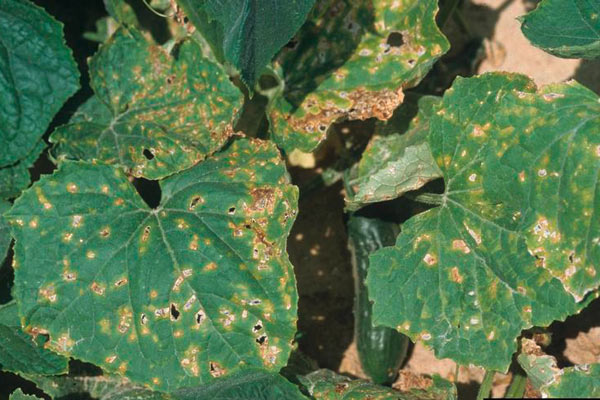
It massively attacks cucumbers grown in polyethylene greenhouses and in the open field. The first symptoms appear as small, water-soaked, yellowish spots of irregular shape, delimited by the veins. In humid weather, small cloudy droplets of bacterial exudate appear on their lower surface. Later it dries as a white film on the spots. As they enlarge, the centre becomes necrotic and falls out. Angular, perforated spots remain on the leaves. On the fruits, small, water-soaked spots of irregular shape are formed, covered with cloudy bacterial exudate. When the fruits ripen, the damage penetrates deeply into the tissues and reaches the seeds, infecting them. Entire fruits die from soft rot. On the cotyledons of plants emerging from such seeds, greasy spots appear. Soon the young plant dies.
Downy mildew (Pseudoperonospora cubensis)
Besides cucumbers, it attacks melons, watermelons and other cucurbits. This is the disease with the greatest economic importance in cucumber cultivation. On the upper side of the leaves, yellowish spots of irregular shape are formed, delimited by the veins. In the field they are smaller, while in greenhouses they are larger. In humid weather they appear water-soaked, and their lower surface is covered with a loose grey-violet coating of the fungus sporulation. Later the spots enlarge, merge and the entire leaf becomes necrotic. The first spots usually appear on the lowest leaves, but in a short time the remaining ones can also be affected. It develops under conditions of high air humidity. The fungus survives as oospores in the soil.
Powdery mildew (Podosphaera xanthii and Erysiphe cichoracearum)
A widely distributed disease both in protected cultivation structures and in the open field. The first symptoms appear on the leaves in the form of small spots of irregular shape, covered with a white powdery coating of the fungus sporulation. Later the spots merge. The leaves become necrotic. Spots can be observed on both the upper and the lower leaf surfaces and on the petioles. Sometimes spots are also found on the stem, but they do not cause serious damage. Under heavy infestation the plants defoliate, the fruits become smaller and deformed. Yields are severely reduced.
Attention must also be paid to pests.
Cotton aphid (Aphis gossypii Glov.)
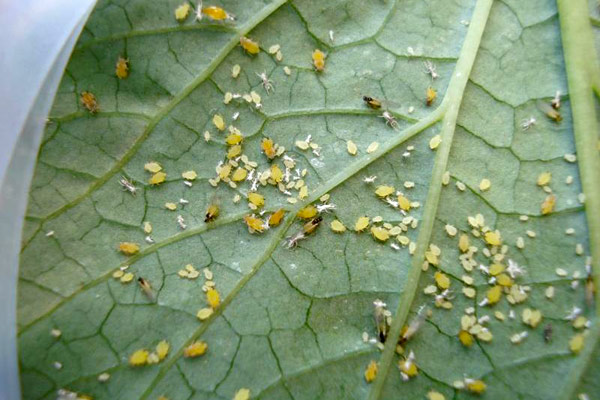
Among cucurbit crops it attacks very severely cucumbers, watermelons, melons and pumpkins. Damage is caused by adults and larvae, which suck sap from the lower leaf surface, the growing point and the stems of the plants. Under heavy infestation the leaves curl strongly. The plants lag in their development and become deformed. When infestation occurs during flowering or fruit set, the flowers drop and the fruits remain underdeveloped. On the “honeydew” secreted by the aphids, saprophytic sooty mould fungi develop, which contaminate the production and interfere with normal photosynthesis. The cotton aphid is a vector (carrier) of viral diseases.
Thrips
On species from the family Cucurbitaceae tobacco thrips (Thrips tabaci Lind.) and western flower thrips (Frankliniella occidentalis Perg.) occur. Thrips develop 8–10 generations per year. They overwinter as adults and last-instar nymphs in plant residues, and in greenhouses they develop throughout the year. Damage is caused by adults and larvae, which suck sap from the leaves and the growing point of the plants. The nymphal stage takes place in the soil. On the attacked organs, small whitish spots with black dots are formed, which represent the pest’s excrement. At higher population density the spots merge and the leaves dry out. Attacked plants at seedling stage may dry up and die.
Leaf-miner flies
In cucumbers, the tomato leaf-miner fly (Liriomyza bryoniae Kalt.) and the South American leaf-miner fly (Liriomyza huidobrensis Blanch.) are found. They develop 5–6 generations per year. They overwinter as pupae in the soil. Under greenhouse conditions these pests develop throughout the year. The females, with the help of the ovipositor, pierce the upper epidermis of the leaves and lay eggs. The punctures made by the females are dot-shaped, white, later turning brown. The main damage is caused by the larvae. They feed on the parenchyma and form serpentine mines on the leaves. Only one larva is found in each mine. Under heavy infestation 10 or more mines can be counted on a single leaf. They destroy the chlorophyll, thereby reducing the photosynthetic capacity of the leaves. Under severe infestation the mines may cover the entire leaf blade and the damaged leaves dry out.
Golden twin-spot moth (Chrysodeixis chalcites Esper)
It occurs during the spring–summer period in cucumber cultivation in protected structures. Under greenhouse conditions and in the presence of food, the pest develops continuously. Initially the caterpillars skeletonize the leaves. As a result of the damage, openings of irregular shape are observed. Later the caterpillars completely consume the leaves, leaving only part of the veins. On cucumber fruits the caterpillars cause superficial feeding damage. The damaged fruits have no market value.
Two-spotted spider mite (Tetranychus urticae Koch)
It lives and feeds on the lower side of the leaf. It forms a web, which under heavy infestation can completely cover the leaves and envelop the flowers, fruits and shoots of the attacked plants. Spider mites cause damage by piercing the epidermis of the leaves and tender stems and sucking out part of the cell sap with the chlorophyll grains. At the puncture sites, small light dot-shaped spots appear, which gradually increase in number and the leaves acquire a mottled appearance. Later the spots turn brown, merge and cover the entire leaf. The spider mite prefers older leaves with reduced water content and senescent, drought-stressed plants. Under heavy infestation the plants dry out. They also damage the fruits, deteriorating the commercial appearance of the production.
Root-knot nematodes (Meloidogyne sрp.)
They damage the root system of the plants, resulting in the formation of galls. During feeding of the larvae in the host cells, changes occur – hypertrophy, disappearance of cell membranes, formation of giant cells and galls. The galls are irregular in shape and of varying size. Initially they are white, but later they darken and become loose. The damaged root system does not function normally, the plants suffer from water deficiency, wilt and die. Attacked young plants lag in growth. In cucumbers, the leaves become slightly curled and their surface becomes uneven.
Plant protection measures:
- Cultivation of healthy and pest-free seedlings;
- Cultivation of resistant varieties;
- Seed disinfection;
- Use of grafted plants on resistant rootstocks to limit attacks by soil-borne pathogens and root-knot nematodes;
- Crop rotation;
- Regular soil tillage;
- Placement of yellow sticky traps to monitor the flight of adults of the greenhouse whitefly;
- Use of blue sticky traps in greenhouses for timely detection of thrips;
- Regular field monitoring;
- Maintaining optimal soil moisture (avoiding drought);
- Destruction of weed vegetation;
- After harvest, destruction of plant residues.
The control system – the exact timing of treatments and the plant protection products authorised for use can be found in issue 5/2018 of the journal “Plant Protection”.