

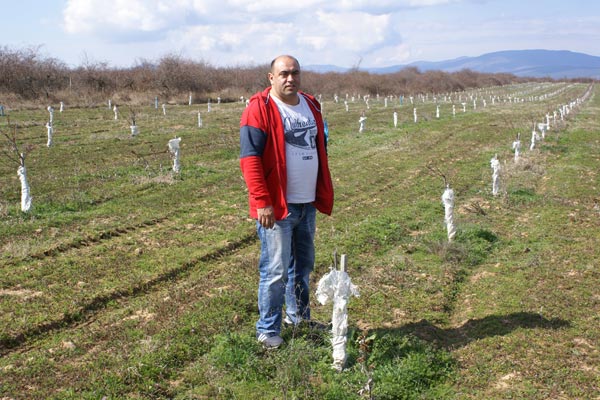
Conversation with Dimo Dimov, farmer from the town of Sungurlare, Burgas region
- Mr. Dimov, today you are part of the agricultural community in Sungurlare, with a solid business and authority, an example of a person who has succeeded thanks to his own hands, sound decisions and measured risk. Such a person attracts journalistic curiosity. With my first question I would like to take you back to the beginning of your start in agriculture, more precisely in viticulture.
The decision to take up agriculture, for me personally, was not difficult at all. Back in the distant 1994 I received a fateful sign – my grandfather’s vineyards of 17 decares became my property and my wife supported me to try to make a new beginning in our lives. I did not hesitate, I quickly gave up milling! The dormant feeling of love for the land in me restarted, awoke, gathered momentum... There are millions of people with innate abilities, but if you do not learn to master your capabilities and do not devote yourself to them, there is no way to reach your full potential. I seem to have turned to philosophy, do you not think?
- What did this accumulated energy “produce”, this categorical choice and desire to prove to yourself that the enthusiasm and euphoria are not a temporary state that will burn out tomorrow? It is no joke for a 23‑year‑old young man to jump in at the deep end... with all the risks of never resurfacing.
I went through everything you are saying, I gritted my teeth, I fell, I got up, but I continued without looking back, step by step... forward against the challenges of our contradictory reality.
I am currently managing vineyards of 300 decares, of which I own 60 decares. Sungurlare is one of Bulgaria’s emblematic vine‑growing regions and there are no random vine‑growers here; I set myself the ambitious goal to be one of them. In the neighbouring village of Lozarevo I leased cherry orchards of 50 decares. These orchards are at a critical age – about 50 years. The owners restored part of them, and now I continue “out of sheer stubbornness” to grow cherries on 20 decares.
My great pride is my new cherry orchard of 13 decares and the young “grove” of blue plums, Stanley variety, of 11 decares in the village of Grozden. My investment project is developing; I continue to upgrade and modernise my farm.
- Fruit growing is a disadvantaged subsector. The flawed management model, the cutting of subsidies and a whole host of additional administrative errors and ill‑conceived measures have led to a drastic decline in fruit production in our country; it is being seriously said that our fruit growing has already become a museum exhibit....
My personal opinion differs from the pessimism in what you have said. In the 2014‑2020 programming period, the state policy regarding subsidies in fruit growing changed in a positive direction. A criterion for fruit quality was introduced and this decision brought substantial economic benefits for Bulgarian fruit growers. In this context I would also add the option for free autumn‑winter pesticide applications, which is a major cost item. In short: we, the fruit growers in Bulgaria, are no longer orphans. Financial support is a sufficiently strong motivator; it defines interest in this key subsector for our country. It is another matter that fruit growing and viticulture require time for recovery – in the best‑case scenario, fruiting starts 3‑4 years after planting a new orchard or a new vineyard.
- Do you believe that state policy has fully fulfilled its mission and obligations and that there is nothing more it can do?
The state continues to be indebted to agriculture and in particular to fruit growing and viticulture. What do I mean? Whose obligation, if not the state’s, is the effective and real protection of agricultural production and property? Market regulation must also be part of the state policy in agriculture. If you ask me, I have secured a market for my cherries and plums – they are purchased by an Italian trader, and the grapes – by the wine cellar in Karnobat. But this is purely a matter of personal initiative and luck, and not a widespread practice. The state is absent; it is precisely the state that should apply its economic mechanisms to secure markets, to combat monopolies and the “games” in purchasing...
The state will only benefit if it abolishes the tax on subsidies; this is an anachronism, a major misunderstanding. What kind of whim is it to plug gaps in the budget with exactly these “meagre” pennies? And another thing. The competent state institutions must necessarily strengthen control over the production and import of planting material.
- Can Dimo Dimov manage the risks in his very specific type of production on his own?
Fruit growing and viticulture are highly sensitive types of production from the point of view of plant protection and nutrition. Without expertise and competences in this seismically unstable environment you are doomed to failure.
- Who is your assistant?
Sustainable growth in fruit growing and viticulture is unthinkable without high‑class agrochemicals. Our market is crammed with all kinds of products, advertising is aggressive. The right choice is more than necessary, but it is very difficult and the risk of throwing your investment to the wind is real. In this complex situation more than anything you need an assistant, a consultant, an adviser, a supplier.
Twenty‑four years ago I made my choice – Viola AE in Sliven! The loyalty and competences of the company’s specialists are beyond any doubt. They take responsibility for every word, proposal and action. Contact with each member of this highly professional team gives me personal satisfaction.
- What would make you happiest?
To be part of our new, profitable, competitive and prosperous agriculture. We have set off in this direction and we will succeed, regardless of the short‑sightedness and lack of foresight of some of our administrators and politicians.
In my humble opinion, agriculture is the most solid business in Bulgaria!
Profile: Dimo Dimov was born in 1971 in the town of Sungurlare. He is married and has two daughters. By education he is a mechanical technician.
--------------------------------------------------------------
As we have already informed you, in four consecutive issues of the journal “Plant Protection” we will publish interviews with agricultural producers, clients of Viola AE, the trading company for pesticides, fertilisers and seeds based in Sliven. In issue 3‑2018 of the journal Plant Protection we published the conversation with Nedelcho Popov, chairman of the agricultural cooperative “Tundzha 94” in the village of Panicherevo, Stara Zagora region. In issue 4 we published the interview with Hristo Stoynov, vine‑grower and licensed wine producer from the village of Lozenets. Expect in issue 5‑2018 the interview with Dimo Dimov, farmer from the town of Sungurlare, Burgas region.
These materials are not of an advertising nature. The aim is to show what people think about their work in the field, the people who are part of the agricultural community of Bulgaria.