

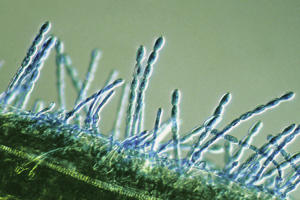
Powdery mildew is one of the most widespread diseases affecting cultivated plants. Its economic importance is continuously increasing. It attacks almost all plant species – cereals, vegetables, fruit trees, vines, ornamental, and forest trees. Compared to other diseases, it is the most easily identified. The causal agents of powdery mildew are over 200 fungal species belonging to 11 genera. They also have over 700 specialized forms. The hosts for these pathogens are over 7,000 cultivated and wild plant species.
The causal agents of powdery mildew on cultivated plants mainly belong to the genera Oidium, Erysiphe, Sphaerotheca, Leveillula, Podosphaera, Uncinula, etc. Despite the diversity of causal agents, the symptoms on plants are similar. These are chlorotic spots covered with abundant powdery coating, from which the disease gets its name. Later, the spots enlarge, merge, and cover the entire leaf. They are most commonly observed on the upper leaf surface, sometimes on the lower, as well as on young stems, flower buds, and young fruits.
Infected leaves often become deformed, scorch, and fall prematurely. Severe infection impairs photosynthesis. Yields are significantly reduced. Annual losses vary in the range of 20–40%. Due to the epiphytotic development of powdery mildew on vines in Europe during the period 1850–1854, wine production in France decreased by over 75%. For the powdery mildew-susceptible apple variety Jonathan, the damage coefficient can reach up to 97%. The most economically significant for Bulgaria are powdery mildew on cereals, vegetables, fruit crops, and tobacco.
The pathogen develops under high temperatures and low relative air humidity. The fungus does not require the presence of water on the leaf surface to cause infection. However, high atmospheric humidity is needed for spore germination, but infection can occur even below 50%. Therefore, the disease is often found in dense plantings with low light intensity, where air circulation is poor. The causal agents of powdery mildew are characterized by host specificity – they cannot survive without the correct host. Fungal spores are dispersed by air currents. Warm days and cool nights in late summer create an ideal environment for spore growth and spread. Besides temperature and relative air humidity, many other factors influence the development of powdery mildew. Excessive unbalanced nitrogen fertilization, dense crops, and cultivation of susceptible varieties are prerequisites for severe disease development. It has been established that the causal agents of powdery mildews are highly variable and plastic. They develop equally well in cool and wet weather, as well as in hot and dry conditions. Dry conditions are favorable for colonization, sporulation, and dispersal of the pathogen's spores. Rain and water droplets on the leaf surface are unfavorable. Disease development is observed both with plant irrigation and in its absence. The fungi overwinter as cleistothecia or mycelium in plant debris.
Control of powdery mildews is based on a set of control measures:
- Resistant varieties. Worldwide, intensive work is being done on developing powdery mildew-resistant varieties. This is the most radical method of disease control in general. For apples, resistant and less susceptible varieties have already been created – Prima, Melrose, Stayman, Red Gold, Stark Delicious, Rumyana, etc. In practice, wheat varieties resistant to powdery mildew are also widespread – Enola, Aglika, Yantar, Vratsa, etc. The long-fruited cucumbers created in recent years for greenhouse cultivation are also resistant to powdery mildew – Kalunga, Lukshur, Hudson, Almeria, Dante, etc. For tobacco, peaches, and peppers, resistant varieties have also been developed.
- Prevention. Limiting the spread of infection from one season to another through: introducing suitable crop rotations; winter spraying of fruit trees; severe pruning of vines and fruit trees; destruction of volunteer plants in cereals. Agronomic measures: sowing and planting on time and in well-ventilated areas; regular soil tillage; optimal timing, seeding rates, and planting density; regular soil tillage; optimal irrigation regime; balanced fertilization; removal of infected plant parts; cleaning of plant debris at the end of the growing season.
- Chemical control. A large range of plant protection products (PPPs) are registered in the country. Besides chemical ones, botanical fungicides are also registered, providing good protection. Depending on their active substance and mode of action (contact, systemic), PPPs should be rotated. The same product should not be used more than 2–3 times per season.