

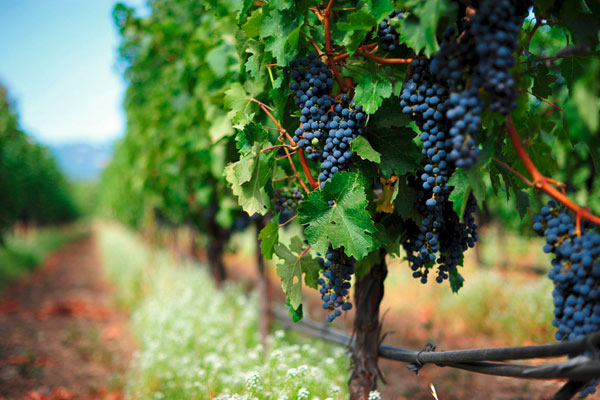
The grapevine has been cultivated on our lands for more than 3,000 years, and later it was introduced into France and Spain. Bulgarians inherited from the Thracians the traditions of its cultivation and wine production. From the end of the 19th and the beginning of the 20th century, viticulture in Bulgaria has gone through various stages of development: cyclical increase and decrease of the vineyard area; significant changes in varietal composition, agrotechnics, pests, plant protection products, methods and control strategies, but it has always been preserved as a livelihood for the population in many regions of the country.
In 1858 vineyard area amounted to 420,000 decares, and in 1897 – 1,200,000 decares. Local and oriental grapevine varieties are grown – Mavrud, Pamid, Dimiat, Red Misket, Gamza, Broad-leaved Melnik Vine, Bolgar, Chausch, Rezekia and others, with goblet pruning, narrow row spacing and many vines per decare. The species composition and population density of pests are limited. Downy mildew was established in 1895, and other major diseases and the most dangerous pests – later. Grapevine phylloxera (established in the Vidin region in 1884 by the teacher Nikola Nedyalkov) destroyed about 2/3 of the vineyards – only 434,000 decares remained, planted on sandy soils.
From the end of the First World War until 1944, viticulture was restored and the area planted with vines reached 1,527,000 decares. Table and wine grape varieties are grown, in narrow rows, mainly on trellis systems and with many vines per decare. During this period many pests appeared and caused damage – grape moths, European grapevine moth, vine scale (from the end of the 19th and the beginning of the 20th century), grape leafroller (1936), powdery mildew (1900), bacterial canker (1902), black rot (1904), esca (black measles) (1909), grey mould (of economic importance after 1916) and others. Against grape moths, Paris green and lead arsenate were applied; against grapevine mite – lime-sulphur solution; against downy mildew – Bordeaux mixture; against powdery mildew – sulphur, lime-sulphur solution and potassium permanganate, and against grey mould – agrotechnical measures due to lack of products. During this period some viral diseases also appeared (yellows, mosaic, leafroll and some others – Kovachevski Iv. et al., 1948).
In vineyards there is a relative biological balance between pests and their biological agents. From the mid-1950s, a new stage began in the development of viticulture and the occurrence of pests. New high-quality wine and some table grape varieties were introduced – Cabernet Sauvignon, Merlot, Sauvignon Blanc, Chardonnay, Aligoté, Muscat Ottonel, Riesling, Rkatsiteli, Alicante Bouschet and others, and Bulgarian table grape varieties were bred – Super Early Bolgar, Brestovitsa, Pleven, Danube and others, as well as many seedless varieties. Vines are grown in wide rows, with 200–280 vines/da, on wire trellis, with long pruning systems and with minimal soil tillage. Vineyards are organized in large blocks of heterogeneous varieties and by the mid-1980s they reach about 1,700,000 decares. Synthetic products are applied against pests, many of which have a broad-spectrum toxic effect, mainly up to 1969–1970. The biological balance between them and entomophagous and acariphagous species is disturbed in favour of the latter, which necessitated constant multiple applications of plant protection products until the early 1980s. After this period, integrated plant protection in viticulture began to be implemented, which contributed to a significant reduction in the use of plant protection products and to the establishment of a relative biological balance between pests and various biological agents.
In the 1980s and later, in certain varieties, new and little-known diseases for that time appeared – esca, eutypa dieback, excoriose and others, as well as a number of viral diseases transmitted by nematodes of the genera Xiphinema and Longitarsus, by various species of leafhoppers and other vectors, and some phytoplasma diseases.
Vineyard area gradually decreased for various reasons and by the end of the 20th century it amounted to 1,139.94 thousand decares. After this period, a new development of viticulture in Bulgaria began. Vineyards were established with high-quality clonal material of Cabernet Sauvignon, Merlot, Sauvignon Blanc, Cabernet Franc, Pinot Gris, Syrah, Gamay Noir, Traminer Rosé, Muscat Ottonel, Riesling and with table grape varieties introduced and bred in Bulgaria; vines are grown on wire trellis, with wooden stakes, with small inter-row spacing and 400–600 vines/da. A large number of small wineries producing high-quality wines have been built.
In 2015 the vineyard area in Bulgaria was 628,000 decares, of which 365,000 decares of wine grape varieties and 225,000 decares of table grape varieties were harvested. A total of 2,424,055.6 kg of wine grapes (average yield 670.2 kg/da) and 19,219,960 kg of table grapes were produced – average yield 724 kg/da. The area under organic grape production is gradually expanding.
The grapevine is affected by more than 40 types of non-infectious and infectious diseases and over 100 species of insects, mites, nematodes and other pests. The current diseases are: downy mildew, powdery mildew, grey mould, bacterial canker, esca (black measles), anthracnose; diseases damaging shoots and woody tissues, as well as viral diseases with nematode vectors of the genera Xiphinema and Longitarsus. In recent years, phytoplasma diseases have also appeared. Almost all these diseases are included in the list of the Ministry of Agriculture and Food for monitoring and for conducting chemical control.
When establishing new vineyards, it is mandatory to study the nematode status of soils and, in the presence of vectors, to undertake the necessary agrotechnical measures before planting the vines. In the case of bacterial canker, attention is paid to varieties sensitive to low temperatures, which below minus 14–15 °C create conditions for mass infection by the bacterium. Among the pests, the tetranychid mites deserve attention for the varieties preferred by them (mainly wine varieties with thick palisade parenchyma), grapevine blister mite – for vine nurseries; grape moths for varieties with yellow-green berry skin and muscat flavour; pests damaging swelling and swollen winter buds of the vine (European grapevine moth, cutworms, beetles) and mainly the little-known grape thrips causing bud desiccation; pests damaging underground parts of vines in nurseries and in vines planted in permanent sites up to 3–4 years after planting, and others.
Soil tillage and operations on the green parts of the plants – shoot thinning, removal of lateral shoots, topping and canopy thinning – play an important role in pest control. Chemical products are applied in accordance with Good Plant Protection Practice (GPPP), the basic principles of integrated plant protection and the requirements of integrated pest management.