

Early leaf blotch in wheat (ELB), also known as spring leaf blotch or septoria leaf blotch (Septoria leaf blotch), is a key disease in a number of regions worldwide with cool and humid conditions during the period from emergence to flowering. The disease occurs in both common bread wheat and durum wheat. Under epiphytotic development of the disease, yield losses may reach up to 50%. In recent years, ELB has ranked among the most harmful diseases in Bulgaria, together with yellow rust, brown rust and powdery mildew. The reasons for this are the conditions favourable for its development, the susceptibility of the cultivars, violations of crop rotation and cultivation technology, as well as untimely treatment with fungicides.
Early sowing, which has been a frequently observed practice in recent years, creates conditions for heavy infection of the crops already in autumn, especially under conditions favourable for the development of the disease. Increasing the seeding rate leads to higher crop density and consequently to longer retention of moisture in the stands. High nitrogen fertiliser rates, as well as the use of highly susceptible cultivars, are other factors that have a positive effect on the development and spread of ELB.
Symptoms of the disease
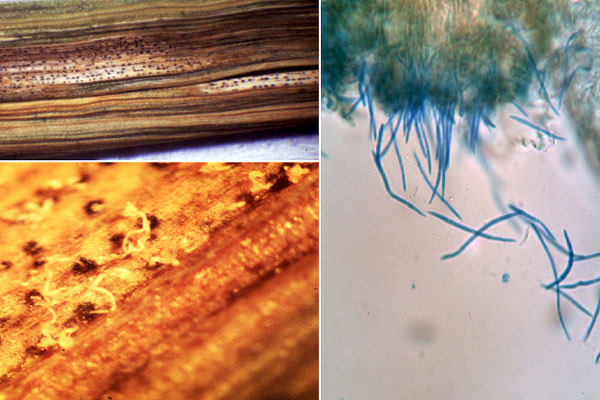
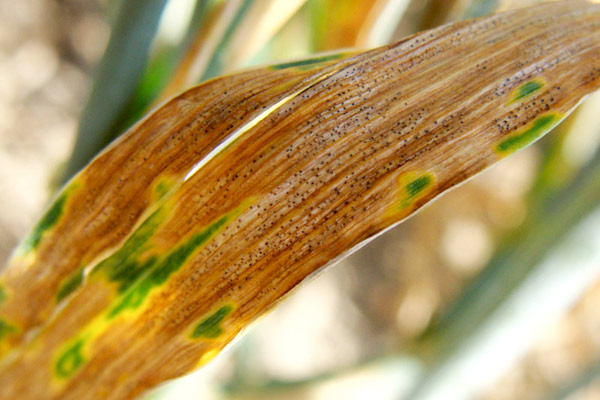
The first symptoms of the disease can be observed shortly after emergence in the form of small chlorotic streaks on the leaves, located between the veins. Gradually, the spots enlarge and acquire a pale grey to brown colour, and the tissues within them scorch. Shortly after their enlargement, numerous dark brown to black, round structures (pycnidia) appear in the spots on both sides of the leaf, which are a characteristic symptom of ELB. The spots on developed leaves are most often elongated, with an irregular to elliptical shape, limited by the leaf venation and scattered with numerous pycnidia. Severely affected leaves scorch. Although less frequently, ELB symptoms may also be observed on the stem and glumes.
Causal agent
The causal agent of ELB is the hemibiotrophic (latently necrotrophic), heterothallic, ascomycete fungus Zymoseptoria tritici (= Mycosphaerella graminicola, anamorph Septoria tritici). The fungus develops several morphological structures: single cells, known as yeast-like cells, multicellular hyphae, spores resulting from sexual and asexual processes. On artificial nutrient media, the fungus usually exhibits yeast-like (unicellular) growth.
In the host, the pathogen develops a multicellular mycelium. The spores (pycnidiospores), resulting from the asexual development of the fungus, are filamentous, colourless, with 3–7 septa, formed in fruiting bodies called pycnidia.
Disease cycle
The fungus Z. tritici survives under unfavourable conditions in the form of pseudothecia and/or pycnidia on plant residues, winter crops, volunteer wheat or some gramineous grasses. Numerous studies confirm the primary role of ascospores as a source of primary infection. Light is one of the factors determining the viability of ascospores. In the absence of light they retain their viability for 1–2 weeks, whereas in its presence they lose viability within 2 days. The released ascospores are carried by air currents over long distances. In general, pycnidiospores ensure the spread of the pathogen during the vegetation period, but at the same time they can serve as primary inoculum. At temperatures of 15–30°C and when plant residues are located on the soil surface, pycnidiospores retain their viability for up to 9 months, but when buried at a depth of 5–7 cm they lose viability within one month.
Once on the leaves, the spores (ascospores and pycnidiospores) germinate within a temperature range of 0–25°C, with optimum temperatures of 15–20°C. For germination, the presence of free water or relative humidity above 85% for more than 30 min/hour or precipitation above 0.2 mm is required. Rainfall above 1 mm for 4 days creates favourable conditions for infection. Under these conditions, the spores germinate within up to 24 hours with an infection hypha that orients itself towards the leaf stomata.
The infection hypha penetrates through the stomata into the substomatal cavity and colonises the intercellular space (apoplast) of the mesophyll. Depending on the climatic conditions, the degree of host resistance and the aggressiveness of the isolates, the pathogen develops latently (hidden phase, the period from penetration into the tissues to the formation of pycnidia) in the apoplast for a period of 6 to 36 days (on average 9–15 days), during which the affected tissues do not show symptoms of infection.
Usually, 3 to 11 days after infection, the fungus begins to form pycnidia in the substomatal cavities, which coincides with the appearance of chlorotic streaks on the affected tissues. The formation of pycnidia is associated with a transition from a biotrophic to a necrotrophic feeding mechanism of the pathogen. This in turn leads to the appearance of the typical symptoms of the disease. In the presence of moisture, the pycnidia release pycnidiospores in the form of a whitish thread, after which they are dispersed by rainwater and cause the secondary and subsequent infections. Depending on the climatic conditions and the time of infection, pseudothecia are formed 65 to 95 days after the appearance of pycnidia in the affected tissues.
Control measures against spring leaf blotch
Disease control must comply with the principles of Good Plant Protection Practice, i.e. combining chemical methods with agrotechnical and organisational–economic measures and approaches.
The organisational–economic and agrotechnical measures include:
- Use of resistant cultivars. Unfortunately, the Bulgarian wheat cultivars registered in our country possess a low level of resistance. Cultivars with relatively good resistance to the disease are Dragana, Merili, Pchelina, Kalina and Kiara;
- Observance of a 3–4-year crop rotation with crops that are not attacked by the pathogen;
- Deep ploughing in of post-harvest residues in the shortest possible time;
- Sowing within the optimum time for the respective region. Early sowing in combination with a wet and prolonged autumn increases the risk of infection;
- Observance of the recommended seeding rate for the given cultivar. Dense crops retain moisture for a prolonged period;
- Balanced fertilisation. High nitrogen fertiliser rates make plants more susceptible to infection;
- Timely control of early spring weeds. Weed infestation of the crop increases humidity.
Chemical means
It is a well-known fact that the flag leaf and the ear contribute to the formation of about 65% of the yield. The share of the penultimate leaf (leaf 2) is about 20%. This is the reason why prevention against foliar pathogens in wheat, including ELB, is aimed at keeping these organs free from diseases. For the conditions in Bulgaria, the critical growth stages of wheat with regard to ELB are stem elongation – second node (GS30–GS32) and flag leaf emergence (GS39–GS45). Preventive treatment of the crops at GS31–GS32 (first–second node) and GS39 (appearance of the ligule of the flag leaf) provides up to 60% protection of the penultimate leaf and up to 80% of the flag leaf under climatic conditions favouring epiphytotic development of the pathogen. It is important to note that the economic threshold of harmfulness adopted in our country is 5% leaf area affected. At present, a sufficient number of fungicides are authorised for use in our country. Their application, however, must be consistent with their mode of action in order to prevent the development of resistance in pathogen populations. The consecutive application of fungicides with a similar mode of action is a prerequisite for the emergence of resistant forms and hence for a reduction in their efficacy. Another important requirement is that the fungicides used should be applied at the registered doses.
Authorised plant protection products
Aviator Xpro 225 EC – 80–125 ml/da, Acanto 250 SC – 60 ml/da, Artea 330 EC – 50 ml/da, Duet Ultra – 60 ml/da, Credo 600 SC – 150 ml/da, Mirador Forte 160 EC – 125 ml/da, Osiris – 200–300 ml/da, Sfera Max SC – 30–50 ml/da, Tango Super – 80 ml/da