

The Central Plant Quarantine Laboratory announces:
Xylella fastidiosa Wells, Raju, Hung, Weisburg, Parl & Beemer is the causal agent of a large number of plant diseases, such as Pierce’s disease of grapevine, alfalfa dwarf, almond leaf scorch, citrus variegated chlorosis, olive quick decline syndrome, scorch of beech, oak, maple, oleander, coffee, etc. Although the bacterium is known as “thermophilic”, its six strains, four of which are present in Europe, together with the large number of host plants and vectors, increase the risk of its rapid introduction and occupation of new territories, including in countries with a colder climate.
Due to its great economic importance worldwide, the bacterium has the status of a quarantine pest. For Bulgaria it is included in Ordinance No. 8 of 27.02.2015 on phytosanitary control, Annex No. 1, Part A, Chapter II, as a pest for which there is evidence that it occurs in the European Union and is important for it.
In August 2015, France reported Xylella fastidiosa subsp. multiplex on Polygala myrtifolia on the island of Corsica, and by the end of the same year the range of hosts expanded and included the species – Spartium juncerum, Artemisia arborescens, Asparagus acutifolius, Coronilla valentina, Lavandula angustifolia, Rosa floribunda.
In 2016 in Spain, Xylella fastidiosa was detected on sweet cherry (Prunus avium) in the Balearic Islands, and later – on Olea europea, Nerium oleander, Polygala myrtifolia, Citrus sp., Lavandula angustifolia, L. dentata, Acacia saligna, Rosmarinus, Prunus dulcis, P. domestica, Vitis sp.
In Germany in the same year Xylella fastidiosa was detected on single oleander plants, and in March 2017 in the Czech Republic – on Polygala myrtifolia, in Switzerland, France, the Netherlands and Austria – on ornamental coffee plants imported from South America. All infected plants were destroyed.
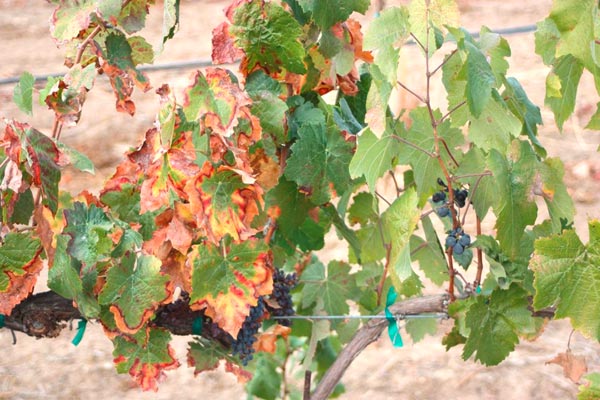
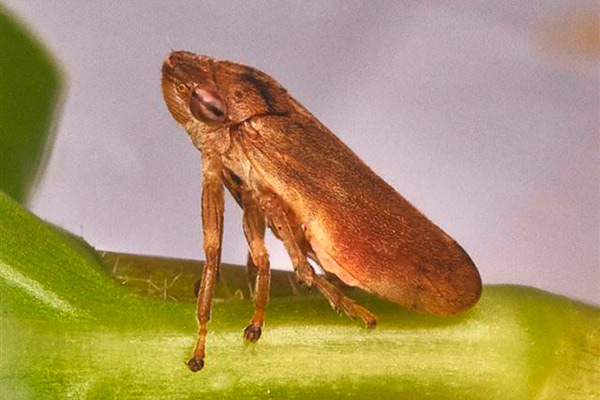
The bacterium is abundant in the xylem of plants and is transmitted by insect vectors – leafhoppers from the family Cicadellinae and the family Cercopidae: Homalodisca coagulata, H. insolita, Oncometopia orbona, Graphocephala versuta and Cuerna costalis. For Europe it has been established that the main vectors are Philaenus spumarius and Cicadella viridis (green leafhopper). Both species occur in Bulgaria. The bacterium attacks species of the genus Prunus – peach, almond, cherry, plum and others. Young shoots are underdeveloped, shortened and darker green. Leaves and flowers appear earlier and remain on the tree longer than those of healthy trees, with the foliage being denser and darker in colour. In June, scorch appears on the leaf margins, which in a short time covers the entire lamina (marginal necrosis). The tree crowns are flattened, compact, umbrella-shaped. Affected trees produce fewer and smaller fruits. Usually after several years (about 3–5) fruiting is reduced by 80–90%.In spring, diseased grapevines show suppressed growth. The plants are stunted and leaf deformations are observed. The development of such plants starts later. During the vegetation period, scorch appears on the leaf margins, which in a short time covers the entire lamina (this symptom is observed from the month of June). The leaves dry up and fall off, while the petioles remain hanging on the shoots. In cases of weaker infection, depending on the grape variety, the tissues around the scorched spots turn yellow or red. The shoots do not ripen or ripen unevenly; when the wood is cut, yellow to brown lines are visible. In the vascular system, plugs of resin-like substances are formed, which cause blockage and the plants wilt. The clusters become spotted and blackened. Depending on the varieties, climatic conditions, evolution of the population of insect vectors, and the presence of host plants, wilting and dieback may occur rapidly in young vines and within three or four years in older ones.Symptoms on ornamental plants are similar in various woody species such as Acer spp., Cornus florida, Celtis occidentalis, Liquidambar stryraciflua, Morus alba, Platanus spp., Quercus spp., Ulmus americana and others. In most cases the disease is identified by characteristic leaf distortion, marginal necrosis with a clearly expressed chlorotic (yellow or red) halo. Usually, symptoms develop from older to younger leaves, with individual branches dying, followed by entire trees. These symptoms are most characteristic at the end of summer and the beginning of autumn. Due to the economic importance of the pest and its established presence in Italy, with a view to clarifying the situation on the territory of the European Union, on 13 February 2014 the European Commission issued Implementing Decision C(2014) 726 final on measures to prevent the spread of Xylella fastidiosa (Well et Raju) in the Union, under which the Member States are obliged to survey and report on the situation regarding the pest on the territory of their countries.
In implementation of the Decisions of the European Commission of 2014 and 2015, the following quarantine measures have been undertaken in Italy:
- Establishment of demarcated zones (including an infected zone + a buffer zone with a width of at least 10 km).
- Destruction of infected plants.
- Destruction of host plants posing a risk of infection in the surrounding zone with a width of 100 m around the infected area, along roads, canals, green areas, etc.
- Control of vectors on weeds and wild plants.
- Insecticidal treatments against adult insect vectors.
- Raising public awareness of the population about the threat posed by the said pest and about the measures adopted to prevent its introduction and spread in the country.
In Bulgaria, surveys for the quarantine pest have been carried out since 2002 on grapevine – in grapevine mother plantations, plantations with imported and local planting material, and since 2014 also on other host plants. Surveys are conducted throughout the country at the respective observation points (fruit, ornamental and forest nurseries, greenhouses, gardens, garden centres, parks, public green areas and commercial sites of host plants originating from third countries and other EU Member States, with particular attention paid to those originating from Italy, France and Spain.
Since the beginning of the implementation of the Monitoring Programme to date, no infection with Xylella fastidiosa has been detected on the territory of the country.
When symptoms are observed by producers and traders of planting material, it is important to notify immediately the plant protection departments of the Regional Food Safety Directorates, which will allow the rapid implementation of appropriate measures against the disease.