

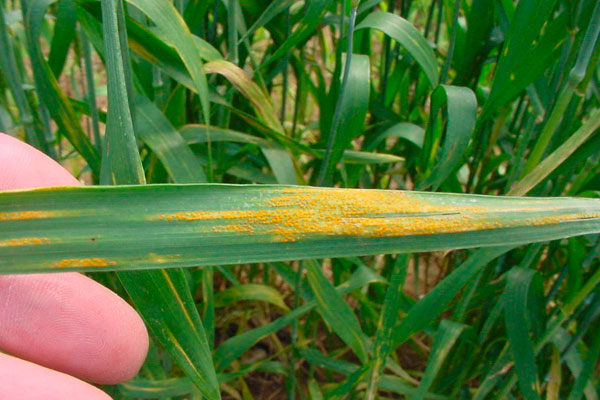
Until 2014, yellow rust had a sporadic character in our country, with its development usually observed along the Black Sea coast. The reason for this is its late manifestation during vegetation, coinciding with rising temperatures, which consequently stopped its development. Unfortunately, over the past few years the climatic conditions have favoured its early appearance, and hence the risk of epiphytotic development of the disease.
The first symptoms of yellow rust on the leaves are narrow, long, yellowish streaks between the veins. Very soon, small yellow sori (pustules) appear on them, arranged in rows like machine stitching. Uredinia are formed under the epidermis and remain covered by it for a longer time compared to the other rusts on wheat. Depending on the degree of resistance of the varieties and the climatic conditions, different levels of chlorosis or necrosis are observed.
Control
Organizational, managerial and agrotechnical measures limiting the development and spread of yellow rust include:
- Use of resistant varieties. The resistance of varieties to yellow rust is relative and is related to the race-specific genes included in the respective varieties, as well as to the racial (virulence) diversity in the pathogen population. Among the varieties bred by the Dobrudzha Agricultural Institute, the variety Dragana has good resistance;
- Balanced fertilization. One-sided fertilization with high nitrogen fertilizer rates creates conditions for crop thickening, and hence longer retention of moisture;
- Observance of the recommended seeding rate for the respective variety.
Chemical control measures
The critical growth stages for the development of yellow rust are from first–second node (GS31-32) to flowering (GS60) of wheat, upon the appearance of the first symptoms. The main objective of preventive treatment in wheat is related to protecting the flag leaf and the penultimate leaf of the plant, as well as the possibility of infection of the spikelets. Most of the fungicides authorised for use belong to the triazole and strobilurin groups, which are risky with regard to the development of resistance in the fungal population during prolonged use.
In the special supplement “Dangerous pathogens in agricultural crops” of issue 3 of the journal “Plant Protection” you can read detailed information about yellow rust in wheat and its chemical control.