

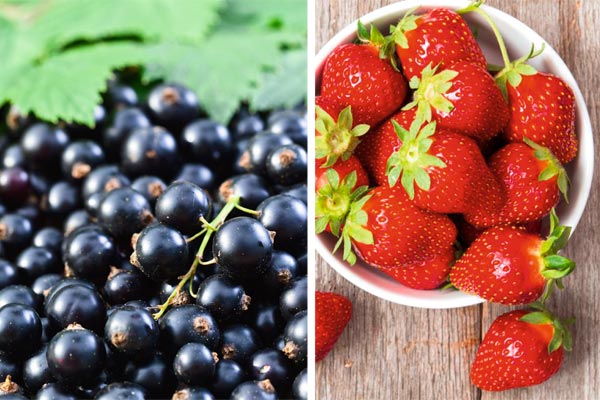
Production of Berry Fruits in the World
Berry crops occupy an important part of the permanent fruit plantations. The total world production of their fruits in 2016 was 11,295,129 t, and the area under cultivation was about 771,636 ha.
The strawberry is the main crop, accounting for 81% of the structure of berry crops. World strawberry fruit production has been continuously increasing – from 8,149,667 t (2014) to 9,118,336 t (2016).
Data by continent for 2016 show that Asia is the leader (4,683,396 t), outstripping Europe by about three times. In third place is North America with 1,442,431 t, of which 1,420,570 t of strawberries are produced in the USA. There is a trend towards an increase in strawberry production in Africa as well (441,980 t /2014 – 620,582 t /2016).
Europe accounts for about 18% of the world production of strawberry fruits. During the period 2014–2016, annual production in European countries increased from 1,614,360 t to 1,670,485 t. The largest producers are Spain (366,161 t), Russia (197,523 t), Poland (196,972 t) and Germany (143,221 t). Although Italy is a traditional strawberry producer, it ranks fifth with a production of 131,436 t.
Asia accounts for 51% of world strawberry production. The main producers are China (3,793,864 t), Turkey (415,150 t), Korea (196,122 t) and Japan (159,000 t).
In North America, strawberry fruit production is about 15%. The largest producer is the USA (1,420,570 t), followed by Mexico (468,248 t) and Canada (21,858 t). It is least represented in South America, where it accounts for 1.78% of world production. The main producers in Africa are Egypt and Morocco, with production of 464,958 t and 136,856 t respectively.
Average strawberry yields worldwide show a slight annual increase. In 2014 they were 2,178 kg/da, and in 2016 – 2,269 kg/da.
As of 2016, the largest areas under strawberry plantations are in China (141,024 ha), followed by Poland (50,600 ha) and Russia (29,520 ha).
World production of raspberry fruits shows a tendency to increase even more rapidly than that of strawberries. On average, during 2014–2016, 624,166 t were produced annually, grown on 93,103 ha with average yields of 670 kg/da, and in 2016 – 795,249 t of fruits, on 106,631 ha with average yields of 746 kg/da (Fig. 2).
The largest producer of raspberries in the world is Europe (62%), and more specifically Eastern Europe, where 336,881 t of raspberry fruits were produced during 2014–2016. The main producers are Russia (164,602 t), Poland (129,063 t), Serbia (61,875 t) and Ukraine (30,600 t). The largest areas under raspberry plantations are in Poland (29,282 ha), Russia (21,025 ha) and Serbia (11,041 ha).
North America concentrates 18% of world raspberry fruit production. The largest quantities are produced by the USA (137,829 t), Mexico (112,661 t) and Canada (10,792 t).
The highest average yields have been reported in the USA (1,572 kg/da), Russia (782 kg/da) and Ukraine – 693 kg/da.
The main crop in the group of currants is blackcurrant. Its production is concentrated in Europe and accounts for about 98% of world output (638,344 t). The largest blackcurrant areas are in the Russian Federation (395,045 ha), Poland (166,110 ha) and Ukraine (24,500 ha). Production of bilberry is concentrated in Europe with 64,959 t. The main producers are Poland (14,721 t) and Germany (10,710 t). The Netherlands (1,021 kg/da) and Germany (394 kg/da) stand out with high average yields.
Production of blueberry fruits in North America (448,002 t) is about 10 times higher compared to Europe. It is concentrated in the USA (269,257 t) and Canada (178,745 t).
The main producers of gooseberry are Germany (82,869 t) and the Russian Federation (65,841 t), which also have the largest areas – 12,507 and 14,201 ha respectively. The highest average fruit yields are obtained in Switzerland (1,728 kg/da), Ukraine (1,318 kg/da), the United Kingdom (825 kg/da) and Belgium (780 kg/da).
Status of Strawberry and Raspberry Fruit Production in Bulgaria
Strawberry
Interest in strawberry and raspberry cultivation in Bulgaria is determined mainly by their exceptionally favourable biological and economic characteristics – early bearing, rapid return on capital investment, good market acceptance of the fruits on both domestic and foreign markets, high production efficiency, etc. Regular fruiting in strawberries begins in the second year after planting, and in raspberries – in the third year. All these advantages predetermine the growing interest in berry crops, which we sincerely hope will take their rightful place in our agriculture and play an important role in the economy of individual agricultural regions.
In Bulgaria, strawberry cultivation is less widespread compared to raspberry. In 2015, 4,999 t of strawberry fruits were produced, of which 4,962 t in open fields and only 37 t in greenhouses (Ministry of Agriculture and Food, “Agrostatistics” Department), (Fig. 3). The harvested open-field area was 756 ha, and the average yields were 656 kg/da. The largest areas under strawberry plantations are in Northern and South-Eastern Bulgaria (394 ha), more specifically in the North-Western region (147 ha). In the South-Central region, strawberry areas amount to 298 ha. The 2015 harvest compared to 2014 increased by 18.9%, and average yields rose by 6%.
In our country, strawberries are grown using two technologies: with mulching and without mulching. Mulching the soil with polyethylene foil has a number of advantages: the harvesting maturity of the fruits is advanced by 3–5 days; yields increase by 30–40%; fruit quality is improved;
the costs for hoeing and irrigation are reduced by more than 50–60%; irrigation water is saved, conditions for the development of fungal diseases and rotting of the fruits are limited; it provides the possibility to apply all kinds of water-soluble fertilizers needed by the plants; fruit harvesting is facilitated.
Strawberries can be grown in the open (field production) and in protected cultivation facilities. Conventional, organic or integrated production is applied.
Planting periods are: early spring (from the end of March to the second half of April), summer planting and early autumn (September to mid-October). The advantages of spring planting are that plants are set under favourable meteorological conditions (temperature and moisture), 90% of them establish successfully, they are well supplied with nutrients and have normally formed flower buds, and labour and water costs are lower. Autumn planting can give good results only if it is completed by mid-October. When planting is carried out later, plants do not root well and freeze during the winter, especially in the absence of or with insufficient snow cover.
Raspberry
In Bulgaria, raspberry ranks first in terms of area among berry crops. In 2014, the planted area was 1,318 ha, and in 2015 – 1,780 ha (Fig. 4). Harvested areas also show an increase, although slight: in 2014 they were 1,191 ha, and in 2015 – 1,522 ha. The largest raspberry plantations are in Northern and South-Eastern Bulgaria (992 ha), more specifically in the North-Eastern region – 551 ha. Total raspberry fruit production increased from 4,569 t to 6,845 t, and the average yield per decare – from 384 kg to 449 kg.
The produced strawberry and raspberry fruits are distributed as follows: own consumption (1.1–2%); for the commercial network (11.6–17.3%); for processing (73–73.5%); for other uses (8.1–13.4%).
There are many reasons for the unsatisfactory condition and low average yields of raspberry cultivation in our country. The more important are:
- Use of infected planting material, which is not true to type and has been taken from production plantations.
- Plantations are established on southern slopes at altitudes up to 500–550 m above sea level.
- Planting is carried out on insufficiently and improperly prepared sites.
- Excessive widening of the row strips with suckers is allowed – up to 70 cm, and sometimes even more.
- Low purchase prices of fruits from cold stores.
- Lack and shortage of labour.
- No systematic, proper and effective control of diseases, pests and weeds is carried out.
- The soil in the inter-rows and row strips is not cultivated regularly, which leads to severe infestation with perennial rhizomatous weeds.
- Varieties are planted under climatic conditions that do not correspond to their biological characteristics and requirements.
Directions of Research and Introduction of Innovations in Scientific Work on Strawberry and Raspberry:
– Development of new strawberry and raspberry varieties, introduction and variety testing.
– Production of planting material, micro- and macropropagation, with the aim of obtaining healthy and high-quality planting material.
– Introduction of new industrial technologies.
– Introduction of machinery for mechanization of the main operations, including fruit harvesting.
– Control of alien invasive insect species, bacterial and fungal diseases.
– Temporary storage and new methods for processing the fruits.
In issue 3/2018 of the journal “Plant Protection” you will find a detailed description, trends and status of berry crops in Bulgaria and worldwide.