

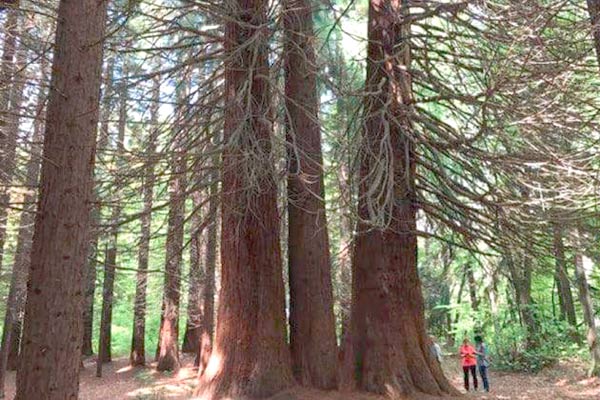
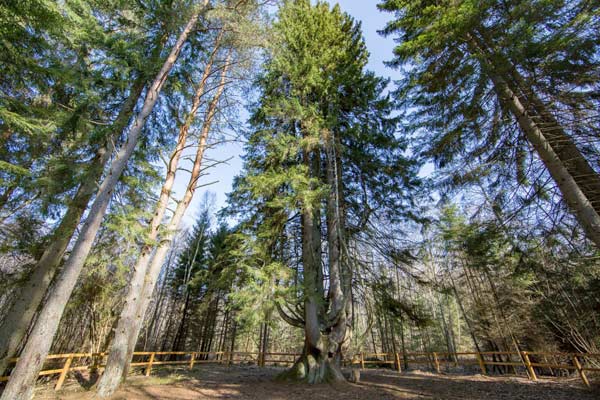
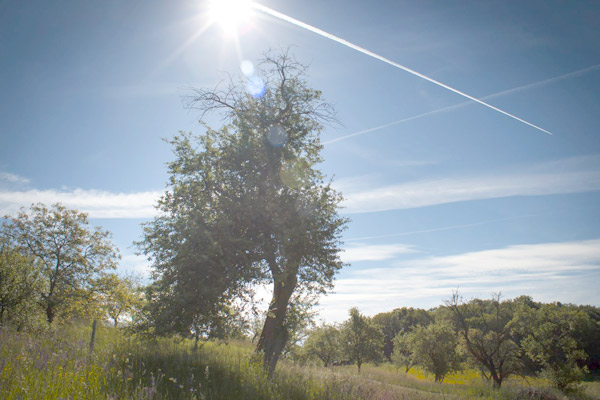
The sequoias of Yuchbunar are this year’s Bulgarian finalists in the competition „European Tree of the Year“, which has been held since 2011. The voting took place from 1 February to 28 February 2018. The results will be announced at the awards ceremony for the winners of the competition – 21 March 2018 in Brussels, when the International Day of Forests is also celebrated.
The majestic sequoias near the village of Bogoslov – nominated for European Tree of the Year 2018
The three majestic sequoias of the species Giant sequoia (Sequoiadendron giganteum) rise near the village of Bogoslov in the Yuchbunar locality, in the region of Kyustendil. Yordan Mitrev, a renowned forester, sowed sequoia seeds as early as the 19th century, and gradually a sequoia forest formed in the area, which is regarded as a natural phenomenon. These are the oldest trees of this species on the territory of Bulgaria, at the age of 130 years.
The giant sequoia is a species of coniferous plant from the cypress family (Cupressaceae), the only modern representative of the genus Sequoiadendron. It is also known as the Mammoth tree. The crown of the sequoia in its youth has an almost perfectly conical shape, and later becomes irregular. The trunk tapers strongly (with decreasing diameter along the length of the stem) and is covered with a thick layer of reddish-brown, soft, fibrous bark. The needles are awl-shaped, grey-green and relatively small, 3–6 mm long. Its height reaches 90–100 m. This is the largest tree species on the planet. Interestingly, giant sequoias can be traced historically back to the Triassic period, 200 million years ago, when the dinosaurs appeared. Sequoias were a dominant tree species during the Cretaceous period, when towards its end the dinosaurs began to disappear, but the giant trees managed to survive. Gradually, the Earth began to cool and dry, and the sequoias gave way to plant species suitable for arid conditions. They disappeared from the face of Europe and became concentrated in the western part of North America. In our time, with the help of experienced foresters, giant sequoias can be seen in many places around the world.
About the competition
The aim of the competition is to draw public attention to the conservation of tree biodiversity in Europe. For the organisers, the leading principle is the connection between nature and the people who are part of it. Therefore, each tree that is a finalist in the competition is evaluated primarily for its contribution to the cultural and natural heritage of the country that nominates it. Just like every person, every tree has its own rich history, waiting to be told and shared.
The competition „European Tree of the Year“ was organised for the first time in 2011 as a continuation of the popular competition „Tree of the Year“, which has been held in the Czech Republic by the „Partnership“ Foundation for many years. The European competition is the final round of the contest, in which the winners of the national competitions participate.
Every year, the association „Environmental Partnership“ (Environmental Partnership Association – EPA) organises the online voting for the competition „European Tree of the Year“. The „Partnership“ Foundation – Czech Republic is a member of the Association.
The first European voting took place in 2011. Since then, the number of countries participating in the competition has increased from 5 to 13.
This year, 13 trees from different European countries reached the final, each with its own specific and intriguing story. The 120-year-old apple tree, which has taken deep root in Slovakia, is a living monument to the country’s fruit growers. It is always laden with blossoms in spring and gives an abundant harvest in autumn. The ancient elms of Cabeza Buey in Spain, despite the serious threat of Dutch elm disease, have managed to survive for 450 years. Situated above the Church of Our Lady of Belén, the elms guard the secrets of the Templars. This year, four oaks will compete in the contest: the oak called „The Elder of the Belgorod Forests“ in Russia; the oak, a symbol of scouts all over the world in London, United Kingdom; and the oak from Cajvana, Romania, which is believed to have existed as early as the time of the great Tatar invasion (1241); the „Chattering“ cork oak from Portugal owes its name to the sounds made by the thousands of birds that perch on its branches, and in 1988 it was entered in the Guinness Book of Records as the „largest cork tree in the world“.
In 2014, Bulgaria won the competition with the Old Elm in Sliven. In 2017, we once again reached the finals with the centuries-old oak by the church in the village of Nasalevtsi.
This year’s winners will be announced at the Awards Ceremony, which will again be hosted by Member of the European Parliament Pavel Poc. It will take place on 21 March 2018 – the International Day of Forests, in Brussels.
More on the topic: