

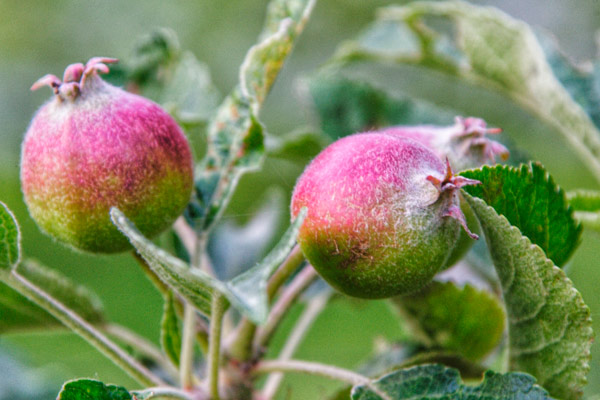
According to FAOSTAT, the first four places in the global production of fruit are occupied by bananas, oranges, grapes and apples.
After 2005 apples surpassed oranges and grapes. And from 2010 to the present (with 70.6 million t) they have consistently occupied second place in the fruit structure of the world – in 2016 their production reached nearly 90 million t. This growth can be explained by the high adaptability of the apple to diverse soil and climatic conditions. In the Southern Hemisphere apple orchards start from South Africa and reach the southernmost parts of Australia (Tasmania Island) and Chile in South America, where the main cultivars ripen from mid-January to early March, i.e. when in Europe domestic production has been almost fully marketed.
Depending on the cultivar-rootstock combination, fruiting begins in the 1st–2nd year after planting, and during the full fruiting period yields are usually 4–5 t/ha. Thus, the apple rapidly recovers the capital invested in establishing the orchard, i.e. it is an early-bearing and high-yielding fruit species.
There is great cultivar diversity with respect to ripening time. For example, in the Plovdiv region it starts at the end of June – beginning of July with Vista Bella and finishes at the end of October – the second ten days of November with Granny Smith and Pink Lady. The storage period depends on the cultivar, with winter cultivars retaining their commercial qualities in conventional cold stores until March – April, and in controlled atmosphere storage until May – June, while at extremely low oxygen content they can be stored until the new harvest.
Apples have high transportability and the ability to preserve for a long period of time both their external appearance and their taste qualities, which is why they are a major object of trade on a national and global scale. One should not overlook the other qualities of the apple as a healthy food for humans, for fresh consumption or processed into juices, concentrates, fruit salads, pectin, etc.
About 65% of the world’s apples are produced in Asia, and China produced in 2015 and 2016 respectively 42.6 million t and 44.4 million t, followed by our neighbour Turkey with about 3 million t of annual production. In second place is Europe, with Poland, Italy and France as the main producers. In third position is America, where the USA and Chile are the leaders, and Brazil and Argentina compete for third place. In Africa the leading apple producers are South Africa, Egypt and Morocco. It is striking that in 1985 Egypt, Morocco and Algeria produced respectively 29 thousand t, 120 thousand t and 42 thousand t, but in 2015 their production increased significantly and reached respectively 696 thousand t, 674 and 451 thousand t, i.e. in these countries the apple is one of the main fruit crops.
In our country the apple-growing area reached its record in 1965 with 477 thousand ha, and production in 1986 increased to 543 thousand t, corresponding respectively to the first stage of intensification of Bulgarian fruit growing, when palmette orchards on moderately vigorous clonal rootstocks were established, and to the second stage – the planting of the so-called high-intensity orchards on moderately and weakly vigorous rootstocks with spindle training system.
In 1897, when statistics began to be kept in our Ministry of Agriculture, apple orchards covered only 160 ha, increasing to 16 200 ha in 1950 and to 41 200 ha in 1960. Apple areas began to decrease after 1965 as a result of intensification, so that in 1990 they were 23 300 ha, and at the beginning of the 21st century – nearly 9 900 ha, i.e. after the political and economic changes in our country and the restitution of land to the former owners or their heirs.
In the last few years apple plantations in our country have exceeded 5 000 ha, and the harvested area in 2015 was 4 760 ha.
Apple production in the 1960s and 1970s was about 400 thousand t, and after 1985 it decreased significantly to below 300 thousand t. The production obtained in 2015 was 58.4 thousand t, compared to 49.4 thousand t of cherries, 36.2 thousand t of plums and 35.3 thousand t of peaches, with a total fruit production for the country of over 213 thousand t.
Although in terms of harvested area the apple ranks third after cherry and plum, it is leading due to the higher average yields – 1 226 kg/ha compared to 614 kg/ha for cherries, 530 kg/ha for plums and 952 kg/ha for peaches and nectarines in 2015. Higher yields of over 1 000 kg/ha were obtained from apple in 1990 – 1 539 kg and in 1980 – 1 137 kg, and apple yields have always been higher than those of other fruit crops in our country.
For comparison, we shall mention the yields in the so-called leading countries in world apple production – France with over 4 t/ha on average for the whole country in 2010–2013, Italy and the Netherlands – 3.8–4.0 t/ha, Chile – 4.5–4.6 t/ha, South Africa – 3.4–3.6 t/ha, the USA and Brazil – 3.0–3.2 t/ha, etc. These data clearly show that in our country the potential of the cultivars is not utilised, mainly due to non-compliance with the production technologies – pruning and training, fertilisation, irrigation and plant protection.
In 2015, 45% of the planted orchards were irrigated, of which 42% used drip systems and 31% – gravity irrigation. In 2001 the average area of an apple orchard was 1.1 ha, while the average size of a fruit orchard in our country was 2.44 ha, or 1.68 ha for plums, 1.79 ha for cherries, 0.98 ha for apricots and 0.73 ha for peaches. These data show that the establishment of producer organisations of fruit growers is urgently needed for Bulgarian fruit growing to become modern, profitable and competitive.
With regard to the cultivar composition, a certain unification is noticeable in the cultivation of the so-called market-oriented cultivars, as the global top 10 includes the Golden Delicious group (translated in our country as Zlatna Prevazhodna) and Red Delicious – Chervena Prevazhodna, followed by Gala, Jonagold, Granny Smith, Fuji, Pink Lady, Braeburn, Elstar and Jazz. These are the cultivars that will be the subject of global trade in apple fruit over the next 10 years.
In our country the first 5 cultivars and some of their better red-coloured mutations are widely grown, mainly those of Gala, Jonagold, Braeburn and Fuji. It should be noted here that in most cases all new cultivars are patented, which leads to a higher price for fruit-growing farmers, especially if the planting material is certified, i.e. virus-free, which is desirable for fruit producers.
It is interesting to mention that in the above-mentioned group of cultivars there are none with genetic resistance to the main disease, apple scab. Therefore, I consider it useful for our fruit growers to know the susceptibility of the widespread cultivars to the economically important diseases of apple – scab, powdery mildew and fire blight.
Only the cultivars Prima and Florina are genetically resistant to the most dangerous disease, scab, thanks to the Vf gene inherited from Malus floribunda clone 821. In recent years the cultivar Rewena has also been spreading, which is likewise resistant to this disease, but in addition it is practically resistant to powdery mildew and fire blight. The cultivar Topaz with its better-coloured clones is also resistant to scab and is already found in our apple orchards. Such qualities can also be claimed for the new Bulgarian cultivars Valana and Melprima, thanks to the above-mentioned gene, which is inherited from Prima as one of the parental forms.
It is very important to note that in the process of creating the above-mentioned cultivars at the Fruit Growing Institute in Plovdiv we established that, of the five races of the disease scab known worldwide at that time, in the Plovdiv region the pathogen population is represented by pathotypes of race 1, as well as races 2 and 5. In 1993 reports appeared of the occurrence of race 6 in Western Europe, and later of races 7 and 8. All this shows how complex the relationship plant – host – pathogen – environment is.
It is also necessary to mention the subjective human factor in conducting the control of diseases and pests in the fruit orchards of the country, i.e. the phenomenon of resistance to certain pesticides. It is well known that resistance appears after long-term use of the same product, and repeatedly within a season. Another reason is the increase of the recommended dose. The result is an increase in the resistance of the harmful organism. For example, out of 1 000 units of a given pathogen, 990 will die, but 10 will survive and will be resistant and, after rapidly multiplying, they will become 1 000 or 10 000 units, but already resistant to the pesticide used.
In addition to the plant protection problem, it should be recalled that for successful crop protection, forecasting and warning are of particular importance. For many years now, meteorological mini-stations have been offered in our country to record temperature, relative air humidity, precipitation and leaf wetness, which together are important for the occurrence of apple scab. These small weather stations are installed in the orchard and connected to the farmer’s computer, where there is software indicating when spraying in the orchard should begin. Similar programmes exist for the control of the codling moth, using pheromone traps. It is known that recently electronic options have appeared that help the farmer monitor the dynamics of the flight of this dangerous pest not only via his computer but also on his mobile phone.
Farmers could regularly follow the bulletins issued on the occurrence and development of diseases and pests by the Regional Food Safety Directorates. This will help them reduce the number of treatments during the season and thereby protect their own health as well as that of consumers. And last but not least, to ensure lower costs per unit area, i.e. to increase their profit. It is high time to break the status quo – spraying every seven days!