

In Bulgaria, dangerous diseases of agricultural crops greatly reduce yields and cause major losses when control measures against them are inadequate.
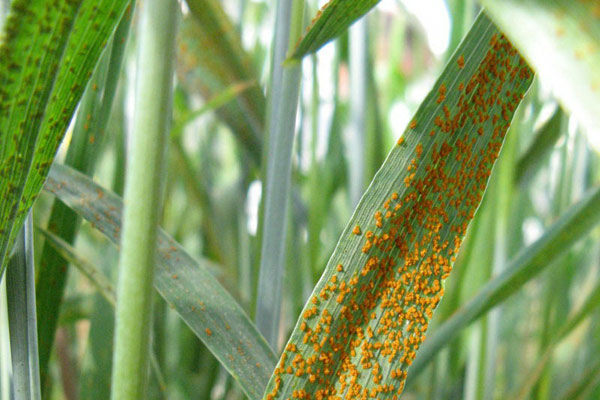
In wheat, powdery mildew (Eryziphe graminis) is particularly dangerous. When the flag leaves and the ear are attacked, losses from it can reach 20–25%. Losses of up to 30–40% in this crop can be caused by fusarium head blight (Fusarium sp.) on the ear, the stem base and the roots. Rusts of cereals are also a serious phytopathological problem. There are records of epiphytotic development in the past of both stem rust and leaf rust in wheat. In barley, stripe disease (Drechslera graminea (Helmintosporium gramineum)) is particularly dangerous.
In cool and humid years and in the case of delayed treatments, apple scab (Venturia inaequalis) affects 100% of the leaves and fruits and severely impairs fruit quality. Fire blight (Erwinia amylovora) occurs on a large scale in pome fruit crops (especially quince and pear) and causes significant losses, and in some cases even the death of entire trees. In recent years, the importance of plum pox (Plum pox virus) has increased worldwide. It causes premature fruit drop of 70–95% of the fruits and severely deteriorates the quality of production. Leaf curl (Taphrina deformans) ranks first in distribution and harmfulness among peach diseases. In our country it appears every year in a severe form, affecting up to 90–100% of the leaves. It reduces tree vigour, their resistance to winter injury, and decreases fruiting. Another dangerous disease of this fruit species is powdery mildew (Sphaerotheca pannosa). It spreads on a large scale and causes significant damage every year. In severe outbreaks of the disease, infection can reach up to 100% on shoots, 95–100% on fruits and up to 95% on leaves. Blossom blight (early brown rot) (Monilia laxa) causes severe damage to apricot, sour cherry, sweet cherry and some plum cultivars. In years with a cool and wet flowering period, epiphytotics (infection up to 95–100%) may occur. Such cases have also been observed in sour cherry. In plums, blossom blight can reach 100%. The death of entire trees has been established in young sour cherry orchards.
In vegetable crops, large losses are also often recorded under unfavourable conditions. Infection by late blight of tomato (Phytophthora infestans) can reduce yields by 30–40%. Damage caused by the tomato spotted wilt virus can reach 50–70%. Blight of pepper (Phytophthora capsici) is the most economically important disease in this crop. In some years it has destroyed up to 15–20 thousand decares of stands. In tomato, eggplant and pepper, losses from stolbur (Phytoplasma sp.) can reach 50–90%. The diseases of greatest economic importance in cucumber are downy mildew (Pseudoperonospora cubensis) and cucumber mosaic. Fusarium wilt (Fusarium oxysporum f. sp. cucumerinum) is also highly damaging in cucumber, affecting both greenhouse and field production.
In recent years, a negative trend has been observed regarding losses of agricultural production caused by diseases – they are constantly increasing. The reasons for this are the introduction of high-yielding varieties and intensive, efficient technologies, as a result of which agricultural production has increased by almost 200%. At the same time, losses from diseases have increased 3–4 times, and the costs for plant protection products – 5–6 times. The causes can be grouped into three main categories related to the concentration, specialization and intensification of modern conventional agricultural production. The establishment of large production blocks and the adoption of monoculture cultivation reduce biological diversity. The intensification of the crop production subsector is associated with the application of ever greater amounts of mineral fertilizers and plant protection products. The combination of these three groups has led to the disruption of the biological balance over large areas and has created conditions for the occurrence of epiphytotics.