

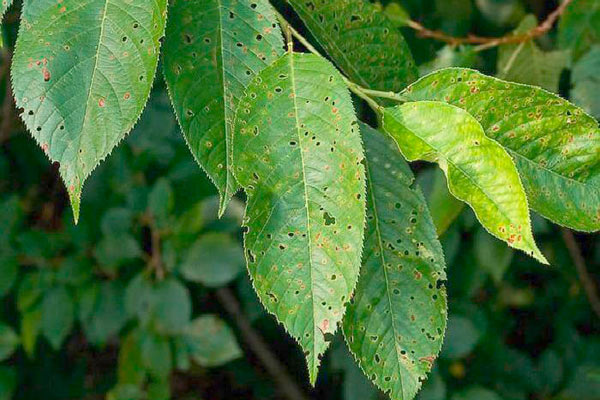
Causal agents: Xanthomonas campestris - bacterium, Bacillus pumilus - bacterium
Hosts: peach, apricot, sweet cherry, sour cherry, almond
Symptoms
The symptoms of shot hole disease are observed on the leaves, shoots and fruits as small reddish spots, which gradually merge into an irregular shape.
The tissue in the centre of the leaf becomes necrotic and falls out.
On apricot fruits, small reddish scabs are formed around the peduncle, while on sweet cherry and sour cherry fruits dark spots are formed, which gradually sink and adhere to the stone.
On peach and almond, gum exudation occurs at the site of damage. The causal agent of the disease overwinters as mycelium in the infected twigs.
Life cycle
The causal agent fungus overwinters as mycelium in the infected twigs. It multiplies during mild winters and in the dormant period, forming conidia which are a source of infection.
The causal bacteria overwinter in the affected plant parts, as well as in the fallen leaves and in the soil.
Infection by shot hole disease occurs through wounds, stomata or the cuticle.
Spores and bacteria are disseminated by rain, wind or insects.
Control:
To control the disease, it is necessary to carry out:
- First spray - at the phenological stage “flower bud”;
- Second spray - after flowering;
- Third spray - 7 days after the second.
Registered fungicides for control:
Captan 80 WG (valid until: 31.07.2021) – 150-180 g/da, Bordo Mix 20 WP – 375-500 g/da, Kocide 2000 WG – 155-285 g/da – for peach and nectarine, for apricot – 185-280 g/da, and Funguran OH 50 WP – 150-250 g/da, Champion 50 WP/ Champ 50 WP/ Macc 50 WP – 300 g/da, Vitra 50 WP/ Cuprohigh 50 WP – 150 g/da; Merpan 80 WG (valid until 31.07.2021)