

Concern about environmental risks and the harm caused by insecticides has doubled following the development of technologies for their precise measurement in environmental components and plant products. This has led to increasing restrictions on the use of pesticides. In 2014, a directive of the European Union on the sustainable use of pesticides entered into force, under which farmers may trade only in products that have been produced in accordance with the rules of integrated pest management. An urgent transition from conventional plant protection to more environmentally friendly methods became necessary.
Pheromones and other behaviour-modifying substances that occur naturally in the environment are an excellent alternative. New or long-established giants of the insecticide industry are developing and already offering commercial products on this basis. The use of various attractants, repellents, deterrents, etc., all belonging to the group of so‑called signalling substances (semiochemicals), is yet to increase.
The existence of pheromones has been known for centuries, probably from observations of mass stinging in bees as a result of the release of a chemical from the sting of a single bee. For the first time, however, a sex pheromone was isolated in 1959 (from the silkworm moth) in Germany (Piosik, 2003). Since then, with the aid of precise techniques and equipment, hundreds and even thousands of sex pheromones of different species have been identified. Today, there is a much clearer understanding of the limitations and possibilities for the application of sex pheromones in plant protection.
There are two main areas of use:
- for detection of the respective pest and monitoring of its population density
- for mating disruption (disorientation method).
Detection and monitoring of pests
The initial application of synthetic sex pheromones was to attract insects to traps for detection and determination of the dynamics of their population density. In most cases, males are those that respond to sex pheromones. Synthetically produced pheromones used as trap lures are a combination of the main chemical components, as well as some additional ones, which attempt to mimic naturally produced pheromones. The more similar the synthetic combination is to that released by the female, the stronger the effect on the searching male will be.
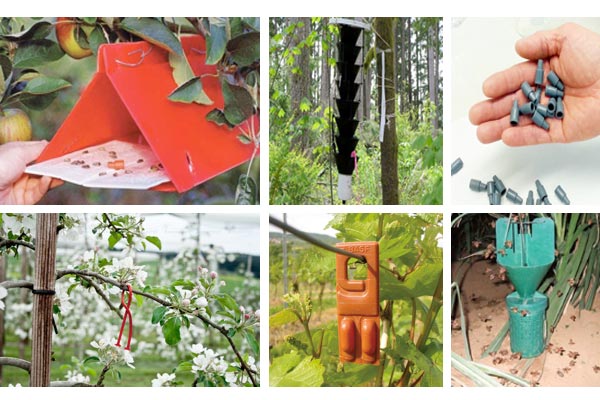
Ideally, the pheromone trap should release pheromone gradually over time. The design of the dispenser (the capsule that emits the pheromone) may vary: plastic tube, sachet, laminated plaque, etc. This design, as well as the size of the trap, may also differ depending on the behaviour of the respective insect. For an accurate assessment of population density there are precise requirements regarding the type of trap and the number per unit area.
Mating disruption method (mating disruption)
The mating disruption method uses synthetically produced chemicals in high concentrations, which confuse males and reduce their ability to locate females. Individual brands of synthetic pheromones usually contain only the main components, since the aim is not to attract but to confuse the males. There are several mechanisms that may be used in the mating disruption method. The release of sufficiently large quantities of synthetic pheromone into the atmosphere in various crops confuses the males by:
- Following a “false” trail instead of searching for females
- Affecting the ability of males to respond to pheromone-emitting females
A false trail is achieved by placing more pheromone sources (tubes, plaques, sachets or other pheromone sources) per unit area compared to the expected number of females. The number of males finding females at the end of the trail should be greatly reduced. The pheromone is released at a relatively low concentration so that a trail is created in the direction of the wind, rather than forming a general background. Males that follow a false trail expend their mating energy in searching for the artificial pheromone sources. As a result, mating is either delayed (with a subsequent negative impact on overall fertility) or prevented. If females do not mate, they cannot lay fertilised eggs, and if mating is delayed, they will lay fewer fertilised eggs during their lifetime. Subsequently, the population decreases and there are fewer larvae to damage the crop.
Males of the pink bollworm in cotton have been observed attempting to mate with the hollow tubes used as a pheromone source. Exactly these pheromones were applied in combination with a small amount of contact insecticide (yet another way to destroy the males). The effectiveness of the added insecticide has not been established, but according to the manufacturers a dead male is better than a confused one.
There is another practice: to treat with a contact insecticide and at the same time to use pheromones. In this case, the aim is to increase the activity of the adults so that they spend more time flying and thus be affected during spraying.
Reduction of the males’ ability to respond is achieved through the additional concentration of pheromone in the air, which “masks” the pheromone released by the actual female. Such high concentrations can be obtained through diffuse pheromone sources – microcapsules sprayed in the standard way, or through point application – using so‑called dispensers of various types – twist ties, capsules, etc. Specific receptors on the antennae respond to pheromone molecules (Cardé and Minks, 1995). When these receptors are continuously activated by high additional pheromone concentrations, the resulting electrical signal decreases. The receptor loses sensitivity and the insect is unable to orient itself. When the central nervous system of the insect is saturated with signals from the receptors, it adapts and can no longer provide an adequate response. The ultimate result of male disorientation is that they cannot locate the pheromone source and mate (Cardé and Minks, 1995).
You can read the full text in issue 8-9/2017 of the journal “Plant Protection & Seeds and Fertilizers”