

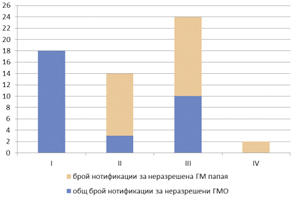
In the last quarter of 2013, the RASFF system recorded 2 notifications for unauthorized GMOs, making this the period with the lowest number of GMO notifications for the past year. Both notifications concern genetically modified papaya from Thailand and are informative for attention guidance. As can be seen from the chart, notifications for GM papaya constitute a significant portion of the notifications for unauthorized GMOs from the second quarter until the end of 2013. It should be noted that, to date, there is no approved GM papaya on the European market, nor any other GM fruits or GM vegetables. No applications for authorization of such products have been submitted either. The genetic modifications in papaya aim to confer resistance to the papaya ringspot potyvirus – PRSV. Globally, it is approved for consumption in the USA, Canada, and China.
Appendix
- The Rapid Alert System for Food and Feed (RASFF): A rapid alert system in the form of a network has been established for direct or indirect risks to human health arising from food or feed. It involves the Member States, the Commission, and the European Food Safety Authority. If a member of the network has information related to the existence of a serious direct or indirect risk to human health, this information is immediately communicated through the system and transmitted to the network members.
- Legal basis: The Rapid Alert System for Food and Feed is based on Regulation (EC) No 178/2002 of the European Parliament and of the Council of 28 January 2002 laying down the general principles and requirements of food law, establishing the European Food Safety Authority and laying down procedures in matters of food safety, Article 50. The conditions and implementing measures are described in Commission Regulation (EU) No 16/2011 of 10 January 2011 laying down implementing measures for the Rapid Alert System for Food and Feed.
- Types of notifications:
- Alert notification – a message about a serious risk requiring immediate action or where the risky product is already on the market;
- Border rejection notification – concerns a consignment of food, feed or raw materials which has been denied entry into the EU due to a risk to human health, animal health or the environment;
- Information notification – this can be for:
- follow-up;
- attention.
Follow-up notifications do not require a rapid response. Attention notifications provide information of interest to the control authorities.
According to data from:
https://webgate.ec.europa.eu/rasff-window/portal and
http://en.biosafetyscanner.org/index.php