

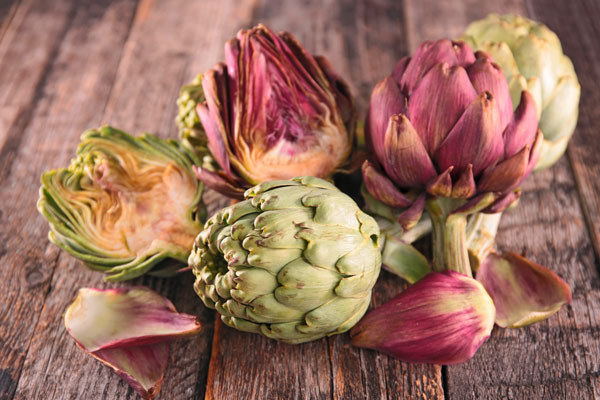
The artichoke (Cynara scolymus) is a perennial herbaceous plant belonging to the family Asteraceae (Compositae). It is cultivated for its nutritional–gourmet and medicinal properties. The tradition of its use is long-standing and dates back to the ancient Egyptians, Greeks and Romans. Initially it was used as wild food, but gradually its cultivation and purposeful growing were established.
It has a well-developed root system, which can reach up to 5 m in diameter and penetrate to a depth of 90–120 cm. The plant reaches a height of up to 2 m. Its stem is short and slightly branched, ending in large flower heads. The leaves are pinnatisect (deeply tripartite), spiny, coloured silvery blue-green, with a grey-felted lower surface. They are 50 to 80 cm long.
The flowers develop in a large, single flower head, also called a capitulum. It is the main edible part of the plant and has a diameter of about 8–15 cm. The bud consists of numerous triangular, fleshy scales, arranged like roof tiles. Depending on the artichoke type, the flower head is coloured green or purple, as well as in various shades and ratios of the two colours. When flowering, the individual florets are purple. The outer ones have a triangular appendage at the tip. The flowers are hermaphroditic (having both male and female organs) and are pollinated by bees. The artichoke flowers from July–August until September.
The edible parts of the plant are the unblown flower buds, called capitula or heads. The fleshy leaves (bracts) are also suitable for consumption. The flower heads are central, of the second and third order, and from one plant 4 to 20 heads can be obtained.
For food, the heart of the unblown flower heads is used; it is rich in potassium, proteins and vitamins. The artichoke is consumed raw, boiled or canned. The fruits are seeds about 7 mm long, possessing a long pappus. They ripen in the period from September to October.
More than 10 types of artichoke are known, with different leaf shapes, different colours and other characteristics. They are mainly divided into Chinese, French and Jerusalem artichoke.
- Chinese artichoke – grown both in the Far East and in Europe. It consists of small tubers and needs to be blanched before removing its hard part.
- French artichoke – its only edible part is the bud. It originates from North Africa, but is cultivated in Europe and America.
- Jerusalem artichoke – the tuber has a nutty taste, with a colour ranging from beige to brownish-red.
Besides being a vegetable, the artichoke is also a medicinal plant. Its healing properties have been known to people since antiquity. It contains the powerful antioxidant cynarin, which cannot be found in any other fruit or vegetable. Cynarin as a medicinal agent is used in the treatment of hepatitis, atherosclerosis, gallbladder diseases, and sometimes in allergies and eczema.
The flower heads are a rich source of bioactive compounds. In folk medicine it is used for the treatment of liver diseases, dyspepsia, chronic albuminuria, postoperative anaemia, as well as a diuretic and liver tonic.
The artichoke is one of the indispensable vegetables in dietetic cuisine. It is rich in dietary fibre, potassium, calcium, phosphorus, magnesium, iron, sodium, vitamin A, B1, B2, C. In addition, it contains proteins, fats, carbohydrates and niacin.
The artichoke is a relatively cold-hardy plant. Suitable conditions for its cultivation are cool and humid summers and mild winters. The optimum temperature for its cultivation is 24ºC during the day and 13ºC at night. It is tolerant to high temperatures (above 30ºC), but the quality and quantity of the edible part of the flower bud decrease. The plants withstand down to minus 3ºC. In our country, after earthing up with straw and soil, it can overwinter successfully. It is demanding with regard to soil type, soil structure and soil fertility. The soil must be deeply cultivated. It is advisable for the soil to be well supplied with organic matter and moisture, but care must be taken to avoid waterlogging. The artichoke develops well on deep, structured soils and responds excellently to manuring with farmyard manure.
Soil preparation begins with deep autumn ploughing. At this time 4–5 t of well-rotted farmyard manure, 40 kg of superphosphate and 20 kg of potassium sulphate per decare are ploughed in. During spring soil cultivation, 30 kg/da of ammonium sulphate are applied.
The artichoke is grown by direct sowing, seedlings and by suckers from old rhizomes. The practice of using seedlings is widespread. For this purpose, the seeds are sown in March in protected cultivation facilities in rows with 8 cm inter-row spacing. After emergence of the young plants, at the first true leaf stage, they are thinned to 7 cm within-row spacing. The seedlings are ready to be planted in a permanent place at the beginning of May, when they reach the 4-leaf stage. They are transplanted on the shoulders of ridges at a distance of 120 cm between the ridges and 80 cm within the rows. The nutritional requirements of the seedlings are very high, which necessitates 1–2 top dressings.
When grown by planting root suckers from old plantations, they must be 10–15 cm long and have 3–4 leaves.
The artichoke can also be grown by direct sowing of the seeds in spring, when a stable warming has occurred. Sowing is done in hills, 2–3 seeds per hill.
Care during the vegetation period consists of removing weeds and timely hoeing so that the soil surface is kept loose. The artichoke is demanding in terms of soil moisture, which necessitates regular irrigation. Depending on the type and structure of the soil, weekly irrigations are carried out. If irrigation is carried out by a drip system, the interval between irrigations is shortened. To ensure the necessary amount of moisture, it is advisable to use drip irrigation systems, which also reduce water consumption by up to 25% on heavy clay soils. Annually, during the vegetation period, 1–2 top dressings with mineral fertilizers are carried out, the rate of which is determined on the basis of an agrochemical soil analysis. Studies have recorded good results from the use of organic fertilizers: composts, vermicomposts, etc., which not only reduce mineral fertilization but also improve soil structure.
To obtain large flower heads, it is necessary to leave 1–2 flowering stems with 3–4 heads each on a single plant. It is advisable to remove newly appearing suckers.
Harvesting usually begins in the second year after planting the plants in a permanent place. Cutting of the flower heads starts in June, when they have reached the size characteristic of the variety and have begun to open at the top. Harvesting is mainly manual and, depending on the weather, is carried out 1–2 times a week. From 1 decare about 4000–5000 flower heads are obtained. After harvesting the produce, the flowering stems are cut, the plants are cleaned of dry leaves and the area is hoed. Late in autumn the leaves are cut high and the plants are earthed up in order to protect the rhizomes from freezing.