

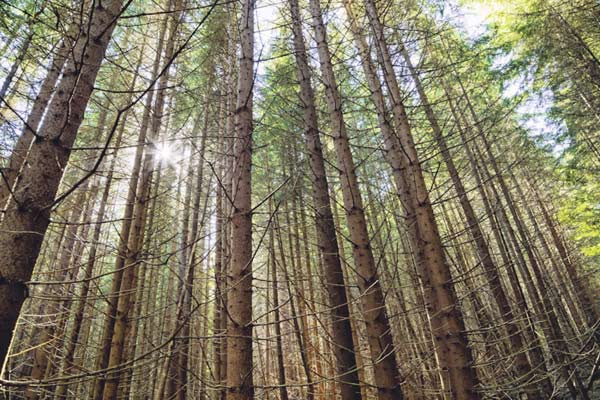
The classic of forest science Georgy Morozov considers the forest not as a simple mechanical aggregate of trees, shrubs, grasses, insects, fungi, lichens, microorganisms, but as an exceptionally complex dynamically balanced ecosystem, composed of numerous mutually connected biotic and abiotic components with dynamically occurring processes of construction and decomposition, in which every organism has its place and role in the structure and functioning of the forest. Any change in the environment leads to irreversible alterations in the structure and composition of forest ecosystems, and often to the disappearance of tree and shrub species. In line with these considerations, it should be noted that since the middle of the 20th century the overall pollution of the environment has also led to climate change on a regional and global scale, deterioration of growth conditions for the majority of tree species, and has provoked total or partial dieback of forest ecosystems.
Under these circumstances in our country one of the most serious problems turned out to be the calamitous outbreak of bark beetles in artificial coniferous forests. All the more so as the greater part of the artificial coniferous forests are at felling maturity and should be regenerated. For the public, and for a considerable part of forestry specialists as well, the bark beetles seemed to appear suddenly, as if introduced artificially into the forest ecosystems, as if in the past they did not exist in the forests and had never been there. In fact, bark beetles have their place in the structure and functioning of dendrocenoses for thousands of years and live in “peaceful coexistence” with tree species and are always found in their communities, in the so‑called “iron” reserve, i.e. in equilibrium with the other components of the forest ecosystem, and they are an integral part of it (Maslov A., 2010; Naydenov Ya., 2013; Ruskov M., 1928, 1937; Tsankov G., 2010; Otto H., 1999 et al.).
In a healthy, sustainably developing forest, when the density and number of bark beetle populations are not high, they colonize, feed and reproduce in single wind‑thrown or broken trees caused by extreme natural factors or in trees severely damaged by fire, diseases or attacks by other insects. In this case they support (facilitate) the recycling of deadwood and play the role of forest sanitarians, exerting a positive influence on the functioning of the forest ecosystem by supporting the development of decomposer organisms: insects, fungi, bacteria, by fragmenting and preparing the woody biomass for decomposition and inclusion in the natural biological cycle of matter and energy. In this situation they are secondary pests which in principle feed saprophytically. But the fallen trees create a “reserve” stock of bark beetles which, given optimal growth and meteorological conditions, including a significant increase in the stock of freshly damaged wood caused by extreme factors or fires, begin to reproduce massively and turn from secondary into primary pests.
The droughts during the periods 1998–1991 and 2010–2012 weakened most coniferous plantation stands over vast territories in Europe and worldwide. Thus, coniferous species, as well as some broadleaved dendrocenoses, became highly vulnerable to bark beetles, which led to a calamitous increase in the density and numbers of their populations. What does vulnerable mean? As a normal reaction to damage to the bark, coniferous trees attacked by bark beetles or other pests respond by exuding resin, in which the pest attempting to colonize them simply drowns. But if the coniferous tree has undergone prolonged severe drought, effective resin exudation is not observed and the pest successfully “exploits” (colonizes) the tree. It is also acknowledged that almost no one fought the bark beetles at the first signs of increasing attacks by them (foresters, not only in our country but also abroad, in most cases have their hands tied by new laws and modern ecological trends). The consequences of this inaction, as well as the spread of the bark beetle, can justifiably be called a disaster of national scale, which crosses national borders and can be said to be becoming a European problem – a bark beetle calamity in Bulgaria, Macedonia, Serbia; the European part of Russia, including the Moscow region, France, Switzerland, Sweden, Norway; there are reports of increasing bark beetle attacks in California and Canada and elsewhere.
Bark beetles, especially the spruce bark beetle (Ips typographus), have for centuries been the most serious pest of coniferous forests in Europe. The first mass outbreaks of the spruce bark beetle were described in the 18th century (Maslov 2001). For our country the first attacks by bark beetles were reported by Yordan Mitrev in the snow‑break coniferous stands in the Rila Monastery forests in 1896; in the forests of the Training and Experimental Forest Enterprise – Yundola (Ruskov M., 1928, 1937). In the period 2001–2016 the spruce bark beetle destroyed a significant part of the spruce trees on Vitosha, in the surroundings of Sofia, and caused serious damage even to the spruce stands in the “Boyana” residence.
How did the bark beetle problem arise and deepen in our country? At the beginning of the 21st century most of the coniferous plantations established in the 1950s and 1960s reached technical maturity and the process of degradation of artificial ecosystems began. At the same time natural disasters and fires led to a sharp increase in the amount of dry and fallen coniferous wood and created excellent conditions for mass development of bark beetles and other harmful insects and diseases. Already at the beginning of the calamitous bark beetle outbreak in the first decade of this century, activities were directed towards timely detection of bark beetle foci and prompt removal of colonized trees, as is the sound Bulgarian practice in this field. Under the current organization of timber harvesting in our country this has proved to be a serious problem: small bark beetle patches in terms of area and timber volume are not an attractive site for logging companies. The coordination of harvesting plans with many institutions, as well as compliance with the requirements of Natura 2000 and the Public Procurement Act for allocating forest areas for felling, in most cases render the implementation of sanitary fellings pointless. From the notification protocols submitted to the Forest Protection Stations (LZS) regarding the expansion of the patches it is evident that in some cases sanitary felling was carried out in the second or even the third year, i.e. after three to four generations and dispersal of the bark beetles throughout the entire stand. In addition, the instructions given under the influence of the “vigilant” public to leave in the bark beetle patches trees with still green crowns but already colonized by bark beetles, which die a few months later, also provide a good basis for permanent dispersal of bark beetles. A delay of one year in felling the bark beetle patches leads to a geometric increase in the number of emerging beetles colonizing healthy trees.
The abolition of phytosanitary cleaning through the removal of dry and fallen trees on a stumpage basis for the local population and its replacement by tendering for industrial timber harvesting, besides depriving the population in mountain regions of a social benefit, also led to an increase in the food base of bark beetles and optimization of the conditions for their dispersal.
Sound Bulgarian silvicultural and forest protection practice shows that the most effective measure for combating bark beetles is the timely implementation of sanitary fellings, i.e. the removal of the food base for mass multiplication of pests. By applying this approach in the vast coniferous forests affected by windthrows in the Beglika–Batak area and the Vetrovala locality on Vitosha, a calamitous outbreak of bark beetles was prevented and today in these areas there are excellent coniferous plantations.
It should be noted that the instructions to fell only trees with already reddened foliage turn sanitary felling into mere collection of dry and fallen biomass, because there are no bark beetles left in these trees. It is mandatory that all trees in the vicinity of bark beetle patches showing signs of colonization by the pest be removed in due time.
The use of trap trees is a good method for controlling bark beetles. Its effective application under the current system of allocating forests for timber harvesting is impossible and requires the establishment in forest enterprises of specialized production units which would fell fresh stems, prepare them as trap trees, carry out the necessary monitoring and at the appropriate time remove them from the stands or debark them.
As realistic measures to limit mass bark beetle attacks and minimize the damage caused by them, as in most European countries, timely sanitary fellings combined with the installation of pheromone traps remain. As regards the cleaning of clear‑cuts from fallen medium‑sized and small woody debris, it is best that it be shredded or burned.
In wood‑processing enterprises, measures such as debarking of timber, installation of pheromone traps, covering of stored unbarked logs with metal mesh treated with appropriate insecticides, and storage of timber under water or under continuous sprinkling can be applied.
We should not close our eyes to the first signs of attacks by the root rot fungus Heterobasidion annosum , (Fr.) Bref., as its mass development can be expected in the near future, as well as the emergence of numerous diseases and weakening insects.
We, forest protection specialists, thank the public for the interest shown and the involvement in the issues of the phytosanitary condition of forests, but it should also be clear that the health of forests is safeguarded by the Forest Protection Stations in Sofia, Plovdiv and Varna, as well as by forest protection experts from the Regional Forestry Directorates, the state forest enterprises, the state forest and hunting enterprises and the scientists from the Forest Research Institute at the Bulgarian Academy of Sciences and the University of Forestry.