

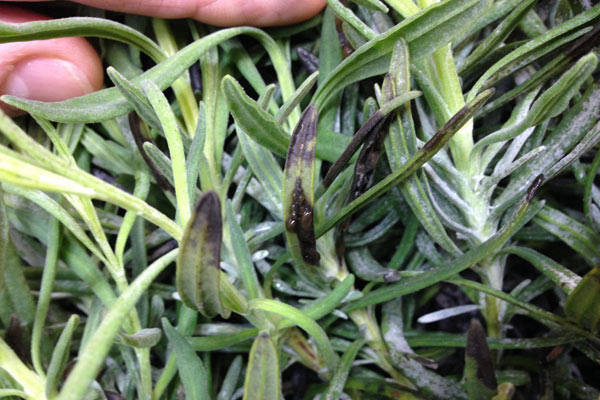
Data indicate that there is a high infectious background in lavender stands, which is a factor for the permanent development of fungal diseases. Under favourable climatic conditions, pathogens may provoke the outbreak of epiphytotics. The health status of the plants is further complicated by the association of fungal pathogens from different genera, which parasitize various organs, leading to profound disturbances in plant growth and development.
The literature reports occurrences of fungal diseases in lavender – phomopsis (Phomopsis lavandulae Gabotto), phoma (Phoma lavandulae), septoriosis (Septoria lavandulae Dezm.), grey mould (Botrytis cinerea) and soil-borne pathogens from the genera Fusarium, Verticillium, Sclerotium bataticola, Sclerotinia sclerotiorum and Phytophthora. Numerous sources provide data on damage caused by Phomopsis lavandulae. On an epiphytotic scale, the disease developed in the second half of the 20th century, when it completely destroyed lavender plantations aged 3–4 years in France (Buczacki, 1998; Harris, 1998). The damage from phomopsis increases when associated with other pycnidial pathogenic fungi from the genera Septoria and Phoma (Buczacki, 1998; Harris, 1998).
In the Bulgarian phytopathological literature there are reports of Septoria lavandulae, Phoma lavandulae, Phomopsis lavandulae, root rot and decline of lavender caused by Phytophthora, Fusarium oxysporum, Armilariella mellea and Rosellinia necartix (Hristov, 1972; Margina, 2000; Bobev, 2009; Nakova, 2011).
On the basis of morphological and cultural characteristics and proven pathogenicity, the phytopathogens Phoma lavandulae, Phomopsis lavandulae, Septoria lavandulae, Phytophthora parasitica and Phytophthora hybrid have been identified.
Phomosis (Phoma lavandulae)
The initial development of the disease is observed at temperatures above 100C and at the bud formation growth stage of the crop. The mass manifestation of the disease is from June to September. During this period, small pinpoint spots with a size of 1–1.5 mm appear, as well as diffuse necrotic spots starting from the tip of the leaves – 1–1.5 x 3.5–4 mm. Yellowish spots are found on the stems, which gradually dry out and become grey-brown, often varying in size from 2–3 mm to 20–25 mm (Fig. 1b). The damage penetrates deep into the stem, forming cankers. Around them and on the wilting or already dried branches, pycnidia (fruiting bodies) of the fungus are found – spherical, brown to black, with dimensions of 125.80 x 110.50 µm. The spores are ovoid, single-celled, colourless (6.12–5.10 x 1.70–1.36µm).
During full flowering, the damage reaches the flowering stems and the flowers often dry up. The peak of disease development is in August and September, and no new infections are recorded in October.
Symptoms on the skeletal branches precede those on the leaves by one month. The most severe manifestations on the branches are observed in July and August. Observations indicate that the pathogen survives in the fallen leaves or in the infected skeletal branches. Cultivar susceptibility is established in September. The cultivar Sevtopolis shows high susceptibility to the pathogen, while Heber and Yubileyna are less susceptible. Druzhba and Hemus occupy an intermediate position.
Phomopsis (Phomopsis lavandulae)
The disease begins its initial development at the bud formation–flowering growth stages, when the temperature rises above 100–150C. Elliptically elongated spots starting from the leaf blade are found on the leaves (Fig. 3a and 3b). It causes the drying of individual branches or entire plants. The stems turn yellow, necrotize and are speckled with black pycnidia. They are rounded to slightly pear-shaped and with a diameter of 37.44–88.21 x 41.44–104.5µm. Two-celled, elliptic spores are formed in them, slightly constricted in the middle and with pointed ends, with dimensions of 6.16–8.75 x 2.77–4.55µm. Subsequently, the spots necrotize. The fungus attacks by “killing the stems” of lavender and they necrotize. The peak periods of the disease most often occur during the warm months – July–August, when the leaves of the affected plants fall off. Poor growth or a complete lack of growth is observed. When analysing diseased tissues, pycnidia of the fungus are found in the stem wood. Differences in cultivar susceptibility to the pathogen are observed only at the disease peak – in July, with proven most severe damage to the skeletal branches of the cultivar Druzhba, and the least severe in the cultivar Sevtopolis. Hemus, Heber and Yubileyna occupy an intermediate position. The fungus survives mainly on stems and branches infected in the previous year, as pycnidia.
Septoriosis (Septoria lavandulae)
The development of the disease starts in May and June and reaches its maximum in September. On the true leaves of lavender, rounded, reddish-brown spots (up to 2–3 mm in diameter) with a purple halo are formed. Later, the tissue in the area of the spots becomes grey, and black pycnidia are observed on its upper surface. They are immersed, spherical, flattened, black, small (diameter 41.3–66.7µm), with a round ostiole. The conidia are filiform, straight or slightly wavy, with pointed ends, multicellular (1–3 septa, without constriction), colourless, 12.8–33.5 x 1.1–2.6µm. The disease attacks more strongly the true leaves of lavender and less so the leathery ones. Its harmfulness is determined by the climatic conditions of the year – high humidity and temperatures above 200C favour it. Under strong manifestation it causes leaf drop and weakening of the plants. The literature reports reductions in yields of fresh material by up to 24%, and in oil content by up to 13%, as well as deterioration of the essential oil quality. The disease is also dangerous for seedling production, as it reduces the percentage of plant establishment. In rainy years it can cause significant damage. All three pathogens develop throughout the year as pycnidia with pycnidiospores. Conditions for more extensive development of the diseases are created by frequent rainfall, moderate temperatures and abundant irrigation.
In recent years, root rot and decline of lavender has emerged as a serious problem in our country, especially in seedling production. At the beginning of the vegetation period, slow growth and yellowing of the leaves are observed, followed by wilting and drying. In diseased plants, necrotic changes are found on the root collar and roots. The bark becomes water-soaked, peels off easily and cankers are often visible underneath. A change in the colour of the wood is observed: in young plants and new infections, a dark orange-red discolouration appears, while in older plants and infections, the colour is dark brown. The leaves of infected plants turn yellow and necrotize. In established lavender bushes, “sectorial dieback” of 1/3 to 1/2 of the bush is observed. In these plants, microscopic examination reveals structures of fungi of the genus Phytophthora. The disease develops most intensively from June to September. Heavy, compacted, high pH and waterlogged soils favour the development of the disease.
The biological characteristics of the pathogens causing the diseases provide grounds for recommending preventive control measures:
- Use of healthy planting material;
- Pruning and burning of diseased branches;
- Deep ploughing-in of fallen leaves in autumn;
- Irrigation with water that has not passed through old plantations;
- Uprooting of dead plants;
- Spatial isolation;
- The places of removed clumps, as well as neighbouring still healthy plants, may be treated with suitable fungicidal products in the form of irrigation;
- The choice of fungicide or combination of fungicides should be made after an up-to-date diagnosis of the problem.
In the period 2013/2014, a phytosanitary monitoring was carried out on the health status of lavender plantations and the distribution of fungal pathogens in the main regions of the country where this crop is grown – Karlovo, Stara Zagora, Kazanlak, Elhovo, Shumen and others. In 2013, 579.63 decares were surveyed /average percentage of diseased plants 20.8/, and in 2014 – 2180.10 decares /21.64% respectively/.