

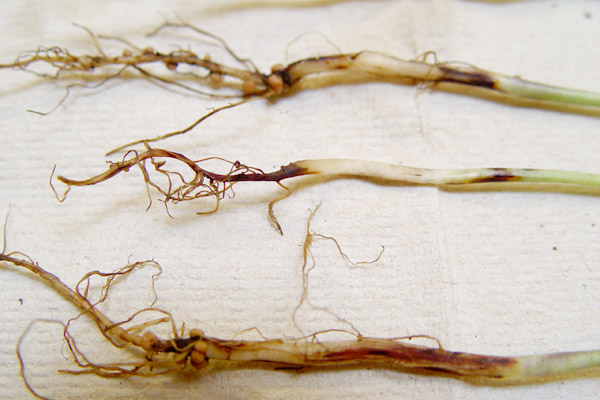
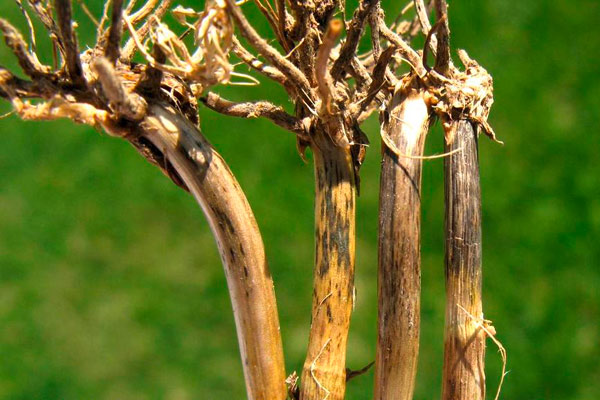
In recent years, diseases characterized by root and basal rot have been developing on wheat and barley with increasing frequency and over larger areas. The damage is of fungal origin and its diagnosis is complicated by the “hidden” nature of the injuries – necrosis of the roots and stem bases up to the first–second node. Subsequently, the diseased plants lag in their development and fail to form yield, which is why this group of diseases is among the most harmful.
The most common diseases in our country are Rhizoctonia root rot (R. cerealis), take-all (Gaeumannomyces graminis var. tritici), eyespot (Tapesia yallundae, syn. Pseudocercosporella herpotrichoides) and Fusarium root and basal rot (Fusarium spp.). In these diseases, necrosis usually progresses towards the aboveground parts, which may cause stem breakage, lodging of the plants or white heads. For the first three diseases, the development of patches is characteristic, whereas Fusarium can affect larger areas as well as the ears of the plants.
Some of the winter periods (including 2017) were also favorable for the development of snow mold (Microdochium nivale (= Fusarium nivale). In this disease, the damage is of a local type on the stem bases, but the pathogen may also cause leaf spotting.
Although the causal agents of the above-mentioned diseases are different fungi, they are preserved mainly through plant residues and soil, while short crop rotations (or the lack thereof) and milder winters favor the accumulation of inoculum and the increase of damage. Climatic factors are beyond the control of producers, and chemical treatments against these pathogens (with a partial exception in the case of early treatment against eyespot) are not effective. Therefore, to reduce losses, priority must be given to agronomic measures. The main role is played by a restorative crop rotation. The use of healthy seeds in combination with high-quality seed dressing, the avoidance of early sowing and optimal fertilization also help to limit the damage caused by diseases of the root system and stem bases of winter cereal crops.