

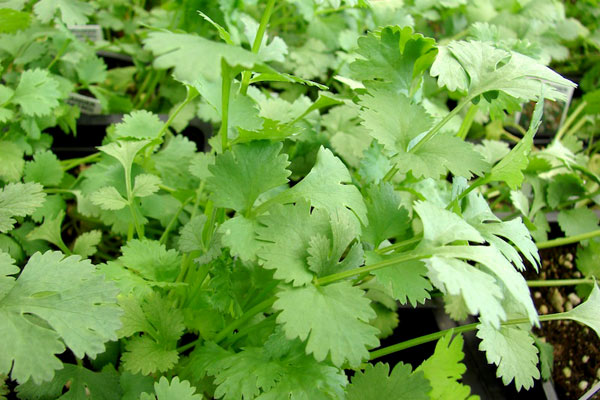
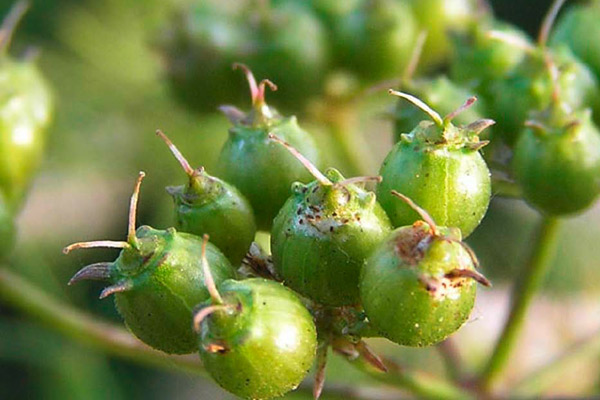
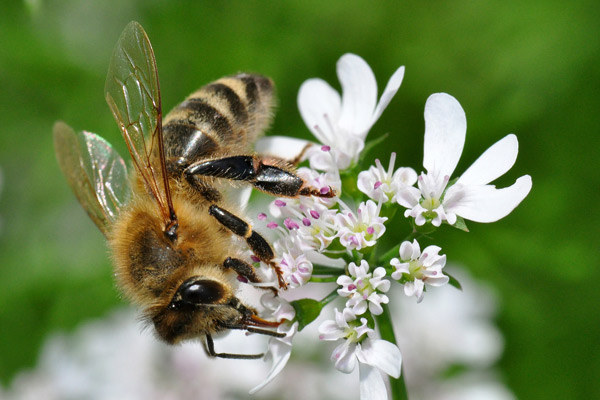
Coriander (Coriandrum sativum L.) is an important aromatic plant belonging to the family Apiaceae. In recent years its cultivated area has been considerable and has remained stable over the years, especially in Southeastern Bulgaria. Weed infestation, the development of diseases and pests in the fields are among the main adverse factors that limit its yield and quality.
In this crop a number of diseases occur, caused by viral, bacterial and fungal phytopathogens. In our country infections have been observed from the following diseases of major importance for the crop:
Bacterial blackening of fruits – Xanthomonas campestris pv. coriandri
The disease appears every year during the flowering period on the still green fruits at the top, but symptoms can also be observed on the flower stalks and on the non-lignified stems. Dark oily spots develop on them, which later become sunken and turn black. Under fa- vourable conditions for the development and spread of the bacterium, the attack on the fruits can reach 80–90%. The causal agent of bacterial blackening of the fruits can survive in coriander seeds and in plant residues.
Cercosporiosis – Cercospora coriandri
The pathogen forms spots on the leaves and flowers of corian- der. On the leaves the spots are limited by the venation, while on the flower stalks longitudinal brown spots can be observed, which may encircle them in a ring. On the affected plant parts a greyish-white sporulating mould develops. Infection of the plants occurs only in the presence of a water droplet. In moderately cool and rainy weather the fungus can completely compromise the harvest. The pathogen is preserved in the seeds and plant residues.
Ramularia leaf spot – Ramularia coriandri
The disease occurs in certain years but can compromise the harvest. It develops throughout the entire growing season, attacking all aboveground parts of the plant. Brown necrotic spots are formed on the leaves, stems, buds, flowers and fruits. Under humid conditions the buds and flowers die within a few days and the plants acquire a charred appearance. Initially the disease appears in foci, but under favourable conditions it affects the entire crop. The rapid spread is facilitated by the short incubation period of about 3 days and the abundant conidial sporulation of the causal agent. The conidia can cause secondary infections of the plants throughout the entire growing season. The fungus is preserved in infected seeds and plant residues.
Cucumber mosaic – Cucumber mosaic virus
The symptoms caused by CMV on coriander manifest themselves as a pronounced growth retardation of diseased plants compared to healthy ones. The infected plants acquire a stunted appearance due to shortened internodes and clustering of leaves. The lower leaves are almost entirely chlorotic and only narrow green stripes remain along the main veins. At the periphery the leaves turn red and dry from the bottom upwards. During the growing season the vi- rus is transmitted by aphids (Myzus persicae, Aphis fabae, Aphis gossypii).
In Bulgaria other diseases of coriander also occur, but they are of no economic importance. Two phytopathogenic fungi of the genus Erysiphe have been reported – Erysiphe umbeliferarum f.sp. coriandri and Erisiphe poligoni DC, causal agents of powdery mildew on essential oil crops. On the roots of the plants fungi of the genus Rhizoctonia most often develop – Rhizoctonia solani and Rhizoctonia bataticola, causing root rot of the plants. Coriander is attacked by numerous pathogens, many of which have not been identified in Bulgaria. Therefore, it is necessary to continuously carry out observations on the development and spread of diseases in the crop for the purpose of developing appropriate plant protection measures.
Control of coriander diseases
For the protection of coriander from diseases and for obtaining a healthy and high-quality harvest, it is necessary to follow the following agrotechnical measures:
● Destruction of all plant residues at the end of the growing season.
● Implementation of a 2–3-year crop rotation.
● Use of healthy seeds.
● Sowing of coriander should be carried out within the optimum time frame and at optimum plant density.
● Cultivation of the crop should be carried out under conditions of a high agrotechnical level.
● Removal of primary virus-infected plants.
The alternation of contact and systemic fungicides provides excellent results against coriander diseases.
Journal „Plant Protection”, No. 8-9/2013