

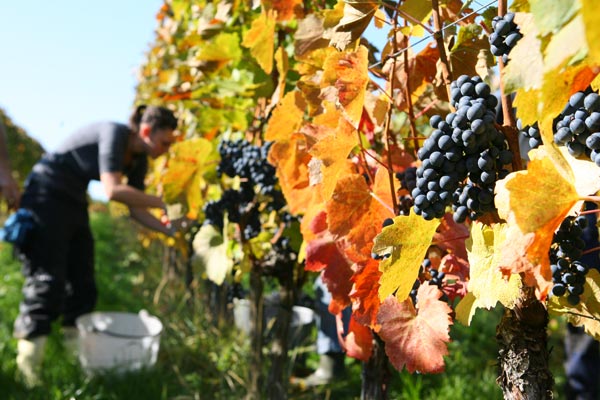
Continue harvesting the medium-ripening table grape varieties. For fresh consumption, pick the bunches whose berries have the colour specific to the variety and a pleasant taste and aroma. If the region has a warm and dry autumn, you can leave bunches on the vine up to a month and a half after ripening. Horizontal high-stem training systems /pergolas, arbours, tunnel-shaped constructions, etc./ are suitable for this purpose. When the berries start to colour, cover the vines with polyethylene or with rain-resistant paper or plastic bags. If you tie the bags to the grape stalks, pierce their bottoms so that the grapes can be ventilated.
If you are keen on home-made products, try
Grozdenitsa (Preserved Grapes)
Use sound grapes with firmer berries – Bolgar, Dimyat, Hamburg Misket, etc. The bunches are cleaned, arranged in a thin layer on some kind of mat in the shade and left for 5–7 days to wilt. Then they are placed in glass jars, and each layer of about 15 cm is sprinkled with mustard seed /it has a preserving effect and gives a piquant taste/.
It is very important that the must with which the grapes will be poured is pre-stabilised. In this way the acids will be neutralised. First, the must is warmed and calcium carbonate is added /30 g/10 l/. Then it is heated until it boils. It is removed from the heat and after a few hours, when the sediment has settled, the clear liquid is transferred to another vessel /preferably a wider one/. It is boiled until it thickens /until the volume is reduced by half/. The grapes are poured over with this cooled must.
Grozdenitsa must be stored in well-sealed containers in a cool room. Sometimes a slight fermentation occurs in it, which imparts a pleasant tangy taste. Consumption of Grozdenitsa can begin immediately after preparation.
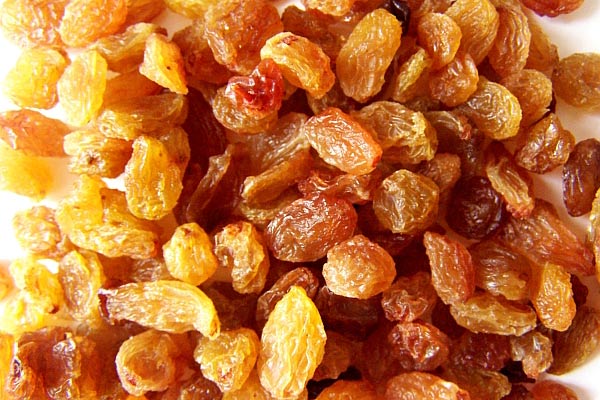
Raisins
In regions with a sunny and prolonged autumn, the bunches are placed in shallow crates with wire mesh bottoms. From time to time they are turned. If it starts to rain, they are covered on top with tarpaulin, but not tightly. More precisely – tents are made. After 10–15 days the raisins are ready. It is advisable that the drying of the raisins takes place in the shade or in well-ventilated premises. Then they have a better colour, a stronger aroma and are more elastic.
When the warm and dry days are fewer, it is advisable to keep the grapes in an ordinary oven at a temperature of 75 degrees until the berries wilt /but without burning/, and then finish drying them in the sun or in the shade.
Natural Grape Juice
Well-ripened grapes from wine varieties are cleaned of dry and rotten berries and washed well. The berries are stripped from the stems and crushed. The juice /must/ is strained through cheesecloth or a strainer into an enamel or glass container. For 1 l of juice, 1 g of sodium benzoate is added. The clear part /without the sediment/ is poured into bottles, which must be stored in a room with a constant temperature.
From about 2.5 kg of grapes of the wine variety Muscat Ottonel, 1 l of natural juice is obtained.
Wine and Rakia (Grape Brandy)
The Institute of Viticulture and Enology in Pleven has developed special tables for calculating the sugar content of grape must to facilitate all enthusiasts of home-made wine and rakia. You can see them HERE.