

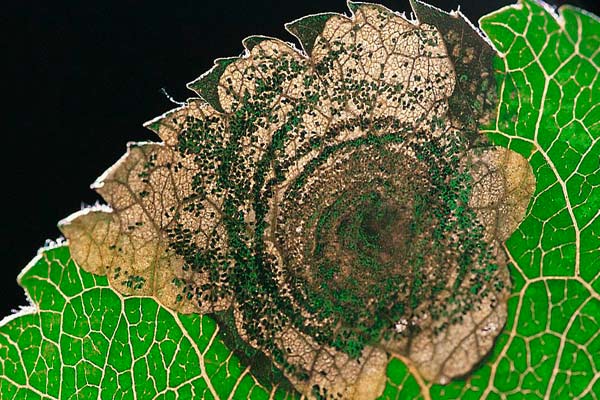
Insects have been passing onto cultivated plants for millennia, a process that continues to this day. During this period, a large part of them have changed their feeding specialization – zoophages have turned into phytophages, phytophages into zoophages, neutral species into phytophages or zoophages, etc. Phytophages gradually adapt to feed on specific parts of the plants – roots, stems, fruits, seeds, leaves, etc., and some of them specialize in feeding on a part of a given organ. Such are the leaf-mining insects, which feed only on the parenchyma of the leaves, without damaging the epidermis, the veins or the petiole.
This group includes mainly microlepidoptera and certain groups of flies, although species from other groups of harmful insects also cause mining. By feeding on the parenchyma of the leaves, leaf-mining insects reduce photosynthesis and increase the intensity of respiration, transpiration, water loss and other processes that negatively affect the growth, fruiting and longevity of plants. It is known that about 90–95% of the dry matter used for building the other organs, including the fruits, is a product of photosynthesis. Leaf-mining insects are classified as so-called physiological pests – they damage the “laboratory” of the plants – the leaves.
In cases of severe infestation, the damage has a fatal impact on the quantity and quality of the production and on the lifespan of the plants (tomato leaf miner, potato tuber moth, etc.). In the case of the apple leaf-mining moth, apple trees gradually shift to alternate bearing and eventually to complete sterility.
Leaf-mining insects are constant pests on many crops (mainly in greenhouses), as well as on tobacco and seed potatoes. The damage is manifested by the formation of “mines”, mainly on the upper side of the leaves, with different shape, coloration and position. Often the mines are numerous and occupy the entire leaf surface.
Control of leaf-mining insects is difficult due to the concealed way of life of the larvae, but currently a large number of products (for tomato leaf miner and leaf-mining moths on fruit crops) and effective parasitoids against leaf-mining flies harmful in greenhouses are authorized for practical use. Control is effective when it is organized in good time and carried out properly and with suitable plant protection products.