

Plant biostimulants are innovative products with a wide spectrum of action. The composition of these products is extremely diverse and depends both on the raw material source and on the additional substances introduced during their production. At present, in the European Union there is no adopted regulatory document governing the category “biostimulants” in agriculture. Companies that are manufacturers or importers of biostimulants most often register them as fertilizers or fertilizer products (EC 2003/2003; paragraph 2 of 13.10.2003), but present them in a broader context – not only as a source of beneficial nutrients, but also as means for counteracting abiotic and biotic stress in plants, improving the quality of crop production, stimulating growth and productivity, and others.
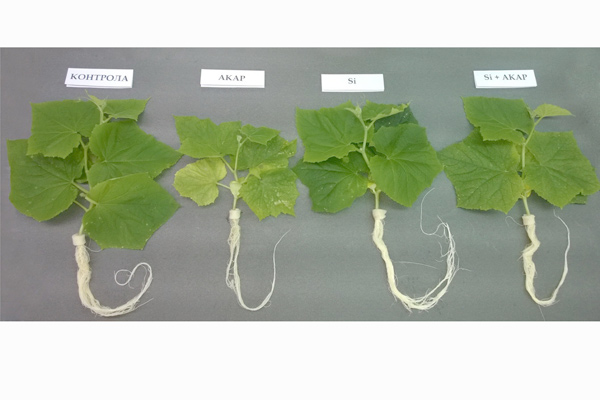
In the Department of Plant Physiology and Biochemistry at the Agricultural University in Plovdiv, laboratory experiments have been conducted, one of which examined the effect of silicon on the development of the two-spotted spider mite (Tetranychus urticae Koch). Young cucumber plants of the variety Gergana, grown as a hydroponic culture, were infested with the mite and supplied with 1.5 mM silicon. Twenty days after infestation, the development of the pest and its impact on the plants were studied.
The plants infested with the mite exhibited suppressed growth of all organs. The negative effect of mite feeding was less pronounced on the plants with added silicon in the nutrient solution. The biometric parameters of these plants – fresh and dry mass, length and height – had higher values than those of the infested plants without silicon in the medium.
Inorganic biostimulants – chlorides, phosphates, phosphites, silicates, carbonates, etc., can be regarded as alternative means for plant protection. They exert a preventive and curative effect on infected and infested plants. On the other hand, their application is maximally sparing to human health as well as to the natural enemies of phytophagous pests. Some of these products are included in the list of authorized products for organic farming. A broader application of inorganic biostimulants in integrated plant protection systems requires the implementation of systematic research on the mechanisms of their action on plants and pests.