

In recent years, farmers have been concerned about the occurrence and spread of diseases, mainly on ornamental shrubs, some leafy vegetables and herbs (for dishes and preserves). The monitoring carried out shows that causal agents of diseases have appeared which are still unknown in practice and for which the literature information is insufficient. In the period 2015–2016, studies were conducted on vegetation heavily affected by diseases.
Aspen (Populus tremula)
Leaf spots /Marssonina castageni/.
At first, light brown spots with a darker border on the side are found on the leaves. At a more advanced stage these spots bleach in the centre and become “pimpled” with black dots – the acervuli of the fungus (Fig. 4). Severely affected leaves scorch and premature defoliation occurs.
Control:
Early treatments should be carried out with copper-containing fungicides, Dithane M 45 - 0.25% or Captan - 0.3%.
Cranesbill (Geranium macrorrhizum)
Powdery mildew (Sphaerotheca humuli).
A greyish-white, spore-forming mycelial coating develops on the leaves (Fig. 5). At a later stage black dots – the cleistothecia of the fungus – are observed. Symptoms are also found on the flowering organs. At an early stage the disease attacks the young, tender shoots, on which a fine white coating develops.
Control:
- Use healthy planting material.
- At the first appearance of the disease, spray with sulphur-containing products.
- When the plants are severely affected, the above-ground mass should be cut and burned and then treated with Topsin M - 0.1%, Bayfidan 250 EC - 0.01%, Folicur 25 EC - 0.08% or with clear formalin - 0.6%, combined with wettable sulphur.
Garden sorrel (Rumex patientia) and common sorrel (Rumex acetosa)
Rust (Uromyces rumicis) - a new disease of garden sorrel and common sorrel in our country.
On garden sorrel (Rumex patientia) and common sorrel (Rumex acetosa) slight swellings initially form on the leaf epidermis and, after it ruptures, a powdery mass of urediniospores and teliospores of the pathogen appears. Very often new circles of secondary sori form around the first sori. Severely affected leaves wilt rapidly and become necrotic (Fig. 6).
Powdery mildew (Erysiphe poligoni, Oidium poligoni) - a new pathogen on garden sorrel and common sorrel. A white, loose coating develops on the leaves, which rapidly spreads over the leaf blade. Severely attacked leaves wilt and the tissues become necrotic (Fig. 7). Diseased plants produce fewer and smaller leaves. Damage is more severe when rust and powdery mildew occur together.
Control.
· Earlier harvesting of the crop.
· Implementation of preventive measures, whereby severely affected leaves and stems are cut and burned and afterwards treated with sulphur-containing products.
· In the presence of both diseases, treatment with sulphur-containing fungicides should be carried out already at the beginning of vegetation.
Lemon balm (Melissa officinalis)
Powdery mildew (Golovinomyces biocellatus) - a new disease of lemon balm. On both sides of the leaf blade a white, powdery coating forms, which later acquires a greyish tinge. Mycelium also develops on the petioles, branches and floral organs (Fig. 8). By the end of summer the cleistothecia of the fungus are formed. The pathogen survives as cleistothecia in plant residues and as mycelium on the rhizomes.
Leaf spots (Phyllosticta decidua) - a new disease of lemon balm (Fig. 9). Small spots with a brown border and black dots – the pycnidia of the fungus – are found on the leaves. In addition to on the plants, the pathogen also survives in the residues in the soil.
Control.
· When the crop is heavily infested and damage is also found on the stems, the affected parts must be collected and burned.
· Early in spring, treat with sulphur-containing products, and for leaf spots use copper-containing products. The fungicide Topsin M is effective against both diseases.
Fenugreek (Trigonella foenum graecum)
Powdery mildew (Erysiphe poligoni). The disease develops on all organs – leaves, stems, flowering branches. A dense, fluffy, greyish-white fungal coating forms on them. Severely affected plants wilt and dry out.
Control.
Preventive spraying with sulphur-containing products should be carried out. Seed-production stands can be treated with Topsin M - 0.1% or Folicur 25 EC - 0.08%.
Celery (Apium graveolens)
Powdery mildew (Erysiphe heraclei). A white ectophytic mycelium develops on the affected organs of the plants. Symptoms are also observed on the compound umbels, including the petals and the fruit (Fig. 10). The pathogen is also reported on carrot, parsley and parsnip. It overwinters as mycelium on green organs and as cleistothecia in plant residues.
Control.
Plant residues should be destroyed and, when necessary, the plants should be sprayed with thiophanate-methyl.
Parsley (Petroselinum sativum)
In 2016, mass damage from powdery mildew and leaf spots was observed.
Powdery mildew (Lycium barbarum). A dense, white, spore-bearing coating of mycelium and fungal spores with black dots – the cleistothecia of the pathogen – forms on the leaves.
The fungus also attacks dill.
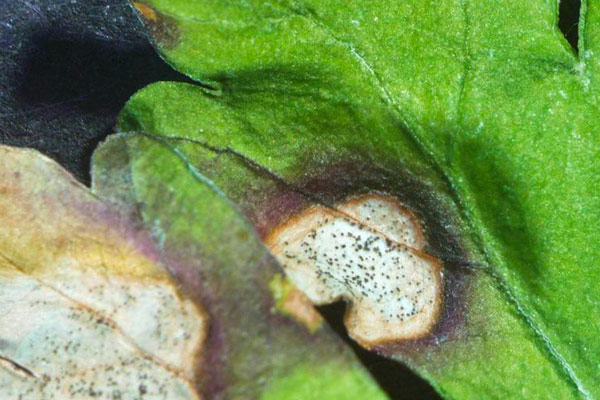
White leaf spots (Septoria petroselini). In 2016 the disease appeared massively in individual stands. The pathogen is seed-borne and, probably, infected seeds were used for sowing where symptoms appeared. The symptoms are easily recognised. Small spots appear on the leaves, initially dark, and later with a distinct whitish centre, with black dots on them – the pycnidia of the fungus.
Damage is very severe when both diseases occur together.
Control. When parsley is grown in places where parsley has been previously grown, or when there is suspicion that the seeds are infected, before sowing the soil should be treated with Topsin M – 50–60 g/m² or, after sowing, instead of watering with water only, irrigate with 0.1% Topsin M. When the disease appears later, after harvesting (cutting the parsley), treat twice with Topsin M - 0.1%.
Goji berry (merdzhana) (Lycium barbarum)
Powdery mildew /Arthrocladiella mougeotii/.
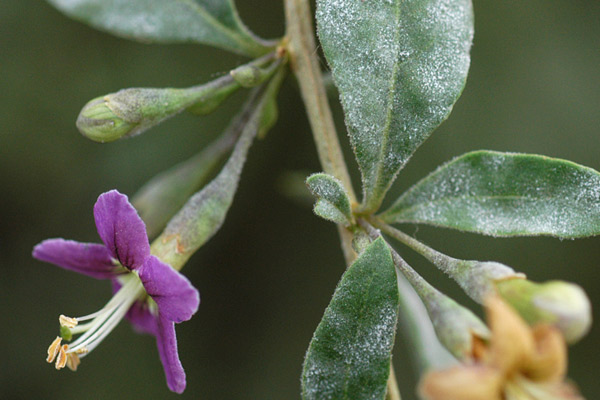
A superficial, greyish-white mycelial coating forms on the leaves, stems and fruiting branches. Under severe powdery mildew infestation, defoliation occurs earlier (Fig. 11).
Control:
· Preventive treatments should be carried out by drenching the plants with thiophanate-methyl and sulphur-containing products.
· In case of more severe infestation, spraying with clear formalin - 0.5% may be carried out in the cool hours – in the morning, or preferably after 19–20 h.