

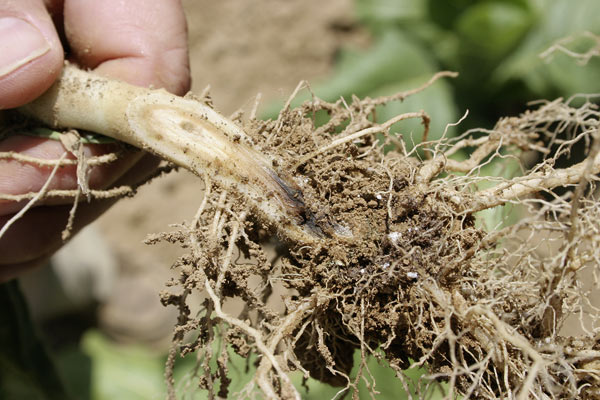
Diseases and pests attack roots, root crops and tuber crops
Part I
In this issue:
- Diseases of the roots of fruit trees
- Soil-borne pathogens of vegetable crops
- Diseases of the root system and stem bases of winter cereals
- Phytopathogens of tobacco roots
Pests of the underground parts of cultivated plants are a group that poses a serious threat to cultivated crops. The damage they cause can result in significant losses for producers of plant products. Among the pathogenic bacteria, species of the genus Agrobacterium, renamed in recent years to Rhizobium, are particularly dangerous. The most widespread species of this genus is Rhizobium radiobacter (Agrobacterium tumefaciens), which is distributed throughout the country, but is of economic importance for fruit nurseries. The pathogen causes the formation of tumours of various sizes on the roots or at the base of the stem, which impede sap flow. The attacked plants become weakened and very often, after the tumours disintegrate, the roots are infected by a number of pathogenic fungi that cause rot.
The underground parts of plants – roots, root crops and tuber crops – are attacked by fungi belonging to the genera Pythium, Plasmodiophora, Fusarium, Spongospora, Rhizoctonia, Phythophthora, Sclerotinia, Rosellinia, Armilaria, Sclerotium, Verticillium, Thielaviopsi.
Species of Pythium, Fusarium, Rhizoctonia, Phythophthora, Sclerotinia cause damping-off of seedlings. This disease attacks vegetable crops at the earliest stage of their development. Damping-off causes serious damage to lettuce, cabbage, pepper, eggplant, tomato and cucumber. The disease may appear as early as seed germination, and the sprouts die in the soil. After emergence, the fungi attack the stems of young plants, as a result of which the stem constricts and the plants fall as if cut down. Damping-off develops in patches, by which it can easily be recognized.
The fungi Fusarium solani and Rhizoctonia solani cause root rot in a large number of vegetable and field crops.
The two species Sclerotinia sclerotiorum S. minor are causal agents of sunflower wilt. Hosts of Sclerotinia sclerotiorum are tomato, potato, alfalfa, clover and others.
Species of the genus Botritis attack onion and garlic. B. alli causes neck rot of onion, and B. pori – grey rot of garlic – a disease that is widespread and in certain years causes significant damage.
Pathogenic species of the genus Phythophthora cause phytophthora root and collar rot in fruit species. Infected plants are severely stunted in their development, their leaves turn yellow, wilt and fall prematurely. The apical parts of the shoots wilt and, in the case of severe infection, the whole tree dies prematurely. Symptoms on the roots and the root collar are the most typical for this disease. When the bark is peeled, it is visible that the wood is coloured brownish-red and the diseased part is sharply demarcated from the healthy tissue by a darker separating band. In our country, 5 species of the genus Phythophthora have been identified on fruit crops, of which the most widespread is Phythophthora cactorum. On strawberry, Phythophthora fragaria, which causes root rot, is harmful.
Fungi of the genus Verticillium are soil-inhabiting and penetrate plants through the roots. They develop in the conducting vessels and cause their blockage, and also secrete toxins, as a result of which the plants wilt.
V. albo-atrum mainly attacks potato, sunflower, rose, mint, hop, pepper and strawberry, while V. dahlia – cotton, stone fruit species, pepper, eggplant and others.
A dangerous pest of cruciferous crops is the fungus Plasmodiophora brasicаe, which infects the roots and causes hypertrophy and hyperplasia, as a result of which tumours are formed.
Tobacco roots are attacked by the fungus Thielaviopsis basicola, which causes damping-off of seedlings in the seedbeds and later root rot of transplanted plants. Under favourable conditions for the development of the fungus, it causes significant damage.
On the roots of cereal crops, the fungi Ophiobolus graminis, Cochliobolus sativus and Fusarium graminearum, which cause root rot, are harmful. Fusarium graminearum also damages maize.
Grapevine is a host of the fungus Rosellinia necatrix, which attacks the roots and causes them to rot.