

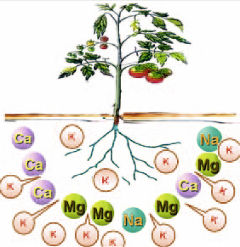
The ratio between ions in the nutrient medium affects the uptake of individual ions and is a common cause of nutritional disorders in plants. This interaction is expressed in the phenomena of antagonism and synergism:
Antagonism is a phenomenon where ions hinder each other's uptake by the plant. These are ions with the same electrical charge and similar properties. It occurs when the concentration of a given ion in the soil (nutrient) solution increases. For example, an excess of nitrogen leads to the "disappearance" of available copper; an excess of potassium leads to a magnesium deficiency, etc.
Synergism is a phenomenon where ions assist each other in their uptake by plants. It is observed between cations and anions, i.e., ions with different properties and charges. For example: potassium, calcium, and magnesium cations have a stimulating influence on the absorption of the nitrate anion (NO3-) and the phosphate anion (PO4-3).
Achieving a balance of nutrients, i.e., the physiological equilibrium of the soil or nutrient solution, is a primary means of managing plant nutrition.
The reaction of the nutrient medium is one of the main factors for plant nutrition, as it strongly influences the absorptive capacity of root cells and the dynamics of nutrients. The reaction of a medium is determined by the concentration of hydrogen cations (H+) and hydroxyl anions (OH-) in it.
Climatic factors– light, temperature, air humidity, and carbon dioxide content, are the dominant ecological factors responsible for photosynthesis, which occupies a central place in the metabolism of green plants. The influence of climatic factors on photosynthesis affects the chemical and biochemical processes, and hence – the growth and development of plants, i.e., their nutrition.
High solar radiation causes damage to leaves and the exposed side of fruits, known as sunscald. It is caused by direct sunlight, which can raise the surface temperature of leaves and fruits by over 10°C compared to shaded leaves and fruits. Symptoms are loss of pigmentation similar to scalding.
High temperature, even for a short period, impairs the growth of the above-ground parts and roots, worsens pollination, and causes abortion. With more prolonged exposure, it disrupts photosynthesis and respiration and leads to leaf dehydration.
Air humidity directly affects plants. It limits transpiration, and this reduces the uptake of nutrients, especially calcium (Ca). Fluid is secreted at the leaf tips in the form of droplets. The effect is intensified when combined with high soil moisture. This can lead to leaf margin scorch. It slows growth and increases the risk of fungal diseases.
Damage from air pollution. Some of the main air pollutants are gases, such as ozone (O3), oxidized and reduced forms of carbon (carbon dioxide – CO2, carbon monoxide – CO, methane – CH4), sulfur dioxide (SO2), nitrogen oxides, ammonia, etc. They can have a direct toxic effect, or indirectly and more long-term affect plants by changing the soil pH, followed by the dissolution of toxic metal salts such as aluminum.
DIAGNOSIS OF GENERAL SYMPTOMS
Each plant species is unique and has specific requirements for the nutrient spectrum. However, under nutritional stress, visual symptoms common to all plants are observed, for the identification of which the following terminology is used:
Chlorosis is the yellowing of plant tissue due to limited chlorophyll synthesis in the leaves and reduced photosynthesis activity. It can spread over the entire leaf surface, along the leaf margins, or form spots or streaks. In some cases, it is accompanied by premature leaf drop, small leaves, drying of shoot tips, death of active roots. Possible causes of chlorosis are poor drainage (waterlogged soil), damaged roots, compacted soil, high alkalinity, sulfur dioxide in the air and/or deficiency of iron, magnesium, nitrogen, etc.
Interveinal chlorosis. Symptoms are yellowing of the tissue between the veins, while the veins themselves remain green.
Necrosis is the irreversible cessation of cell life activity, as a result of which the tissue turns brown and dies. It can manifest on different parts of the plant – leaves, stems, fruits, petioles, roots. It can appear as spots of various sizes and shapes or cover a large part of the plant tissue. It is caused by a deficiency (low levels of phosphorus, potassium, nitrogen, boron, iron, and nickel) or excess of nutrients, an unfavorable soil reaction (pH) for the cultivated crop.
Leaf scorch. Scorch is the browning of the leaf periphery. In some cases, the symptoms may continue inward between the veins as spots and the entire leaf may dry out. The cause is dehydration of leaf tissue as a result of unfavorable climatic factors and a weak, inactive root system, especially during a period of active growth; soil drought or waterlogging.
Local symptoms. These are symptoms that are limited to a single leaf, part of a leaf, or part of the plant.
Stunted or arrested growth. Symptoms are expressed in a reduction in the height of affected plants. In some cases, the plant takes on a bushy appearance – becomes stunted.
Anthocyanin coloration. It is expressed in the accumulation of the pigment anthocyanin, giving the leaves a red-violet to lilac coloration. The main cause is an increase in sugar content during phosphorus starvation. For correct visual diagnosis, it is important to know the morphological characteristics of a healthy plant in order to assess any deviations in the appearance of plants, their growth and development, and the quality and yield of the product.
An important step in visual diagnosis is to clarify the zone of symptom manifestation – the entire leaf, leaf periphery, interveinal tissue, veins. When identifying morphological changes in plants, the following should be considered. If only the leaf veins are yellow, the cause is not in the nutritional regime. If the morphological changes affect individual plants but spread over groups of plants, the cause is in past treatment of the soil or plants.
/Continued in issue 3/2014/
[1] Guttation (from Lat. gutta – drop) – secretion of excess water in the form of droplets on the leaves when plant roots absorb more water than the leaves transpire. Unlike dew (condensed water vapor present in the air), guttation consists of droplets of a solution of various chemical substances, coming from the roots and stems.