


In June, air temperature and humidity are suitable both for the growth of fruit crops and for the occurrence and development of economically important pests on them. During the month, the fruits of the fruit species increase rapidly in size, and some ripen.
POME FRUIT SPECIES
Main pests for the period
Apple and pear scab Venturia inaequalis; Venturia pirina
Powdery mildew on apple Podosphaera leucotricha
Fire blight Erwinia amylovora
Coddling moth Laspeyresia pomonella = Cydia pomonella
Round leaf-miner moth Cemiostoma scitella = Leucoptera malifoliella
San Jose scale Quadraspidiotus perniciosus
Aphids fam. Aphididae
European red mite Panonychus ulmi
Powdery mildew on apple
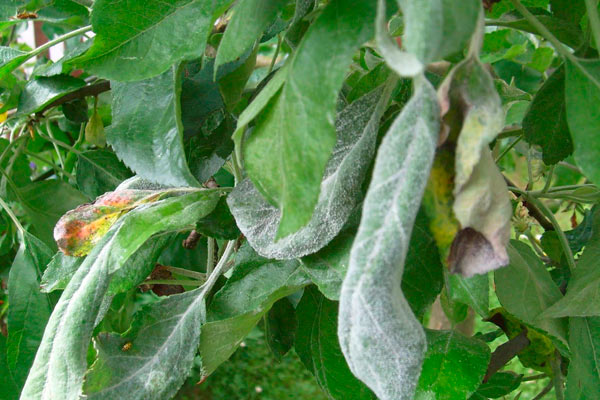
Leaves attacked by the disease are small, elongated, boat-shaped curled, light green and entirely covered on the underside with a powdery coating. Infected shoots have shortened internodes, are small and covered with grey-white mycelium. On the fruits, the spots are like a rusty net that penetrates the tissues to varying depths. If there are frequent showers during the month, the development of powdery mildew is suppressed due to the washing off of a large part of the spores with which it infects.
Strategy for pest control
During the vegetation period, spraying is carried out every 10–12 days until the development of the disease is limited, using one of the authorised plant protection products.
Authorised plant protection products: Bayfidan 250 EC - 0.015%; Belis – 80 g/da; Kumulus DF - 0.6–0.9%; Luna Experience - 20–75 ml/da; Systhane 20 EW - 28–42 ml/da; Systhane Ecozom EW - 60–185 ml/da; Score 250 EC - 0.02%; Strobi DF / Discus DF - 0.02%; Thiovit Jet 80 WG - 600 g/da; Topsin M 70 WDG - 0.12%; Flint Max 75 WG – 0.02%; Shavit F 72 WDG - 0.2%.
Coddling moth
In June, the larvae of the first generation cause damage. They feed on the seeds and the seed capsule, which they destroy completely. One larva damages 2–3 fruits. The damaged fruitlets fall off, and moulds develop in their core. The damage often remains unnoticed due to the June fruit drop. After completing its feeding, the larva leaves the damaged fruit. It descends on a silk thread or crawls along the trunk and, in the bark crevices, spins a cocoon in which it pupates.
Strategy for pest control: Chemical treatment is carried out against hatching larvae before they bore into the fruits at the economic injury level (EIL) for the first generation: 0.8–1% fresh entries in the fruits.
Authorised plant protection products: Aphicar 100 EC - 30 ml/da; Affirm 095 SG - 300 g/da; Vazak New 100 EC - 0.0125%; Deca EC / Desha EC / Dena EC - 30 ml/da; Decis 2.5 EC - 0.03%; Decis 100 EC - 7.5–12.5 ml/da; Diclain 2.5 EC – 0.03%; Dimilin 25 WP - 0.04%; Dukat 25 EC - 30 ml/da; Dursban 4 EC - 150–187 ml/da; Efzimetrin 10 EC / Cyper 10 EC - 30 ml/da; Calypso 480 SC - 20–25 ml/100 l water; Karate Zeon 5 CS – 0.02%; Coragen 20 SC - 16–30 ml/da; Lambada 5 EC - 15 ml/da; Madex Twin - 10 ml/da; Madex Top - 10 ml/da; Meteor - 60 ml/100 l water; Nexide 015 CS – 0.03%; Pyrinex 48 EC – 0.12%; Proteus O-TEC - 0.05–0.06%; Ranner 240 SC – 0.04%; Reldan 40 EC – 0.12%; Sineis 480 SC - 20–37.5 ml/da; Sumi Alpha 5 EC / Sumicidin 5 EC – 0.02%; Supersect Mega / Supersect Extra – 0.015%; Fury 10 EC – 0.0125%; Cyclone 10 EC - 30 ml/da; Cyperfor 100 EC - 30 ml/da; Sherpa 100 EW / Aphicar 100 / Cyperfor 100 EW / Cyclone 100 EW - 30 ml/da; Sherpa 100 EC - 30 ml/da.
STONE FRUIT SPECIES
Main pests for the period
Cherry leaf spot (Cylindrosporiosis) on sweet and sour cherry Blumeriella jappii
Powdery mildew on peach Sphaerotheca pannosa
Late brown rot Monilinia fructigena
Cherry fruit fly Rhagoletis cerasi
Plum fruit moth Laspeyresia funebrana = Grapholita (Aspila) funebrana
Oriental fruit moth Grapholitha molesta
Peach twig borer Anarsia lineatella
Powdery mildew on peach
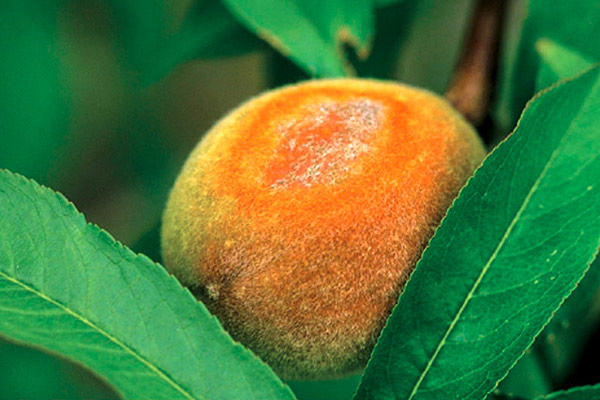
The systemic form of the disease develops as a result of infection located in the vegetative buds and appears on the shoots, which are underdeveloped, deformed and entirely covered with a powdery coating. The local form of the pathogen appears on the young developing fruits, which become covered with powdery spots – these enlarge and cover a significant part of the surface. After some time, the powdery coating falls off, and the fruit flesh underneath becomes corky, lignified and cracked.
Strategy for pest control: Treat upon detection of the first spots, and subsequently at intervals of 10–12 days until fruit enlargement.
Authorised plant protection products: Difcor 250 SC - 20 ml/da, Luna Experience - 50 ml/da, Score 250 EC - 0.02%, Signum - 0.045%, Systhane 20 EW - 15.0–36.0 ml/da, Systhane Ecozom EW - 65–200 ml/da, Thiovit Jet 80 WG - 600 g/da, Topaz 100 EC - 0.03%.
Plum fruit moth
During the period, moths of the second generation of the pest are flying. The females lay eggs on the day after their emergence. The hatching larva bores into the fruit immediately next to the place where the egg was laid and excavates a gallery in the fleshy part of the fruit around the stone, which is filled with rounded granular excrements and frass. The damaged fruits prematurely show signs of ripening and fall off.
Strategy for pest control: Chemical treatment is carried out against the larvae at the moment of hatching and boring, at EIL for the second generation: 1.5–2% fresh entries in the fruits;
Authorised plant protection products: Vazak New 100 EC – 0.0125%; Decis 2.5 EC – 0.05%; Decis 100 EC - 7.5–17.5 ml/da; Dimilin 25 WP - 0.04%; Dursban 4 EC - 150–200 ml/da; Eforia 045 ZC - 150 ml/da; Coragen 20 SC - 16–30 ml/da; Pyrinex 48 EC – 0.15%; Ranner 240 SC - 0.03%; Sumi Alpha
5 EC / Sumicidin 5 EC – 0.02%.