

During the month, the forecast maximum temperatures, in the range of 34-35ºC, will have a negative impact on flowering and fertilization of vegetable crops. The expected precipitation, mainly during the first half of the period, will maintain favourable conditions for the development of economically harmful fungal diseases in vegetables – downy mildews of vegetable crops, grey mould, leaf mould, etc. Where possible, after the rainfall has stopped, timely plant protection sprayings with authorised PPPs against the specified pathogens should be carried out. Plant protection sprayings must be performed during the cooler hours of the day, at an air temperature not higher than 25ºC.
GREENHOUSE PRODUCTION
Main pests for the period
Late blight (Phytophthora infestans)
Early blight (Alternaria porri f. sp. solani)
Leaf mould (Fulvia fulva)
Grey mould (Botrytis cinerea)
Downy mildew (Pseudoperonospora cubensis)
Powdery mildew on cucumber (Podosphaera xanthii)
Powdery mildew on pepper (Leveilula taurica syn. Oidiopsis taurica)
Tomato leaf miner (Tuta absoluta)
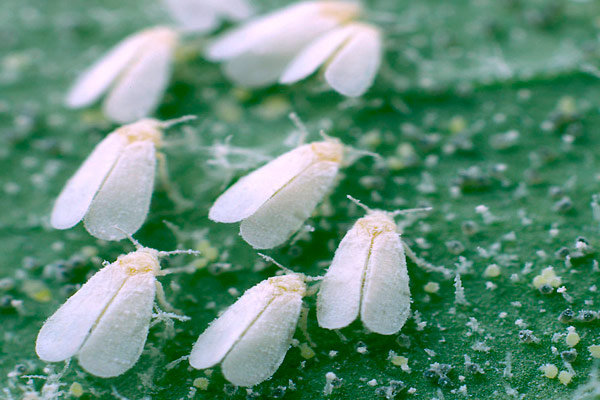
Greenhouse whitefly (Trialeurodes vaporariorum)
Cotton aphid (Aphis gossypii Glov.)
Thrips (Thrips tabaci, Frankliniella occidentalis)
Two-spotted spider mite (Tetranychus urticae)
Harvesting is carried out during the period, therefore PPPs with short pre-harvest intervals must be selected.
Tomatoes, cucumbers, peppers
Leaf mould (Fulvia fulva)
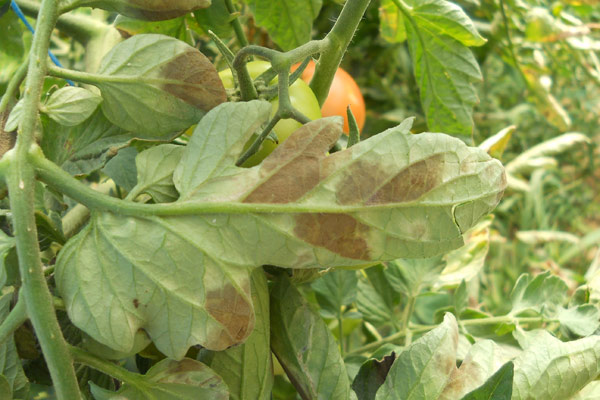
It mainly attacks tomatoes grown in protected cultivation facilities. Its economic importance is particularly great for plastic-covered greenhouses. On the upper side of the leaves relatively large, pale spots appear, with irregular shape and indistinct margins. Later they turn yellow. Under conditions of high air humidity, their lower surface is covered with a light coating of the fungal sporulation, which later darkens and becomes velvety brown. This is the most typical diagnostic symptom of the disease. When the number of spots on a leaf is significant, they coalesce and the leaf burns out. Under favourable conditions for the development of the fungus, the crop may be defoliated, which greatly reduces yield.
Strategy for pest control
Growing resistant tomato varieties. Optimal plant density. Regular ventilation of greenhouses. Maintaining an optimal temperature-humidity regime (air humidity below 70% and temperature 18-220C). Removal of old leaves.
Authorised plant protection products: sinstar – 70-80 ml/da, and cidely top – 100 ml/da.
Grey (Botrytis) rot (Botrytis cinerea)
It attacks plants in all stages of their development. In young plants it most often damages the stem base, where a dry brown spot appears, initially affecting only the cortex. Later the pathogen penetrates inwards and may interrupt sap flow, as a result of which the plant dies. On petioles and leaf tips, light brown elongated spots appear. Under conditions of high air humidity, the spots are covered with abundant grey-brown mycelium and sporulation of the fungus. The development of the disease on fruits most often starts from the peduncle cavity, where the tissues lighten and soften. Later they are covered with abundant sporulation.
Strategy for pest control. Regular ventilation of greenhouses. Suckering should be carried out in the later hours of the day, after the dew has evaporated. Maintaining an optimal temperature-humidity regime.
Authorised plant protection products: arvak 50 WG – 150-200 g/da; difcor 250 SC – 50 ml/da; driza WG – 150-200 g/da; prolectus 50 WG – 80-120 g/da; rebut WG – 150-200 g/da; sabueso – 150-200 g/da.
Greenhouse whitefly (Trialeurodes vaporariorum)
Adult whiteflies are active at night, when they fly short distances. During the day they hide on the underside of the leaves and fly only when disturbed. The larvae, nymphs and adults cause damage. They suck sap mainly on the underside of the leaves of plants. During feeding the larvae excrete large amounts of sugars in the form of honeydew, as a result of which the leaves become sticky. Sooty mould fungi develop on it and the physiological processes of the attacked plants are disrupted.
Strategy for pest control. To monitor the occurrence and population density of whitefly, yellow sticky traps should be used. At low density in greenhouses, the biological control agent Encarsia formosa may be introduced.
Authorised plant protection products. For tomatoes and cucumbers: admiral 10 EC – 0.05%, actara 25 WG – 0.03%, via drip irrigation system actara 25 WG – twice – in young plants up to 6 weeks of age: 1st application – 10-14 days after transplanting (40 ml/da); 2nd application: 14 days after the first (40 ml/da) – once – in plants older than 6 weeks (80 ml/da), bi-58 – 0.1%, vaztak nov 100 EC – 0.03%, deca EC/desha EC/ dena EC – 50 ml/da, decis 2.5 EC – 0.05%, eforia 045 ZC – 125 ml/da, confidor energy OD – 0.08%, lanate 20 SL – 125 ml/da, lanate 25 WP – 100 g/da, meteor – 80-90 ml/100 l water, mospilan 20 SG – 35-40 g/da, naturalis – 75-100 ml/da and fury 10 EC – 0.02%.
for tomatoes: brai – 50-112.5 ml/da, mospilan 20 SP – 0.02%, mulligan – 25-95 ml/da, proteus O-TEC – 0.05-0.06%.
FIELD PRODUCTION
Main pests for the period
Tomatoes, peppers, potatoes
Late blight on tomato and potato (Phytophthora infestans)
Phytophthora fruit rot on tomato (Phytophthora nicotianae var. parasitica)
Early blight of tomatoes, peppers and potatoes (Alternaria porri f. sp. solani)
Bacterial speck and spot of tomato and pepper (Pseudomonas syringae pv. tomato, Xanthomonas vesicatoria, X. gardneri)
Cucumbers, watermelons, melons
Downy mildew (Pseudoperonospora cubensis)
Fusarium wilt (Fusarium oxysporum f.sp. cucumerinum)
Angular leaf spot (Pseudomonas syringae pv. lachrymans)
Other vegetables
Downy mildew of cabbage (Peronospora parasitica)
Downy mildew of onion (Peronospora destructor)
Tomatoes, peppers, eggplants
Planthopper (Hyalesthes obsoletus)
Cotton bollworm (Helicoverpa armigera)
Cabbage
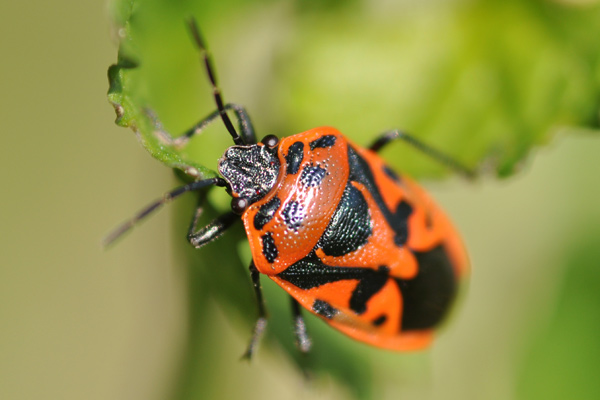
Cabbage bug (Eurydema ornata)
Cabbage flea beetles (Phyllotreta sp.)
Potatoes
Colorado potato beetle (Leptinotarsa decemlineata)
Tomatoes
Phytophthora fruit rot on tomato (Phytophthora nicotianae var. parasitica)
In young transplanted plants it infects the stem base up to the soil surface. Sunken water-soaked spots appear, which interrupt sap flow. The plants turn yellow, wilt and die. On fruits that are in contact with the soil, large grey-brown spots with dark concentric rings inscribed in them appear. This is the most characteristic damage, known as “deer eye”. From the lower trusses the infection spreads to the upper ones.
Strategy for pest control
Planting healthy seedlings. Over-wetting of the soil surface where the tomatoes touch it should not be allowed. Spraying the soil surface with a copper-containing PPP before the plants lodge on the soil.
Authorised plant protection products: All copper-containing PPPs registered against late blight.
Bacterial speck and spot of tomato and pepper (Pseudomonas syringae pv. tomato, Xanthomonas vesicatoria, X. gardneri )
They attack all parts of tomato plants. On leaves, stems, petioles and flower pedicels small black spots with a chlorotic halo around them appear. Under severe attack the leaf burns and dies. On fruits, the spots are initially water-soaked, and later become black, slightly raised, resembling scabs (bacterial speck/spot). In bacterial canker the spots are initially small, water-soaked, round or irregular in shape. On the upper side they are slightly sunken. Under severe attack the leaves scorch and die. When the flower pedicels are affected, the flowers drop. On fruits, the spots are small, water-soaked with a lighter border around them. Later they become brown to black and their epidermis cracks. The fruits are not marketable, and the pathogen may reach the seeds and infect them superficially. The bacterium survives in the seed coat, in plant residues and in the soil.
In pepper, the spots on the leaves are round, water-soaked and rapidly necrotise. Severely attacked leaves turn yellow and fall. The spots on the fruits are brown, slightly raised, similar to warts, and on the stems long narrow lesions may develop.
Strategy for pest control. Sowing disinfected seed. Planting healthy seedlings.
Authorised plant protection products: bordo mix 20 WP – 375-500 g/da; cuproxat FL – 0.3%; funguran OH 50 WP – 0.3%.
Cucumbers, watermelons, melons
Fusarium wilt (Fusarium oxysporum f.sp. cucumerinum)
The first symptoms are expressed in yellowing and wilting of the lowest leaves. Yellowing may start on one side of the plant, respectively on one of the vines. Gradually, the wilting moves upwards and affects the upper levels. Subsequently the whole plant wilts and dies. Initial discolouration of the vascular system is an important diagnostic sign. On a cross-section of the stem, darkening of the vascular bundles is observed. In case of early infection and stronger development of the disease, darkening is observed up to the stem tip and along the branches. This is one of the diagnostic symptoms of the disease. The fungus penetrates directly through roots and root hairs, even if they have no wounds. It develops in the vascular system, destroying and blocking it. It spreads through water, soil tillage and tools.
Strategy for pest control. Regular field inspections of crops. Removal of the first diseased plants. Preventive treatments with PPPs by watering the plants where the presence of the pathogen in the soil has been established.
Authorised plant protection products: watering with 0.1% topsin M.
Angular leaf spot (Pseudomonas syringae pv. lachrymans)
The first symptoms appear as small water-soaked, yellowish spots of irregular shape, delimited by the veins. In wet weather, small cloudy droplets of bacterial exudate appear on their lower surface. Later it dries as a white film over the spots. After they enlarge, the centre burns out and falls away. Angular, perforated spots remain on the leaves.
The disease also attacks the fruits. Small water-soaked spots of irregular shape are formed on them, covered with cloudy bacterial exudate. When they ripen, the damage penetrates deep into the tissues and reaches the seeds, infecting them. It survives in plant residues in the soil and in seeds. It is spread by raindrops.
Strategy for pest control. Sowing disinfected seed. Regular field inspections of crops. Preventive treatments with PPPs under favourable conditions for development of the pathogen.
Authorised plant protection products: bordo mix 20 WP – 375-500 g/da; cuproxat FL – 0.3%; funguran OH 50 WP – 0.3%.
Tomatoes, peppers, eggplants
Cotton bollworm (Helicoverpa armigera)
The larvae cause damage by gnawing the leaves, buds and flowers; at a later stage they attack the green fruits, bore into them and feed on their contents. Control treatments against the bollworm are effective when targeted at young larvae of the second to third instar. To cover a generation, two treatments at an interval of 8-10 days are necessary, depending on weather conditions and the residual effect of the insecticide.
Strategy for pest control. Regular field inspections of crops.
Authorised plant protection products. coragen 20 ml/da, avant 150 EC 25 ml/da; altacor WG 8-12 g/da, ampligo 150 ZC 40 ml/da, affirm 095 SG 150 g/da, nurelle D 80 ml/da and others. In organic production of vegetable crops it is possible to use rapax (Bacillus thuringiensis subsp. kurstaki, strain EG 2348) at a rate of 100-200 ml/da, registered for tomato, pepper and eggplant, and syneis 480 SC (spinosad) 12.5-30 ml/da.
Cabbage
Harlequin cabbage bug (Eurydema ornata)
Adults and nymphs cause damage by sucking sap from the young tender parts of cabbage plants and the tissues at the feeding sites die. Yellow-white spots appear on the leaves, which later darken and dry. Damaged plants lag in their development, form small heads, which very often are tasteless.
Strategy for pest control. Regular field inspections of crops.
Authorised plant protection products. upon occurrence of the pest, treatments may be carried out with the following products: decis 2,5 EC 50-70 ml/da; vaztak nov 100 EC 0.03%.