

In May, meteorological conditions are extremely favorable for the development and spread of numerous diseases and pests in fruit crops. During this period, pome fruit species enter from the phenophase “fruit the size of a hazelnut” to “fruit the size of a walnut”, and stone fruit species from the phenophase “fruit set formation“ to “fruit growth”.
Pome fruit species
Main pests for the period
Apple and pear scab Venturia inaequalis; Venturia pirina
Powdery mildew on apple Podosphaera leucotricha
Fire blight Erwinia amylovora
Coddling moth Laspeyresia pomonella = Cydia pomonella
Spotted tentiform leafminer Cemiostoma scitella = Leucoptera malifoliella
Pear psylla Cacopsylla pyri
San Jose scale Quadraspidiotus perniciosus
Aphids fam. Aphididae
European red mite Panonychus ulmi
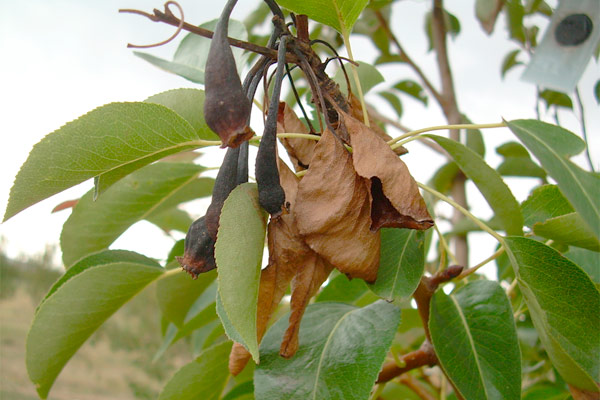
● Fire blight
Upon infection, young fruit sets and fruits acquire a brown to black coloration, dry out, mummify and remain attached to the fruiting twigs. Leaves and shoots wilt, dry out, and become brown in apple and dark brown to black in pear. The tips of the attacked shoots bend in a hook-like manner, more precisely acquiring the shape of a “shepherd’s crook”. In warm and humid weather, the infected parts are covered with yellowish droplets of bacterial exudate. In cases of severe attack, cankers form on the trunk and scaffold branches, the bark cracks, turns yellow and dries out.
Strategy for pest control:
When the disease is established, treatments with plant protection products should be carried out in autumn and early spring. In cases of severe infection during the vegetation period and in case of absolute necessity, pruning and burning of diseased branches is undertaken.
Authorized plant protection products:
bordo mix 20 WP - 375 - 500 g/da; vitra 50 WP / kuprohay 50 WP - 150 g/da; kocide 2000 WG - 155- 680 g/da; funguran OH 50 WP - 110-500 g/da.
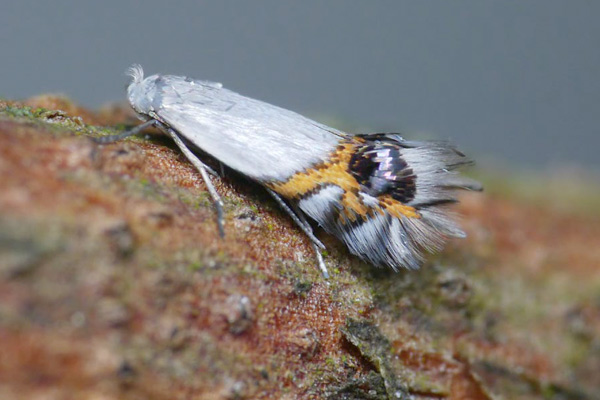
●Spotted tentiform leafminer
During the month, the development of the first generation of the pest takes place, mainly in the lower part of the crown. The caterpillars cause damage by boring into the leaf parenchyma, directly under the egg shell, forming densely arranged, spiral-shaped galleries, which appear as concentric round spots from the black stripes of excrement left inside. Fully developed caterpillars gnaw a round hole on the underside of the leaf and descend on a silken thread, pupating in a white cocoon on the leaves, in the calyx and stalk cavities of the fruits, and in cracks of branches and trunk.
Strategy for pest control:
Chemical control is carried out at the beginning of caterpillar hatching at EPV (economic threshold): in the phenophase “fruit set formation” and “fruit growth” – 2-3 eggs and mines per leaf.
Authorized plant protection products:
aficar 100 EC - 30 ml/da; bi-58 – 0.15%; vaztak nov 100 EC - 0.015%; deca EC / desha EC / dena EC - 50 – 70 ml/da; dimilin 25 WP – 0.05%; dukat 25 EC – 30 ml/da; dursban 4 EC – 0.015%; efcimetrin 10 EC / cyper 10 EC - 30 ml/da; calypso 480 SC – 0.02%; karate express WG / ninja / forza – 60-100 g/da; mospilan 20 SG – 20 g/da; neksid 015 CS – 0.04%; sumi alpha 5 EC / sumicidin 5 EC – 0.02%; supersect mega / supersect extra – 0.03%; ciklon 10 EC - 30 ml/da; cyperfor 100 EC - 30 ml/da; sherpa 100 EC - 30 ml/da.
Stone fruit species
Main pests for the period
Shot hole diseases gen. Stigmina, Pseudomonas, Xanthomonas
Blossom blight / early brown rot Monilinia laxa
Cherry leaf spot (cylindrosporiosis) on sweet and sour cherry Blumeriella jappii
Cherry fruit fly Rhagoletis cerasi
Plum fruit moth Laspeyresia funebrana = Grapholita (Aspila) funebrana
Oriental fruit moth Grapholitha molesta
Peach twig borer Anarsia lineatella
●Blossom blight / early brown rot
Symptoms of the disease on the fruits initially appear as a brown spot, which rapidly enlarges and covers the entire fruit. Under humid conditions, scattered, small, grey tufts of conidiophores are formed on the affected parts. A characteristic feature of early brown rot is the mummification of the fruits, which remain in the tree crown.
Strategy for pest control: Spraying is carried out whenever conditions for infection are present, at 8-10 day intervals, while carefully observing the pre-harvest intervals of the applied fungicides and the fruit harvest time.
Authorized plant protection products:
Peach: delan 700 WDG – 0.05%; difcor 250 SC – 20 ml/da; captan 80 WG - 150-180 g/da; luna experience – 63—75 ml/da; prolectus 50 WG - 80 g/da; signum – 0.03%; sistan 20 EW - 12.5-30.0 ml/da; sistan ecozom EW – 65-200 ml/da;
Apricot: difcor 250 SC – 20 ml/da; captan 80 WG - 150-180 g/da ; luna experience – 63—75 ml/da; signum – 60-75 g/da; sistan 20 EW - 12.5-30.0 ml/da; sistan ecozom EW – 65-200 ml/da; thiram 80 WG - 0.3%; topsin M 70 WDG - 0.12%; chorus 50 WG – 0.045%;
Plum: difcor 250 SC – 20 ml/da; captan 80 WG - 150-180 g/da; sistan 20 EW - 12.5-30.0 ml/da; sistan ecozom EW – 65-200 ml/da;
Sweet and sour cherry: captan 80 WG - 150-180 g/da; luna experience – 63—75 ml/da; thiram 80 WG - 0.3%;
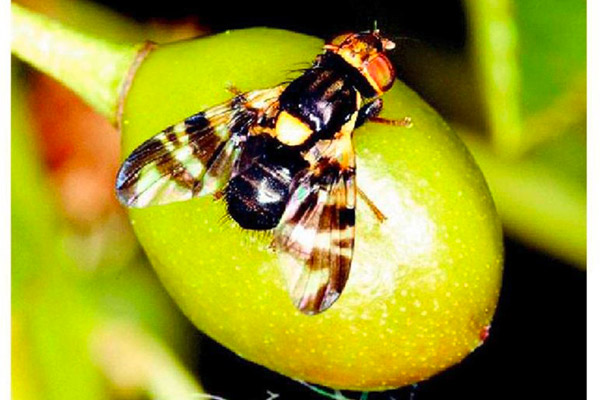
●Cherry fruit fly
This is the economically most important pest on sweet cherry. The flight of the flies begins at a soil temperature of about 100C. Emergence coincides with the ripening of the earliest cherry cultivars. The female lays its eggs in fruits that have begun to ripen. Damage is caused by the larva, which feeds on the fleshy part of the fruit. Damaged fruits darken, rot and become depressed at the site of injury. Infested fruits are unsuitable for consumption.
Strategy for pest control:
Chemical control of cherry fruit fly is carried out against the adults before they lay their eggs, approximately 10-12 days after the beginning of the flight.
Authorized plant protection products: vaztak nov 100 EC – 0.015%; decis 2.5 EC – 0.03%; decis 100 EC - 10–17.5 ml/da; eforia 045 ZC - 150 ml/da; calypso 480 SC – 0.02%; karate express WG / ninja / forza - 60-100 g/da; karate zeon 5 CS - 15 ml/da; naturalis - 100-200 ml/da; fury 10 EC – 0.0125%.