

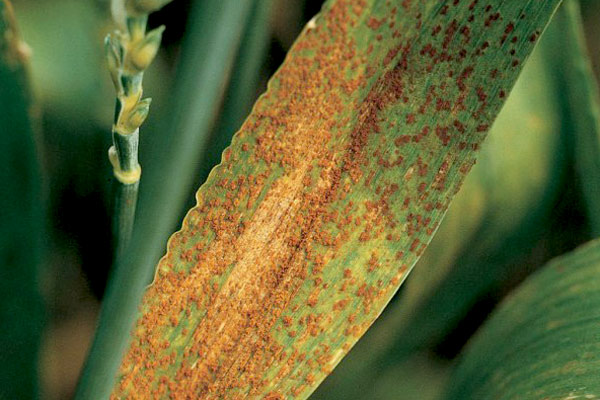
It is caused by Puccinia recondita. The conditions in Bulgaria are extremely favourable for the causal agents of the disease, which is widespread in our country. It develops every year, especially under intensive rainfall and warm days (20-25°C), but in some years it appears epiphytotically and causes major losses.
Brown rust (leaf rust) of wheat develops in our country almost every year to a greater or lesser extent, and therefore has significant economic importance. Unlike stem rust and yellow rust, the damage it causes is relatively low, but it occurs every year. Yield losses are most often up to 10%, but may reach 30% under conditions favourable for the development of the pathogen. Even the slightest infection of the wheat plant by brown rust affects the number of kernels per spike and their thousand kernel weight. The greatest losses are observed when the disease affects the flag leaf and the penultimate leaf of the plants. In cases of relatively early occurrence and strong development, the plants lag in growth, tiller less and form smaller spikes, and the grain is of reduced quality.
Symptoms of brown rust are observed on the leaves and leaf sheaths from emergence to the end of the growing season, but not on the stem and spikelets. On the leaves, mainly on the upper side, small sori are formed, brown to rust-brown in colour, unevenly scattered over their surface, whose size does not exceed 1-2 mm. Around the sori, depending on the susceptibility of the variety, a wider or narrower chlorotic halo appears. Under severe brown rust infection, the leaf curls around the main vein and then dries out. Towards the end of the growing season, small, black, shiny teliospores are formed on the lower side of the leaves and on the leaf sheath.
Heavy nitrogen fertilisation and cultivation of susceptible varieties may lead to earlier spring onset and spread of the disease, but usually mass infection begins after spike emergence, with late-maturing varieties being more severely affected. The critical period for the plants is from the emergence of the flag leaf to the end of flowering, and in particular from the appearance of the first awn to full spike emergence.
Control measures:
Organisational, economic and agrotechnical measures for control of brown rust include:
- Use of resistant varieties. The varieties of Dobrudzha Agricultural Institute possess different degrees of resistance to the pathogen. The occurrence of the disease in individual years is related to the population dynamics of the pathogen, i.e. the race diversity in different years;
- Optimal sowing rates and balanced fertilisation. High sowing rates combined with excessive nitrogen fertilisation increase the susceptibility of plants and lead to dense stands and therefore to longer retention of moisture;
- Timely destruction of volunteer plants on which the pathogen successfully overwinters.
Chemical control:
* Among chemical means, fungicides registered against the disease may be used, most of which are also registered against yellow rust, early leaf blight, Fusarium head blight, and powdery mildew: Aviator Xpro 225 EC – 80-125 ml/da, Amistar Prime – 70 ml/da, Verben – 60-100 ml/da, Elatus Era – 50-100 ml/da, Zantara 216 EC – 125 ml/da, Cayunis – 80-100 ml/da, Opulent – 50-100 ml/da, Prosaro 250 EC – 100 ml/da, Revystar – 75-100 ml/da, Soligor 425 EC – 70 ml/da, Riza 25 EW – 50 ml/da, Tesoro 250 – 100 ml/da, Sinstar – 70-80 ml/da, Sielex – 80 ml/da or 100 ml/da or 133 ml/da (the dose is determined depending on the degree of infection), Mirador Forte 160 EC – 125 ml/da, Custodia – 100/125 ml/da, Comrade – 80/100 ml/da, Magnelo EC – 100 ml/da, Univoc – 120/150 ml/da, Soleil – 120 ml/da, Magnelo EC – 120 ml/da
* Plant protection products list updated on 09.05.2025.