

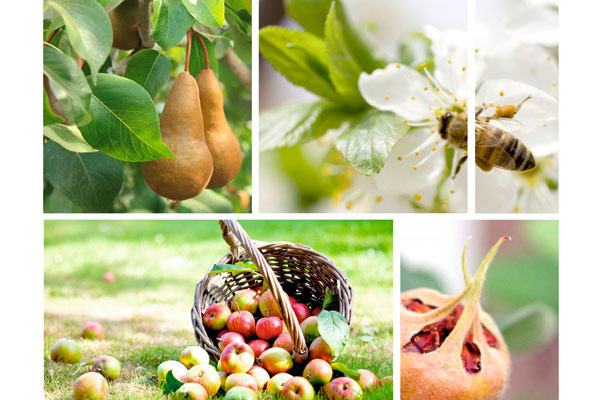
Among the pome fruit species – apple, pear, quince and medlar, in our country the largest areas are occupied by apple. In world fruit production this fruit species ranks fourth after grapes, oranges and bananas. Apple fruits are a valuable food for humans due to their rich content of sugars, acids, vitamins, tannins and pectin. Apple has high adaptability to different ecological conditions, which allows its wide distribution. In addition, apple fruits can be stored for a long time and used both for fresh consumption and for processing into juices, jams, pectin, vinegar, etc. They are also a valuable raw material for the production of cosmetic perfumery products.
The main apple producers in the world are China, the USA, Italy, France. In Bulgaria, apple is grown throughout the country, but the most favourable conditions for it exist in the valleys of the Struma, Maritsa, Kamchiya and Ogosta rivers. In our country, the apple area in 2015 was 5,416 ha, of which 4,765 were fruit-bearing (according to data from the Ministry of Agriculture and Food, “Agrostatistics” Department). In 2004, 39,393 t were produced, and in 2016 – 58,419 t. The average yields for the country during this period ranged from 8,838 kg/ha to 12,260 kg/ha. The average yields for the countries of the European Union are about 18,000 kg/ha, and in France they range from 35,985 kg/ha to 40,482 kg/ha. Imports of apples and pears into our country average about 35,000 t per year. Bulgaria mainly imports apples from Poland, North Macedonia and Greece.
More than 7,000 apple cultivars are known worldwide. In our country, more than 400 apple cultivars are grown in the breeding orchards of the institutes of the Agricultural Academy, Sofia. A number of cultivars and hybrids new to our country are also being tested. In recent years the main cultivars represented in our country have been: Golden Delicious, Golden Resistant, Red Delicious, Granny Smith, Florina, Melrose, Sharden, Idared, Gloster, Gala, Chadel, Mollie’s Delicious, etc. For organic fruit production in our country, scab-resistant cultivars such as Prima, Jonafree, Liberty and especially Florina are suitable. In a number of European countries, scab-resistant cultivars – Pioneer, Macfree, Pilot, Topaz, Novamac, Sawa, Rubinola, are recommended as suitable for planting in integrated and organic apple production.
In Bulgaria the pear area in 2015 was 655 ha, of which 528 were fruit-bearing (according to data from the Ministry of Agriculture and Food, “Agrostatistics” Department). In 2004, 1,795 t were produced in our country, and in 2016 – 2,953 t. The average yields for the country during this period ranged from 3,765 kg/ha to 6,000 kg/ha.
The cultivars represented in pear orchards are Giffard’s Butter Pear, Beurré Bosc, Williams’ Bon Chrétien, Doyenné du Comice, Clapp’s Favourite, Passe Crassane, Popskaya Pear, Santa Maria, Starkrimson, Hardenpont’s Butter Pear, Hardy’s Butter Pear and others.
The areas occupied by quince are insignificant – 153 ha, of which 83 ha are fruit-bearing (according to data from the Ministry of Agriculture and Food, “Agrostatistics” Department).
Diseases
Pome fruit species are hosts to a large number of harmful organisms – diseases and pests. The most widely represented pome fruit species – the apple, is attacked by numerous fungi, bacteria and viruses that cause significant damage to producers. In the specialised literature, 57 fungal diseases of apple are described, but scab caused by the fungus Venturia inaequalis is the most harmful fungal disease of this crop not only in our country, but also in all countries where apples are grown. Under favourable conditions for the development of the disease, losses in susceptible cultivars can reach up to 100%. Pear scab Venturia pirina is also the most harmful fungal disease of this crop. Powdery mildew of apple Podosphaera leucotricha is the second most important fungal disease in economic terms. Among the bacterial diseases of pome fruits, the greatest damage is caused by fire blight caused by Erwinia amylovora. In individual years with favourable conditions for the development of the disease, it can cause dieback of highly susceptible pear cultivars if no control measures are taken against it.
Pests
Among the pests of pome fruit species, the greatest damage is caused by fruit moths – codling moth Cydia (Laspeyresia) pomonella and oriental fruit moth – Cydia (Grapholita, Laspeyresia) molesta; fruit sawflies – apple sawfly Hoplocampa testudinea and pear sawfly Hoplocampa brevis, aphids and scale insects – green apple aphid Aphis pomi, apple–plantain aphid Dysaphis plantaginea (D. mali), rosy apple aphid Dysaphis devecta, San José scale Quadraspidiotus perniciosus and others, leaf-mining moths – spotted tentiform leafminer Cemiostoma scitella, fruit-tree leaf-miner Lyonetia clerkella, apple blotch leafminer Lithocolletis blancardella and others; orchard mites – European red mite Panonychus ulmi, pear leaf blister mite Eriophyes pyri and others, psyllids – pear psylla Psylla pyri and others.
Establishment of an orchard
Protection of apple and pear from diseases and pests, as well as of other fruit species, must be considered already at the stage of orchard establishment, bearing in mind that orchards occupy the same area for a long period of time. Their establishment requires substantial financial resources and labour, which necessitates that producers comply with the basic requirements of the individual crops. In addition, they must take into account current consumer requirements for fruit without residual amounts of pesticides, as well as the protection of soil and water from pollution.
Sites for new apple and pear orchards must meet the biological requirements of the fruit species and cultivar. Sites where winter temperatures fall below the critical thresholds for a given fruit species and summer temperatures rise above 35–37 °C are unsuitable for orchards. In such locations, late spring frosts and freezes should not occur more than twice in 10 years. The establishment of orchards is not recommended in regions where hailstorms occur more than twice in 10 years or where strong winds prevail during fruit enlargement and ripening.
Suitable terrains are river valleys, the foothills of mountains and uplands, but without steep slopes – up to 6 degrees for apple and pear. Soils suitable for orchards must be well aerated, with good water-holding capacity and permeability. These requirements are met by alluvial-meadow soils, typical leached chernozems, cinnamon forest soils and grey forest soils.
The groundwater level should not rise closer than 80–100 cm to the soil surface. Waterlogged, saline and eroded soils are not suitable for orchards. Orchards should not be established on soils contaminated with heavy metals and other chemical pollutants (along roads with heavy traffic or industrial enterprises emitting dusts or other pollutants).
For up to 4 years, orchards with apples and pears should not be established on sites previously occupied by the same species. It is very important that orchards be established on areas free from infection with crown gall caused by Rhizobium radiobacter syn. Agrobacterium tumefaciens.
The most reliable way to reduce the use of pesticides is to select cultivars that are resistant or less susceptible to the economically important diseases.
When establishing an apple orchard, it is very important to know that scab (Venturia inaqualis) causes the greatest damage to producers, a problem that can be solved by planting resistant cultivars. Worldwide, more than 150 scab-resistant cultivars have been developed – among them the more widespread are: Prima, Priscilla, Sir Prize, Liberty, Jonafree, Redfree, Freedom (developed in the USA); Macfree, Novamac, Moira, Brightgold (Canada); Florina, Judeline (France); Pioneer, Romus – 1, Romus – 2, Voineşi (Romania); Rubinola, Topaz, Rajka (Czech Republic); Gavin (England); Rebella, Regine, Revena, Reglindis (Germany), of which Rebella is also resistant to fire blight. Most apple cultivars with very good eating quality and high market demand are susceptible to scab, but they also differ significantly in their level of susceptibility to this disease. The large differences in cultivar susceptibility to scab necessitate different numbers of sprays to protect trees from the disease. In scab-resistant cultivars, no treatments against scab are required, while in the remaining cultivars 8 to 14 treatments are necessary, depending on the meteorological conditions during the year and the degree of cultivar susceptibility.
With regard to susceptibility to powdery mildew, apple cultivars also differ significantly. To protect weakly susceptible cultivars from powdery mildew, a minimum of 2 and a maximum of 4 sprays are carried out, whereas for highly susceptible cultivars – from 5 to 10.
Before establishing orchards, careful consideration must be given not only to cultivar selection but also to the planting layout. The varying susceptibility of apple and pear cultivars to the most economically important diseases, the different fruit ripening periods and flowering phenophases allow the application of differentiated plant protection. In this way, unnecessary spraying of individual cultivars is avoided.
Differentiated plant protection
Differentiated plant protection requires orchards to be established according to layouts that take into account cultivar susceptibility to diseases and the timing of fruit ripening. In scab-resistant apple cultivars (listed above), no treatments against scab are required, while in the remaining cultivars 8 to 14 treatments are necessary, depending on the meteorological conditions during the year and the degree of cultivar susceptibility. In orchards with highly susceptible and scab-resistant cultivars, they must be arranged in such a way that they can be sprayed differentially. The same requirement must be observed with regard to cultivars with different susceptibility to powdery mildew.
The main pest in fruit-bearing apple orchards is the codling moth (Cydia pomonella), against which spraying has to be carried out every year. In most apple-growing regions of the country, the control schedule against codling moth is 2 + 2, and in some years 2 + 3 when broad-spectrum insecticides are used. In practice, the sprays are 3 + 3 respectively for the first and second generations, because some of the sprays against San José scale coincide with those against codling moth. Ripening of summer cultivars usually begins in July – Vista Bella, or August – Mollie’s Delicious, Prima and others, which creates problems in protecting apple from codling moth and San José scale in orchards where the planting layout does not allow differentiated spraying. In such orchards, even after harvesting the fruit of the summer cultivars, treatment of the trees against codling moth continues because it is impossible to exclude them, which not only increases the cost of fruit production but also unnecessarily pollutes the environment. In orchards where the planting layout allows cultivar-specific plant protection, two insecticide treatments are omitted for the summer cultivars. All of this also applies to the pear fruit moth.