

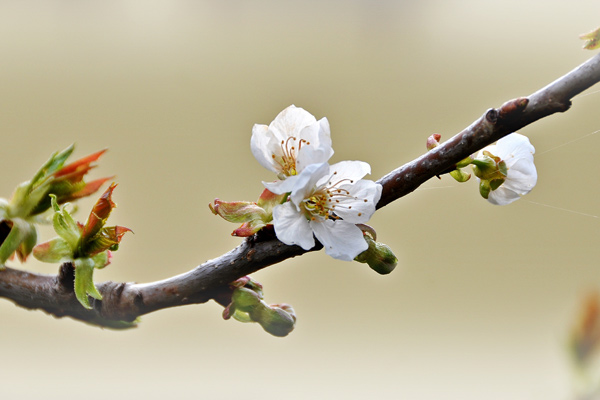
In April, pome fruit species enter from the phenophase “flower bud burst” – “pink bud” to the phenophase “flowering”. The phenophase of development of stone fruit species is “white bud” - “full bloom” - “fruit set formation”. During this period, vegetation sprays are carried out against a number of economically important diseases and pests in fruit crops.
FRUIT CROPS
Pome fruit species
Main pests for the period
Apple and pear scab Venturia inaequalis;Venturia pirina
Powdery mildew on apple Podosphaera leucotricha
Blight of quince fruit set Monilinia Cydoniae
Fire blight Erwinia amylovora
Coddling moth Laspeyresia pomonella =Cydia pomonella
Apple sawfly Hoplocampa testudinea
Pear psylla Cacopsylla pyri
Spotted tentiform leafminer moth Cemiostoma scitella = Leucoptera malifoliella
Aphids fam. Aphididae
● Apple and pear scab
The pathogen attacks the leaves immediately after bud burst. When the leaves unfold, the fungus infects both the lower and the upper surface. On the lower surface of young leaves, a velvety, oily-green mould coating develops with indistinctly outlined margins. On the upper side of the leaves, grey, smooth spots are formed with a dark green coating in the centre. Spots also develop on the leaf, flower and fruit stalks. As a result, the flowers and young fruit sets drop off.
Strategy for pest control: During the growing season, preventive pre-bloom treatments of apple and pear are carried out. Post-bloom treatments are performed at an interval of 8-10 days, depending on the fungicide used, weather conditions and the degree of infection. To prevent the development of resistance, it is mandatory to alternate products with different active substances and modes of action.
Authorized plant protection products:
Apple:
antracol 70 WG - 0.2%; delan 700 WDG 0.035%+0.02% discus DF; ditan DG - 200 g/ha; ditan M-45 - 200 g/ha; difcor 250 SC - 15 ml/ha; difo 25 EC/shardif 25 EC/difenzon 25 EC - 20 ml/ha; captan 50 WP - 0.2%; captan 80 WG - 150-180 g/ha; luna experience - 20-75 ml/ha; manfil 75 WG - 320 g/ha; merpan 80 WDG - 0.15%; polyram DF - 0.2%; sankoceb 80 WP - 200 g/ha; silit 40 SC - 160 ml/ha; scab 80 WG - 188 g/ha; score 250 EC - 0.02%; strobil DF/discus DF - 0.02%; strobil DF + delan 700 WDG - 0.02%+0.035%; thiovit jet 80 WG - 600 g/ha; thiram 80 WG - 0.3%; faban - 120 ml/ha; flint max 75 WG - 0.02%; folpan 80 WDG - 0.15%; fontelis SC - 75 ml/ha; chorus 50 WG - 0.03% (preventive) 0.05% (curative); shavit F 72 WDG - 0.2%.
● Apple sawfly
The sawfly flies immediately before apple flowering. It feeds on pollen and nectar. The females lay, in the phenophase “bud formation”, one egg per flower at the base of the ovary, near the pistil under the stamens, making an incision with their ovipositor at the base of the sepals. The damage is caused by the larva, which hatches at the end of apple flowering. It burrows under the skin of the fruit set and makes a tunnel beneath it, which often encircles the fruit along its bulging part. As the fruit grows, the cells become corky and depressed.
Strategy for pest control: Chemical control is targeted against adults, before and during egg laying - phenophase “flower bud” and against larvae, at the developmental stage “beginning of hatching”, which occurs immediately after petal fall, at Economic threshold: 2-3 adults/100 shoots; 1-3% damaged fruit sets.
Authorized plant protection products: decis 2.5 EC - 0.03%; meteor - 60-90 ml/100 l water.
Stone fruit species
Main pests for the period
Shot hole diseases gen. Stigmina, Pseudomonas, Xanthomonas
Blossom blight (early brown rot) Monilinia laxa
Cherry leaf spot (cylindrosporiosis) on sweet and sour cherry Blumeriella jappii
Black plum sawfly Hoplocampa minuta
Plum fruit moth Laspeyresia funebrana = Grapholita (Aspila) funebrana
Oriental fruit moth Grapholitha molesta
Cherry weevil Rhynchites auratus
● Cherry leaf spot (cylindrosporiosis) on sweet and sour cherry
The first infections occur in wet, rainy and moderately warm weather and coincide with the appearance of the first leaves. Numerous small purplish spots appear on infected leaves, which later turn brown and scorch. At high humidity, on the underside of the leaves, at the site of the spots, a coating of white clusters is visible. Similar symptoms are also observed on the petioles and fruit sets. Fully developed leaves are resistant to infection.
Strategy for pest control: The first spray during the growing season is carried out immediately after flowering, and the second and third - at 10-14 day intervals, depending on weather conditions and the residual effect of the fungicide used.
Authorized plant protection products: delan 700 WDG - 0.05%; signum - 0.03%; silit 40 SC - 150 ml/ha; score 250 EC - 0.03%; flint max 75 WG - 30 g/ha.
● Black plum sawfly
Damage is caused by the false caterpillar of the pest, which hatches at the end of plum flowering. It feeds on the interior of young fruits and fills them with black, sooty matter. In order to complete its development, one larva damages up to 5 small fruits, which subsequently drop prematurely together with the stalk.
Strategy for pest control: Post-bloom spraying should be carried out (when 2/3 of the petals have wilted but not fallen) against the false caterpillars, before they bore into the young fruits. In case of severe infestation, a second spraying should be carried out when the first damaged fruits begin to fall.
Authorized plant protection products: decis 2.5 EC - 0.05%; sumi alpha 5 EC/sumicidin 5 EC - 0.02%.
VINEYARDS
During this period, grapevines are in the phenophase from “bud swelling” to appearance of the “first inflorescences”.
Main pests for the period
Powdery mildew Oidium tuckeri
Excoriosis of grapevine Phomopsis viticola
European grapevine moth Lobesia botrana
Grape erineum mite Eriophyes vitis
● Powdery mildew
The pathogen overwinters in the buds and on the shoots as mycelium, which begins to develop at a temperature of 6.2°C. Powdery mildew attacks all green parts of the plant - leaves, shoots, inflorescences and young berries.
Strategy for pest control: In the presence of symptoms on the shoots, the first spraying is carried out at the phenophase “woolly bud” or when the shoots reach a length of 6-8 cm.
Authorized plant protection products: acoidal WG - 0.25%; bayfidan 250 EC - 0.01%; bayfidan 312 SC - 12 ml/ha; bumper 25 EC - 0.02%; vivando - 20 ml/ha; dynali 090 DC - 50-65 ml/ha; domark 10 EC - 25-30 ml/ha; indar 050 EW - 0.06%; cabrio top - 0.2%; collis SC - 0.04%; quadris 25 SC - 0.075%; kumulus DF - 0.2-0.3%; orius 25 EW/dynasty 25 EW/tebumax 25 EW - 0.04%; sistan ecosom EW - 0.2-1.5 l/ha; solfoliquid - 0.3%; strobil DF/discus DF - 0.02%; talendo 20 EC - 20-25 ml/ha; talendo extra - 7.5-25 ml/ha; thiovit jet 80 WG - 0.3%; topaz 100 EC - 0.015%; top plus 70 WP - 0.1%; falcon 460 EC/impuls super EC - 30 ml/ha; flint max 75 WG - 0.016%; folicur 250 EW/horizon - 0.04%; folpan 80 WDG - 0.1%+ardent 50 SC - 0.015%; shavit 25 EC/tridemol 25 EC - 0.01%; shavit F 72 WDG - 0.2%.
VEGETABLE CROPS
Field production
Main pests for the period
Downy mildew of onion Peronospora destructor
Onion fly Delia antiqua
Tobacco thrips Thrips tabaci
● Downy mildew of onion
The disease appears in the form of chlorotic, light green, elliptical spots, which, in the presence of moisture, become covered with a violet sporulating coating. Infection occurs at temperatures of 3–25 ºC and the presence of water droplets on onion plants.
Strategy for pest control: Volunteer and primary diseased plants should be pulled out and destroyed. Upon detection of the first downy mildew spots, vegetation treatments should be carried out. In dry conditions, treatments should be carried out less frequently.
Authorized plant protection products: acrobate plus WG - 200 g/ha; acrobate plus WG new - 200 g/ha; bordo mix 20 WP - 375-500 g/ha; verita WG - 0.15%; verita new - 0.15%; corsate 60 WG - 30-40 g/ha; melody compact 49 WG - 185 g/ha; orvego - 70 ml/ha; pencoceb 80 WP - 200-250 g/ha; pencoceb 75 WG - 210-260 g/ha; polyram DF - 180-220 g/ha; ridomil gold MZ 68 WG - 250 g/ha; ridomil gold R WG - 500 g/ha; signum - 150 g/ha.
● Onion fly
The damage is caused by the larvae, which bore into the base of the leaves, then tunnel through the stem and move into the bulb. Symptoms of damage are yellowed, stunted plants that lodge, are easily pulled out and dry up. The damaged plant tissues ferment and have an unpleasant smell of rotten onion.
Strategy for pest control: Usually the flight of the flies begins in the second ten days of April. Mass flight coincides with the flowering of sour cherries. This is the most suitable period for the first spraying against the pest, which is carried out at the Economic threshold: 5 flies/10 sweeps with an entomological net. Infested onion plants should be pulled out and destroyed in a timely manner.
Authorized plant protection products: deca EC/desha EC/dena EC - 50 ml/ha;
meteor - 80-90 ml/100 l water.