

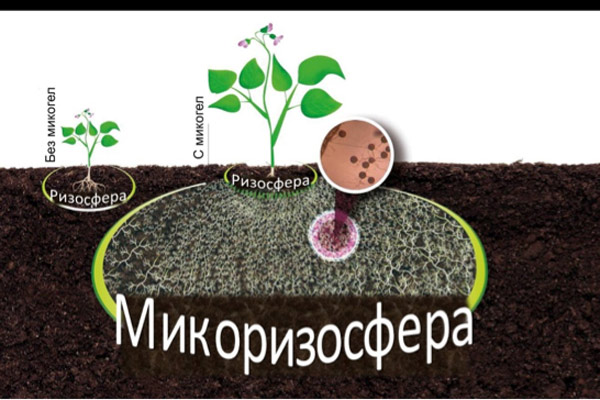
The significant diversity of biostimulant products and the wide range of positive effects in plants that they can induce implies a large set of mechanisms of action. One of the mechanisms of action of biostimulants, which is realized through indirect effects, is related to the natural phenomenon “mycorrhiza”.
Mycorrhiza and its importance as a mechanism of action of biostimulants
Mycorrhiza (ecto- and arbuscular) is a symbiosis between the roots of 97% of terrestrial plants and mycorrhizal fungi. It has been repeatedly established that the formation of mycorrhiza increases plant biomass and stimulates their photosynthetic activity. Arbuscular mycorrhiza can play a significant role in the biostimulation of plants because it builds a network of hyphae through which it multiplies the volume and contact surface of the roots (rhizosphere) with the soil and soil microorganisms. In mycorrhizal associations, the fungi receive organic carbon compounds from the plants and, in return, supply them with elements that are poorly mobile in the soil, such as phosphorus. In addition, mycorrhizal fungi aggregate soil particles and improve soil structure and its hydro-physical properties, increasing plant tolerance to drought, salinity, heavy metals, etc. They also enhance plant resistance to pathogens by thickening the cell walls of root cells, stimulating the synthesis of protective substances (jasmonates, salicylates), etc.
According to Dr. Alberto Bago (EEZ-CSIC, Spain), the effectiveness of the mycorrhizal products used for plant biostimulation is limited by several key factors, namely the loss of colonizing structures during their formulation in solid form, the presence of insoluble substrates in them, and the presence of other, undesirable microorganisms. The new product – Mycogel, in which these problems have been overcome, was presented at the international conference Biostimulants Europe 2016 in Spain. The product is in gel form and is suitable for application in irrigation systems. It does not contain other microorganisms because it is cultivated in a sterile environment. The application of Mycogel leads to the formation of a mycorrhizospheric space in the roots, in which 1 cm of mycorrhized roots is equivalent to about 3 m of hyphae.
You can read more about the importance of mycorrhiza as a mechanism of action of biostimulants in issue 1/2017 of the journal “Plant Protection”.