

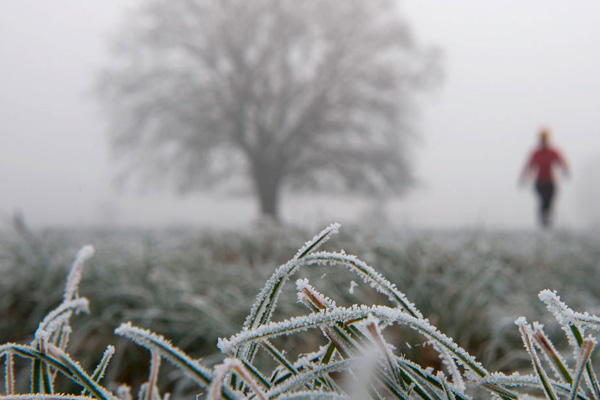
During the month, the forecast minimum temperatures, in places down to minus 12°C, under conditions without snow cover and with more prolonged persistence, will be critical for the winter cereal crops that did not enter the tillering phase during their autumn vegetation. These values will also threaten with winterkill the lagging winter rapeseed stands which, as a result of the autumn drought, did not form a rosette (of 7–8 leaves) – a phase in which the plants have increased cold resistance. The low January temperatures will also put to the test the winter hardiness of some perennial crops. Values below minus 17–18°C will pose a risk to the buds of vines, especially table grape varieties, and below minus 20–21°C – to the fruit buds of a large part of peach varieties.
In January the agrometeorological conditions will be determined by temperatures below the climatic norms, which will maintain the autumn-sown crops and perennial plantations in dormancy.
A large part of the wheat and barley stands will overwinter in the third leaf and tillering growth stages. Exceptions will be observed in the late-sown winter cereals, sown in the second half of November, which ceased their vegetation in the emergence and initial leaf formation stages. They are weak, insufficiently hardened and will be the most vulnerable to the impact of the low January temperatures.
During the month, the forecast minimum temperatures, in places down to minus 12°C, under conditions without snow cover and with more prolonged persistence, will be critical for the winter cereal crops that did not enter the tillering phase during their autumn vegetation. These values will also threaten with winterkill the lagging winter rapeseed stands which, as a result of the autumn drought, did not form a rosette (of 7–8 leaves) – a phase in which the plants have increased cold resistance.
During the short-term, relatively warmer periods of the month, when maximum temperatures of up to 10–15°C are forecast, in the southern regions part of the winter cereal crops will pass from deep to relative dormancy, but resumption of vegetative processes in the stands is unlikely.
The expected precipitation, close to the norm for January, will increase soil moisture reserves in the 50 cm and 100 cm layers. At the beginning of winter, in some places in the Danube Plain (Novachene agrometeorological station) and in part of the southern regions (Haskovo agrometeorological station) the level of moisture reserves in the one-metre soil layer was low for the season, below 70% of field capacity (FC).
Weekly agrometeorological forecast for the period 06–13.01.2017
During most days of the next seven-day period the agrometeorological conditions will be determined by below-normal temperatures. At the beginning of the period, snowfall and the formation of a permanent snow cover are expected in most of the country’s arable regions. It will provide protection for the autumn-sown crops from the impact of low negative temperatures, in places below minus 17–20°C, which are forecast at the end of the first and the beginning of the second ten-day period of January. In the absence of snow cover and with more prolonged persistence, these values will be critical not only for the late-sown winter cereals which ceased their vegetation in the emergence and third leaf stages, but also for part of the stands in the tillering phase. Temperatures of this order, under conditions without snow cover, will threaten with winterkill the winter rapeseed as well, especially the stands that failed to form a rosette during their autumn vegetation.
The low January temperatures will also put to the test the winter hardiness of some perennial crops. Values below minus 17–18°C will pose a risk to the buds of vines, especially table grape varieties, and below minus 20–21°C – to the fruit buds of a large part of peach varieties. In the regions where critical temperatures for vines have been recorded, timely sampling is recommended to determine possible frost damage, with a view to defining the correct approach when carrying out the forthcoming pruning.
Source: NIMH-BAS