

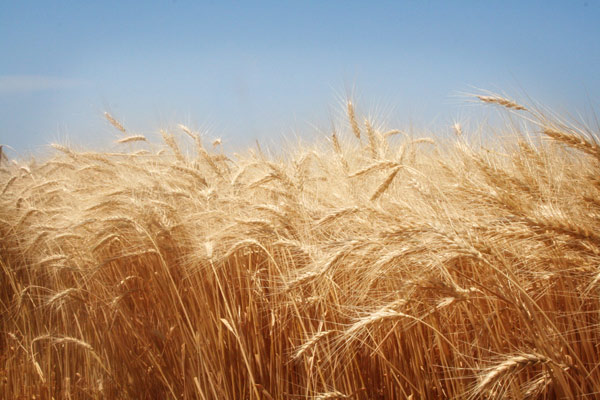
Abundant harvest and low prices – this is, in brief, how the current agricultural campaign can be described. The full grain silos remain closed, awaiting a better market situation, but the decline in prices of agricultural commodities on the exchanges does not offer much hope to traders and producers.
A rich wheat harvest of 5.6 million tons, comparable with the statistics before 1980, was reported by the Ministry of Agriculture and Food at a meeting of the Grain Advisory Council at the beginning of the month. The average yield for the country is 494 kg/ha, with the highest reported in Silistra Region – 568 kg/ha. “And the quality of the wheat is better than last year, with 43% of the yield having very good baking qualities,” emphasized Minister Desislava Taneva.
In fact, on a global scale, record yields are expected both for wheat and for oilseed crops. The produced quantities are estimated at 743 million metric tons, according to the latest USDA (United States Department of Agriculture) assessments (1.2% more compared to the previous marketing year). The main producers of cereals – Australia, Canada, Russia and Ukraine – are also registering distinctly high yield levels.
However, inversely proportional to this year’s agricultural abundance are the low purchase prices of agricultural raw materials on the exchanges. Thus, despite the high revenues from an exceptional harvest, farmers are receiving lower profits. This trend has been observed in the sector for some time and is generating negative sentiment in the agricultural business, especially among smaller farms.
Low profits
The purchase prices of agricultural raw materials remain unsatisfactory, despite the adverse climatic conditions at the beginning of the year and the summer droughts. In an attempt to manage the situation, larger landowners are holding their grain in their modern silos and waiting for more favorable offers on the market. For them this is not a matter of survival, because their funds do not come only from the harvest, and the taking of bank loans with low interest rates ensures a trouble-free autumn sowing. Whether this strategy will prove successful only time will tell. In any case, releasing even quantities of grain onto the market will certainly guarantee a higher average price for the harvest.
The most profitable in the agricultural scheme remain the companies engaged in the production and trade of agricultural commodities. It is with them that the narrowing of profit margins is most evident. Overall, revenues are higher by almost 9%, reaching BGN 7.1 billion, but the aggregate profit has shrunk from BGN 203 million to BGN 139 million, or 31% less in 2015 compared to 2014. For now, only distributors of plant protection products, fertilizers and seeds are showing stable profits.
High revenues
The informational agricultural campaigns of multinational companies provide Bulgarian farmers with access to high-quality selected seeds, resistant to drought and diseases, and to regulated plant protection products. Their model of “comprehensive customer care”, under which services are provided from the sale of a rich seed portfolio to a dedicated team of agronomists in the field, has led not only to increasing profits, but also to farmers’ dependence on the specific offers of seed companies. Another reason for the good results are some protections attractive to farmers, such as insurance against non-emergence of rapeseed due to drought, offered by “Monsanto International Branch Bulgaria”. The latter reported for 2015 a profit of BGN 12.4 million and revenues of BGN 26.1 million, which is 8% more compared to the previous year. What profits will be after their merger with the German chemical group Bayer we will expect to see in the next agricultural year.
Change of strategies among the major market players
Overall, the trend is for Bulgarian agricultural companies to continue to close the cycle of production, processing and trade, while international companies specialize mainly in trade. The Burgas-based company “Sevan” traditionally ranks among the largest, as in addition to trading in agricultural commodities, it is also among the producers. Its main revenues come from the export of produce abroad. Last year the company commissioned its new grain storage facility in the village of Svoboda, Kameno Municipality. Its capacity was doubled to 200 thousand tons, and as of January the investment for this amounted to BGN 600 thousand. With the aim of improving logistics and reducing transport costs, the vehicle fleet has also been renewed with 30 new tractor units and semi-trailers.
Cargill, one of the world leaders in the production and trade of grain and oilseeds, has changed its business strategy and has focused solely on the purchase and sale of agricultural produce and on its development as a global maritime operator. Cargill’s Ocean Transportation division manages one of the largest charter fleets in the world for dry bulk cargo, with over 600 vessels calling at around 1,000 ports annually and transporting more than 200 million MT of dry bulk cargo.
Excellent cereal yields and the accumulation of grain surpluses over the past few years do not automatically lead to high prices. The low levels on global agricultural exchanges and the regrouping at the level of global players in seeds and plant protection products promise a dynamic business environment in the coming season.