

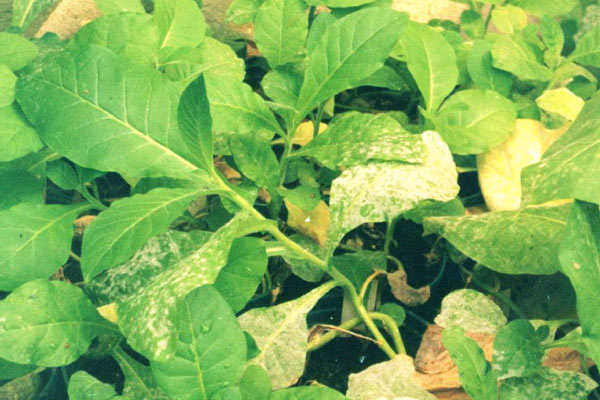
Powdery mildew or ash disease is one of the earliest known diseases of tobacco, both in our country and in other countries where this crop is grown. In our country it occurs annually in very small proportions. This is mainly due to the hot and dry weather that sets in here in August, and sometimes in September, which hinders the development of the fungus causing the disease. However, when a large amount of rainfall occurs during these two months, the disease may become widespread and cause severe damage.
During such favourable periods, powdery mildew on tobacco appears initially on the lower leaves of the plants. It gradually spreads upwards until it reaches the upper leaves. The ash disease is characterised by the appearance on the leaves of individual clusters of dense white filaments resembling cobwebs. These spots increase in size and acquire a distinctly powdery appearance. The entire spot looks like a heap of white dust, which scatters when the leaves are shaken. The spots multiply and gradually increase until they cover most or the entire surface of the leaves. They usually spread irregularly over the leaf blade, often along the main veins. They usually appear on the upper and very rarely on the lower side of the leaves. The affected leaves gradually turn yellow and dry out. If the powdery coating is wiped off the less severely affected leaves, it can be seen that under the spot the epidermis has acquired a light brown or yellowish colour. After harvesting and curing, even slightly infected leaves turn black, become brittle and unsuitable for processing and use.
Control
The strategy for controlling the disease includes the main agrotechnical measures for prevention and limitation of the disease. These are: observing the optimum planting density for each tobacco type, avoiding the use for tobacco production of low, poorly ventilated areas along river valleys, orienting the rows of the plantations in the direction of the prevailing winds for better aeration, applying an optimal irrigation regime, avoiding unilateral nitrogen fertilisation, and timely picking and removal of the affected leaves. Chemical control is carried out immediately after the appearance of the first spots of the disease on the leaves. Registered fungicides based on propiconazole, penconazole and thiophanate-methyl are used. No resistance of Erysiphe cichoracearum D.C. to any of the listed active substances has been established. Since systemically acting products, applied at the first symptoms of disease development, have a very good curative effect, preventive treatments are unnecessary.